One of the easiest mistakes to make when combining development boards and sensors is assuming that every digital signal is compatible simply because both devices use the same communication protocol.
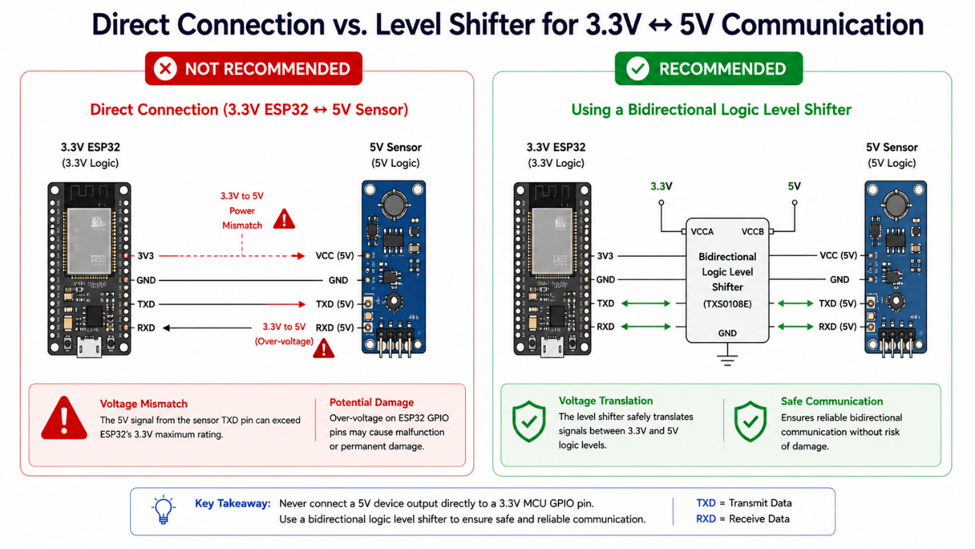
A common example is connecting a 3.3V ESP32 directly to a 5V Arduino module or pairing a 5V sensor with a 3.3V microcontroller. Although the wiring may appear correct, differences in logic voltage can lead to unreliable communication or, in some cases, permanent damage to sensitive input pins.
Understanding when a level shifter is required is one of the most useful practical skills for anyone building embedded systems.
What a Logic Level Shifter Does
A logic level shifter converts digital signals between different voltage domains while preserving logic information.
For example, when a 3.3V microcontroller communicates with a 5V peripheral, the level shifter ensures that each device receives signal levels that are safe and easy to recognize.
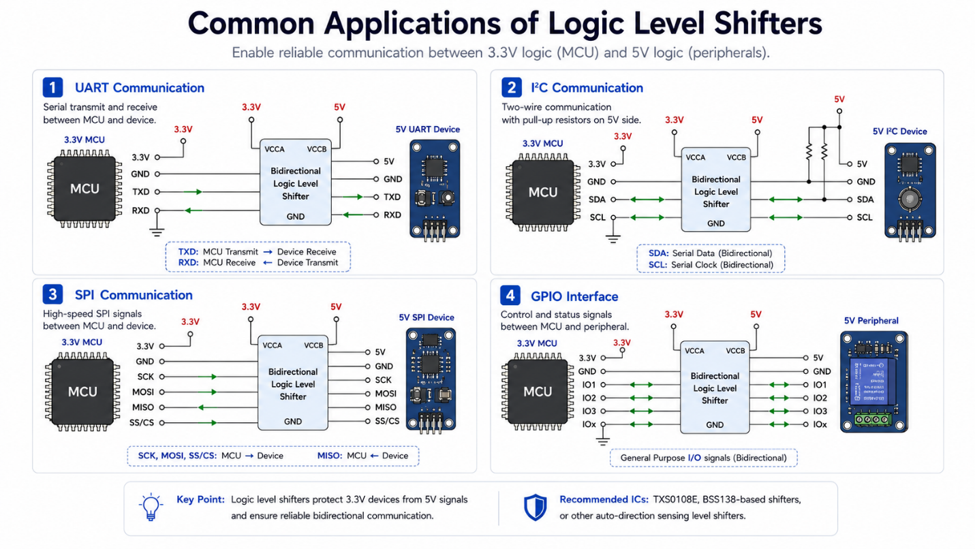
Some communication interfaces, such as I²C, often use bidirectional level shifters, while UART and SPI may use dedicated unidirectional translation circuits depending on the application.
When You May Not Need One
Not every mixed-voltage design requires a dedicated level shifter.
Many 5V microcontrollers can correctly recognize a 3.3V logic HIGH on their digital inputs, while some sensors already include onboard voltage translation circuitry. Reading the datasheet remains the best way to determine whether direct connections are acceptable.
Making assumptions based solely on operating voltage can lead to unnecessary hardware—or worse, damaged components.
One Thing I Always Check
Whenever I connect two different development boards or modules, I verify three things before wiring them together:
- Operating voltage
- Logic voltage levels
- Input voltage tolerance
A quick check of these specifications often prevents communication problems that are much harder to diagnose later.
Recommended Devices
Some commonly used logic level shifters include:
| Device |
Channels |
Typical Applications |
| TXS0108E |
8-bit bidirectional |
GPIO, I²C, SPI |
| TXB0108 |
8-bit auto-direction |
GPIO, SPI (not recommended for I²C) |
| BSS138 MOSFET Level Shifter |
2/4-channel |
I²C, GPIO |
| 74LVC245A |
8-bit bus transceiver |
High-speed digital interfaces |
One of the most popular options for hobby and embedded projects is the BSS138-based level shifter module because it is inexpensive, widely available, and works well for I²C and general GPIO translation. For higher-speed digital interfaces, dedicated ICs such as the TXS0108E or 74LVC245A are often a better choice depending on the application.
Logic level compatibility is just as important as choosing the correct communication protocol. Spending a few minutes checking voltage specifications before connecting two devices can prevent unreliable operation and help protect valuable hardware.
#ElectronicTips# #EmbeddedSystems# #ESP32# #Arduino# #LogicLevelShifter# #DigitalElectronics#



 Electronic Community