


How traces talk to each other ||Crosstalk
 View
View
Crosstalk is a phenomenon where a signal transmitted on one copper trace on a PCB creates an unwanted effect on a neighboring trace. This happens because of electromagnetic coupling between the conductors.
In any high-speed design, crosstalk is a critical factor because it can lead to signal integrity issues, data errors, and EMI (Electromagnetic Interference) problems.
How Crosstalk Happens
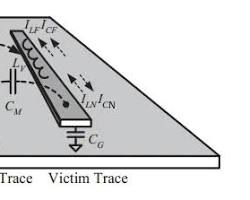
When a signal moves through a trace (the Aggressor), it creates an electromagnetic field around it. If another trace (the Victim) is close enough, that field induces a current and voltage in it. This happens through two primary mechanisms:
-
Capacitive Coupling (Electric Field): Mutual capacitance between two traces allows a change in voltage on the aggressor to "inject" current into the victim.
-
Inductive Coupling (Magnetic Field): Mutual inductance between two traces allows a change in current on the aggressor to induce a voltage on the victim, similar to how a transformer works.
Types of Crosstalk
Crosstalk is generally categorized based on where it is measured on the victim trace:
-
Near-End Crosstalk (NEXT): This is the crosstalk that travels back toward the signal source (the transmitter) on the victim trace. It is often the more significant of the two in many digital designs.
-
Far-End Crosstalk (FEXT): This is the crosstalk that travels in the same direction as the signal on the aggressor trace, reaching the receiver side of the victim trace. In homogeneous environments (like an internal layer with a consistent dielectric), FEXT can actually be zero.
#PCB#
 #PCB#
#PCB#
Sign In Or Register Comment after
No comments yet. Be the first to comment!