


 View
View
Minimizing crosstalk is essential for signal integrity. Designers use several techniques to keep signals clean:
-
The 3W Rule: A common rule of thumb is to ensure the spacing between the centers of two traces is at least three times the width of the traces (3W). This significantly reduces coupling.
-
Ground Planes: Placing a solid ground plane directly beneath the signal traces provides a low-impedance return path. This keeps the electromagnetic fields tightly coupled between the trace and the ground plane, rather than letting them spread to adjacent traces.
-
Orthogonal Routing: When routing traces on different layers (like Layer 1 and Layer 3), it is best to route them perpendicular (orthogonal) to each other. This prevents them from running parallel for long distances, which is where crosstalk is most severe.
-
Guard Traces: A grounded trace (guard trace) can be placed between two signal traces to act as a shield, though this takes up significant PCB real estate and can sometimes introduce other signal integrity issues if not designed correctly.
-
Differential Pairs: Using differential signaling where two traces carry equal and opposite signals allows the receiver to subtract the common crosstalk, effectively canceling it out.
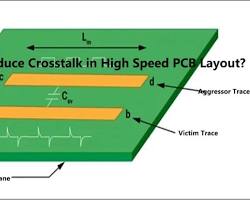
To find how JLCPCB helps in reducing cross talk you can visit the below post:
https://jlchub.com/posts/16290-JLCPCB:%20Manufacturing%20Controls%20for%20reducing%20Cross%20talk?share=jlc1773921092684
Sign In Or Register Comment after
No comments yet. Be the first to comment!