


Ordering Stencils: Why You Should Never Hand-Solder QFNs Again
 View
View
QFN (Quad Flat No-leads) packages are standard for modern microcontrollers and RF ICs because they are small and have excellent thermal properties. However, their design makes them a nightmare for a traditional soldering iron.
When you order a Frameless Stencil from JLCPCB (usually for just $7), you move from "hacking it together" to professional-grade assembly. Here is why stencils are mandatory for QFNs.
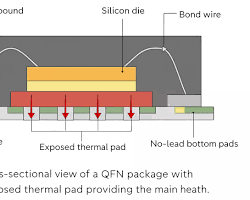
1. The "Invisible" Thermal Pad
The biggest reason to avoid hand-soldering QFNs is the large center pad (Exposed Pad or E-Pad). This pad is not just for ground; it is the primary heat sink for the chip.
- The Hand-Solder Struggle: You cannot reach this pad with a soldering iron because it’s directly under the chip. Some designers try to drill a large "thermal via" and solder it from the bottom, but this often results in a weak connection or localized overheating of the substrate.
- The Stencil Solution: The stencil applies a perfect square (or window-pane pattern) of solder paste on that center pad. When it hits the reflow oven or hot plate, the heat is distributed evenly, ensuring the chip stays cool during operation.
2. Precise Solder Volume (Avoiding Shorts)
QFNs have tiny "pads" with no leads sticking out, often at a 0.4mm or 0.5mm pitch.
-
The Hand-Solder Struggle: If you apply solder wire by hand, even the smallest amount is often too much for a QFN. This leads to Solder Bridging (shorts between pins) under the chip, where you can't see them. You would need an X-ray to confirm if your board is dead.
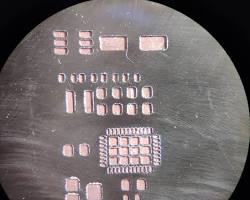
-
The Stencil Solution: A laser-cut stencil from JLCPCB ensures exactly the right volume of solder paste is deposited. This is measured in microliters. This precision is what makes high-density boards possible.
3. Surface Tension and Self-Alignment
This is a "magic" moment in PCB assembly.
- The Hand-Solder Struggle: Trying to hold a 5mm x 5mm QFN in place while soldering one corner will almost certainly tilt it. This leads to tombstoning or pads not making contact.
- The Stencil Solution: When the solder paste on all pads melts at once (in a reflow oven or on a hot plate), the surface tension of the liquid metal pulls the chip into its perfect center. If the chip was slightly misaligned, it "clicks" into place automatically. This only works with a stencil-applied layer of paste.
4. Professional Reliability
For high-speed or RF designs, hand-soldering QFNs can introduce parasitic inductance and capacitance.
- The Hand-Solder Struggle: Blobs of solder on RF pins can act as antennas or change the impedance of the signal path.
- The Stencil Solution: Uniform, thin solder joints provide the cleanest signal path for high-frequency microcontrollers and sensors.

Sign In Or Register Comment after
No comments yet. Be the first to comment!