


Star Grounding: The Ultimate Way to Reduce Analog Noise.
 View
View
If you’re experiencing noise, unpredictability, or overall annoyance when working with an analog circuit, it’s probably due to the method used to ground the circuit; not because of any components. Enter star grounding, which is a rather straightforward way of helping to significantly improve your signal by reducing interference.
Star grounding connects all ground returns from the circuit(s) to a single central connection point instead of allowing current to flow through shared paths. The primary benefit of this method is that, because multiple circuits share ground paths (resulting in mixed return circuit currents), the mixing of return circuit currents generates voltage drops – or noise – when there is a shared circuit of low-level analog and/or high-level digital signal.
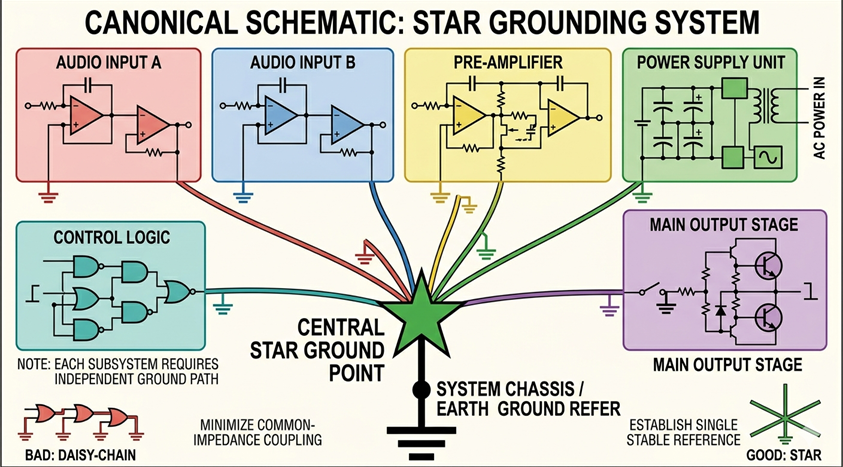
Canonocal Star grounding Schematic
Think of the shared path as a street that is shared by all return currents (mixed) at which to get to their destination (central star point). A street that has only one lane will be very congested; whereas, multiple streets with only one lane each will not be congested.
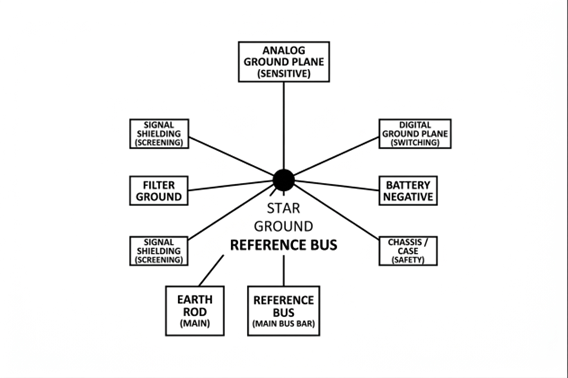
Star Grounding Reference Bus
In mixed-signal designs (digital switching noise and fragile analog signal), this becomes critical, as analog and digital signals can and will interfere with one another.
In practice, star grounding separates high-current (power stage, motor) and low-level analog (sensor, amplifier) returns by creating pathways from each section back to the central star point; thereby reducing the amount of interference. This becomes especially crucial with systems that use precision components, such as an operational amplifier circuit; as even a small voltage change (due to movement of the common ground point) will create distortion in the measurement.
But star grounding will not solve all problems. On newer multilayer printed circuit boards (PCBs), such as those designed with easyEDA Pro, using a solid ground plane typically has better electrical performance than a star ground layout due to having lower impedance return paths. Understanding which approach to use in what situation and when they can be combined is critical.
So if you’re dealing with analog noise, don’t first blame the components of your design. Instead, reevaluate how you have established ground on your PCB. A star ground properly implemented can sometimes mean the difference between a clean signal and hours of aggravating debugging!
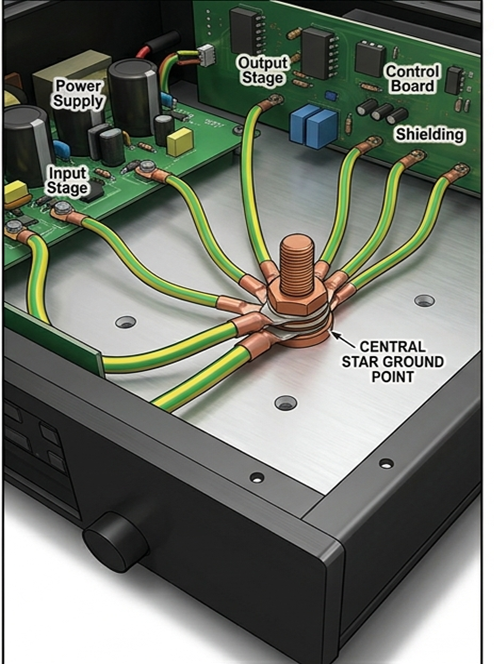
General star grounding
Sign In Or Register Comment after
No comments yet. Be the first to comment!