


Common Footprint Mistakes That Can Ruin Your SMT Order
 View
View
The significance of a perfect schematic diminishes if your footprint is not accurate. In SMT assembly, even minor errors in the footprint can lead to costly production failures very rapidly.

SMT Assembly line/Pick and place
First of all, pad sizing errors are very common. Making solder joints can be weak when using pads that are smaller than what is needed. In contrast, when using larger pads you may experience loss of solder from tombstoning (when part of the electronics component lifts off of the printed circuit board). Make sure your land pattern matches the one recommended by the manufacture. This is the best method to achieve accurate solder joints.

Close-up of soldered SMD components
Secondly, make sure that there are no errors in pin pitch or spacing. Even a slight difference between pin pitches can cause the component not to fit. This is especially critical with fine pitch ICs such as QFN or BGA packages; tolerances for these components are very tight.
Another major issue is incorrect orientation of the footprint. If the pin 1 indicator is not aligned properly, an entire reel of components may be incorrectly installed, which may not be immediately obvious until the assembly is completed and tested.
Missing or unclear silkscreen markings are another piece of the puzzle that could cause assembly issues. You have a much lower probability of making a successful assembly if you can't find any obvious polarity markings (e.g. diodes, capacitors or chips).
Another reason for comparing parts in your design with their datasheet is that you can't assume that all parts that have a common part number will be compatible with each other with regards to the footprint. However, you should verify the footprint matching part number in the datasheet for all connectors and power parts.
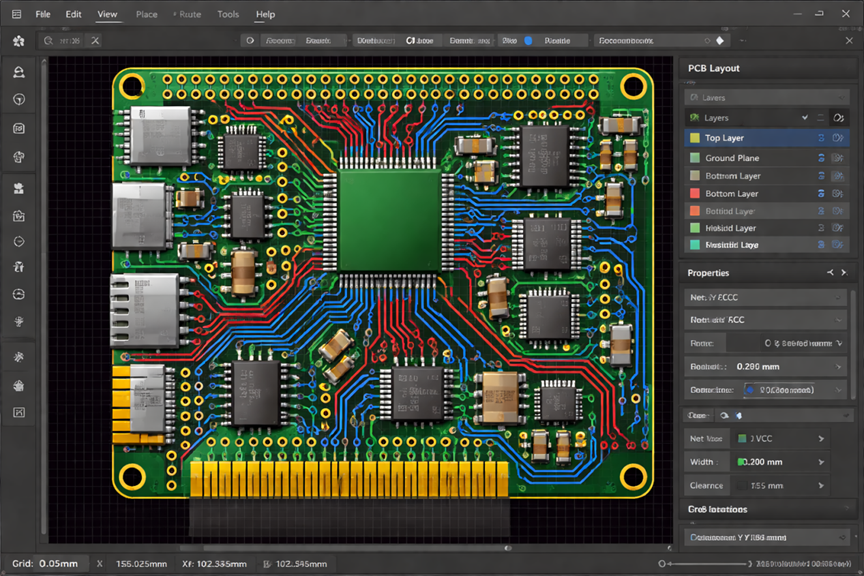
PCB design software layout screenshot (conceptual)
Courtyard and clearance violations are two areas that are critical to any assembly process. If courtyards overlap one another, it may cause confusion with pick and place machines, or worse, actual assembly collisions.
The thermal design of a product is important; missing thermal pads on power ICs will cause them to overheat or have poor soldering, especially on packages designed to dissipate heat.
Also make sure to do a 3D assembly check before ordering the products, as doing so is beneficial to identify placement issues not found in the schematic or 2D layout.
Sign In Or Register Comment after
No comments yet. Be the first to comment!