


LoRaWAN vs. NB-IoT: Choosing the Right Protocol for Remote Sensing
 View
View
Three factors will aid you in your determination of which network is best for your IoT application: Coverage, power, and infrastructure.
LoRaWAN is the best candidate if your IoT application requires a network to work out of the grid, or in rural areas. LoRaWAN operates in an unlicensed band, has a long range (up to several kilometres), and consumes very little power – requiring batteries to last for multiple years.In addition, you can use private gateways for your device to provide access to the internet.
NB-IoT (Narrowband Internet of Things) is a licensed cellular technology that has been approved by 3GPP and utilizes existing LTE networks and licensed spectrum. With NB-IoT as an option, you have another viable method of connecting your devices to the Internet; how to do this depends on your needs. NB-IoT also has very good Quality of Service (QoS) because of its direct connection to either the Internet/cloud. While NB-IoT provides a reliable connection for several devices connected to the Internet, it can draw considerably more power than LoRaWAN and is therefore subject to some restrictions on carrier network connectivity.
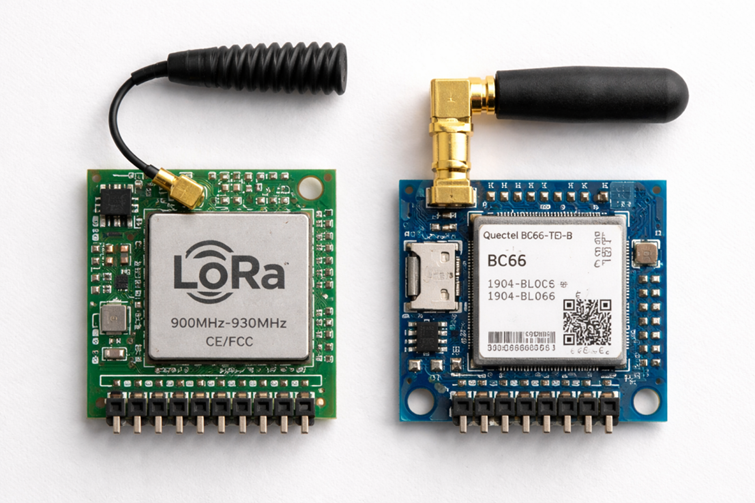
Side by side LoRa module and NB-IOT module
Your best option for flexibility and extra low power consumption would be the LoRaWAN option, though if you need a mobile/cellular carrier level of reliable connectivity (with[during and after] supported network issues), then you would want to use NB-IoT instead.
Sign In Or Register Comment after
No comments yet. Be the first to comment!