


What is "High Speed" Anyway? Determining When Layout Becomes Critical
 View
View
When designing printed circuit boards (PCBs), "high speed" is not solely determined by clock frequency, but rather by the rate at which signals are switching (rise and fall times). When rise/fall times are down to the point where they are close to the speed it takes to propagate a signal along a trace, layout becomes very important; as a rule of thumb, when the length of a trace exceeds approximately 1/10th of its effective wavelength (also called edge length), it must be treated as if it were a transmission line. At that point, reflection, impedance mismatch, and ringing will create distorted signals.
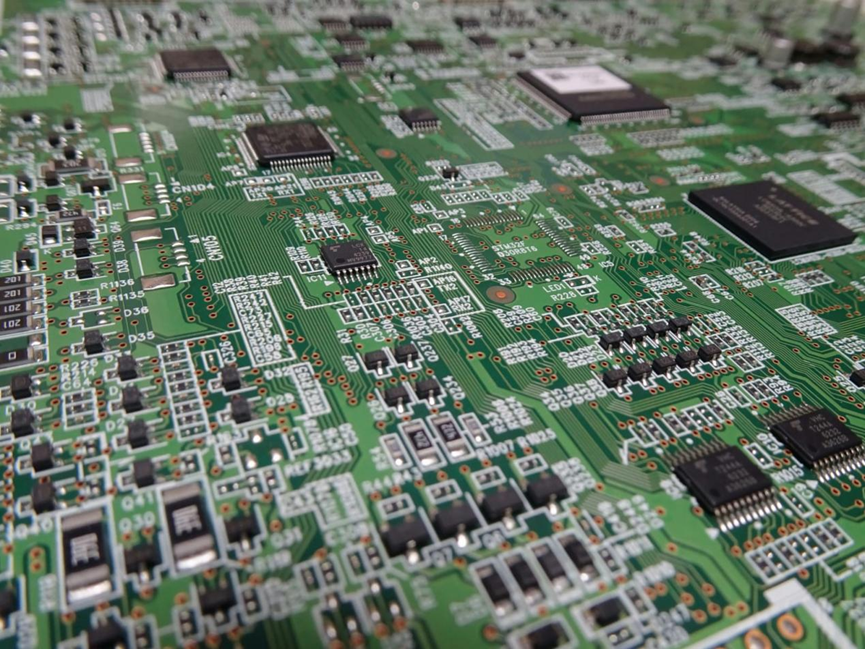
PCB close-up
This is why "slow" systems (e.g., tens of MHz) may require fast design techniques if they incorporate very fast digital logic families with very sharp edges.
Three layout considerations are particularly important for high-speed circuit designs; controlled impedance (all traces and cables have impedance), continuous ground plane (a common reference with low impedance), and tightly coupled return path (the return current flow follows the path of least impedance; in most cases directly under the trace). In high-speed applications, signals form loops, and return current finds the path of least impedance, typically directly under the trace. Interruptions (such as ground splits) will increase the total area of the loop and increase the amount of electromagnetic interference (EMI).
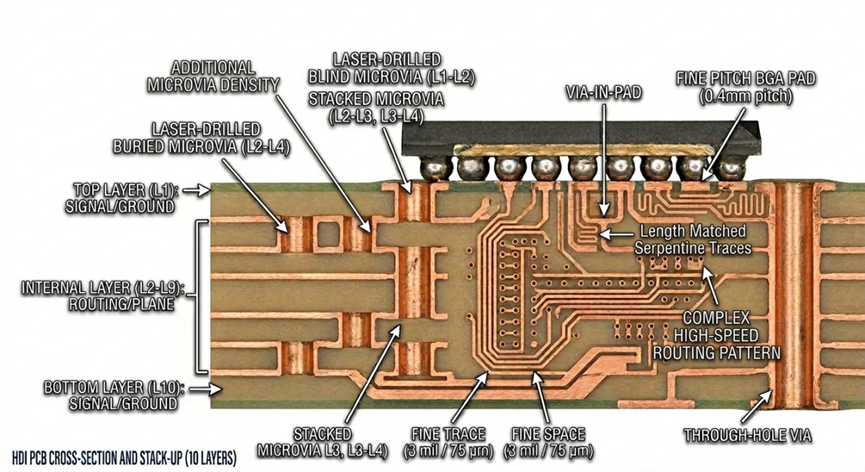
Dense PCB routing / high-speed layout
When designing for fast applications, crosstalk must also be taken into account. Two close traces that run parallel and adjacent to each other can couple energy to one another over long cable lengths. Proper trace spacing and layer management will help reduce the amount of crosstalk present in a design.
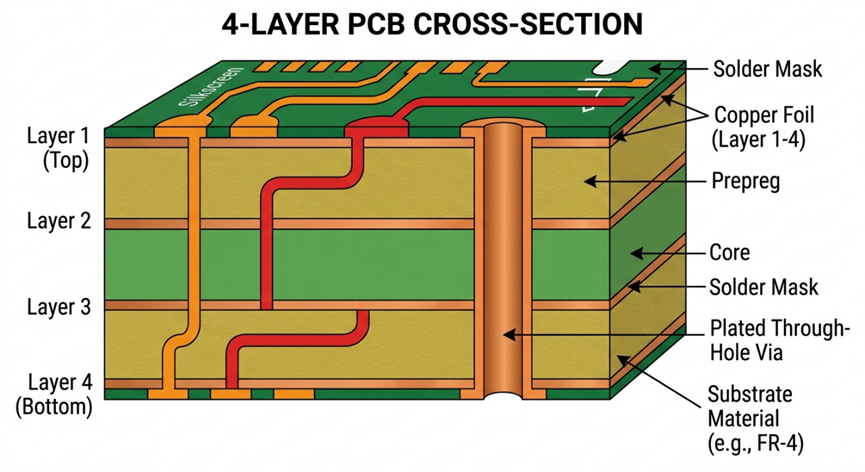
PCB layer management can be an important factor to consider
Interface Standards are another triggering mechanism. Controlled routing (i.e., differential routing methods) and matched lengths are required of signal traces regardless of clock rate for Protocols such as USB, Ethernet and DDR memory.
The takeaway from this is that the phrase "High Speed" is defined as beginning at the point where physics (not simply connectivity) starts to govern signal behavior. Therefore, if you have fast edge rates, long trace lengths, or tight timing constraints on your signals, layout is critical for successful operation.
Sign In Or Register Comment after
No comments yet. Be the first to comment!