


Managing Component Heat: When to Use Thermal Vias vs. Heat Sinks
 View
View
Heat has the potential to destroy PCBs without producing any noise. If you ignore it, your circuit board will become unreliable and ruin your design. The big question really is how to deal with heat.
Thermal vias are your first line of defense. A thermal via is a small hole plated through to another layer of copper, typically used under or near heat-generating devices such as: regulators, power ICs, etc. Thermal vias transfer heat from the top layer of the PCB to the inner or bottom copper planes. They are small, inexpensive, and effective for transferring and dissipating moderate amounts of heat. A well-designed array of thermal vias—which have proper diameter, spacing and are connected to a large copper pour—will greatly enhance the capability of the PCB to dissipate heat without adding any additional board space.
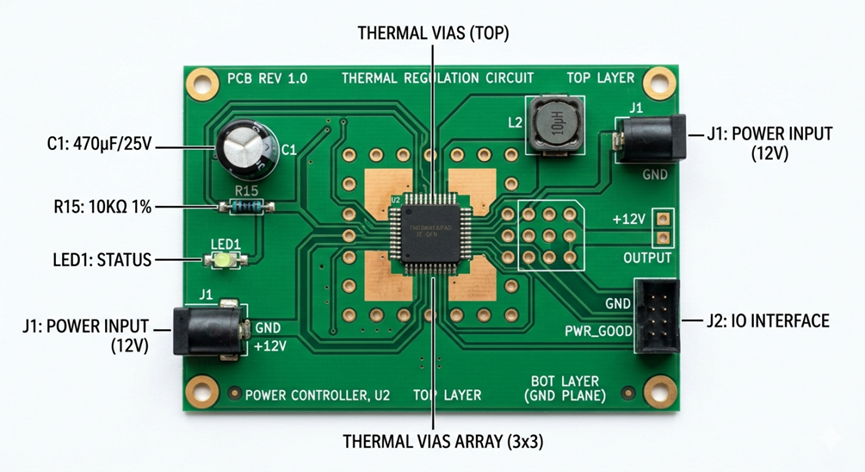
PCB with thermal vias
However, thermal vias do have limitations. They are designed to transfer the heat to the PCB copper for distribution. If the PCB does not have adequate copper at the copper plane level(s) to dissipate the thermal energy in a time frame, the thermal energy will continue to place excessive heat on the thermal vias and eventually overheat the device.
This is where heat sinks come into play. A heat sink is a device that is designed to attach physically to the device being cooled and to increase the amount of surface area that will be able to dissipate thermal energy to the surrounding air. Heat sinks are extremely important for devices that generate a lot of thermal energy compared to the capacity of the PCB to dissipate the thermal energy. An example of this would be voltage regulators, power transistors, or LED devices.
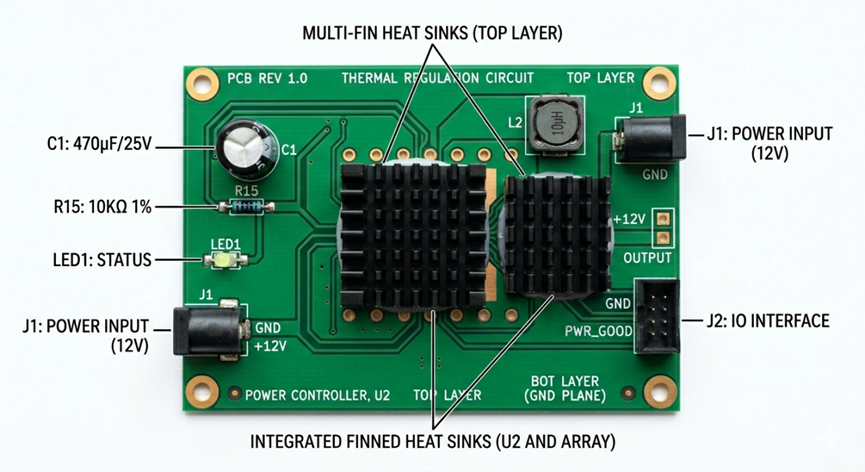
PCB with thermal vias
The decision of whether to use thermal vias or a heat sink depends on the application requirements and the available space. In general, thermal vias and solid ground planes are adequate for compact designs such as wearables and IoT nodes. In high power applications, you can use both thermal vias to transfer heat away from the component and a heat sink to transfer heat to the air.
Airflow should also be taken into consideration when selecting a heat sink; heat sinks in an enclosed space without any form of airflow will not work well.
In conclusion: Thermal vias provide good heatsinking but are not as effective as using a full sized heat sink in a normal way. When used together, they ensure that you don't overheat your printed circuit boards.
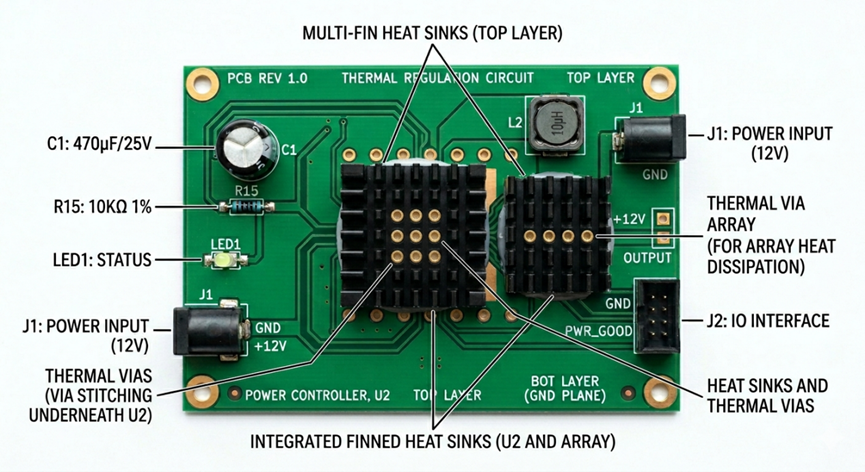
PCB integrating heat sinks and thermal vias
Sign In Or Register Comment after
No comments yet. Be the first to comment!