


Managing Skew in Differential Pairs: Techniques for Timing Match
 View
View
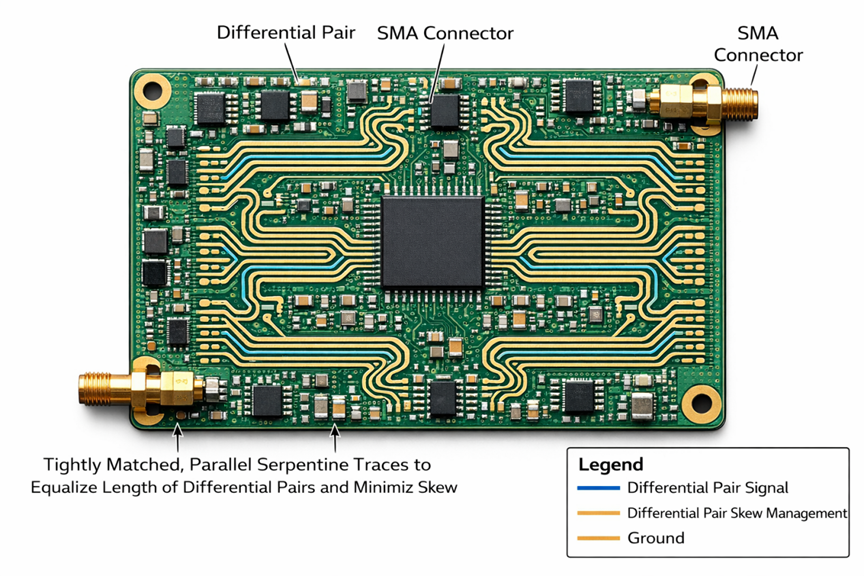
When there is a disparity between the lengths of two traces in a differential pair, there can be an unequal electrical environment which leads to the traces being mis-timed. Therefore, it is necessary to keep the traces as closely matched in length as possible (typically a few mils in length) for high-speed signals. When routing differential pairs, they need to remain paired when routed; never separate them. Use serpentine tuning only if absolutely necessary and use it in a symmetrical manner to eliminate any disruption to the impedance of the signal. Spacing between the two traces and having a continuous reference plane between them will create equal propagation delay to both traces. Minimize the use of vias and if you must use vias, use the same number of vias on both traces. Maintaining control over the skew will maintain the integrity of the signal at high speeds thus creating a reliable means of communication at high-speed.
Sign In Or Register Comment after
No comments yet. Be the first to comment!