


The Importance of Decoupling Capacitors: Placement and Values.
 View
View
Decoupling capacitors are invaluable components of reliable PCB design. They provide noise suppression, voltage stability, and keep your integrated circuits from operating chaotically.
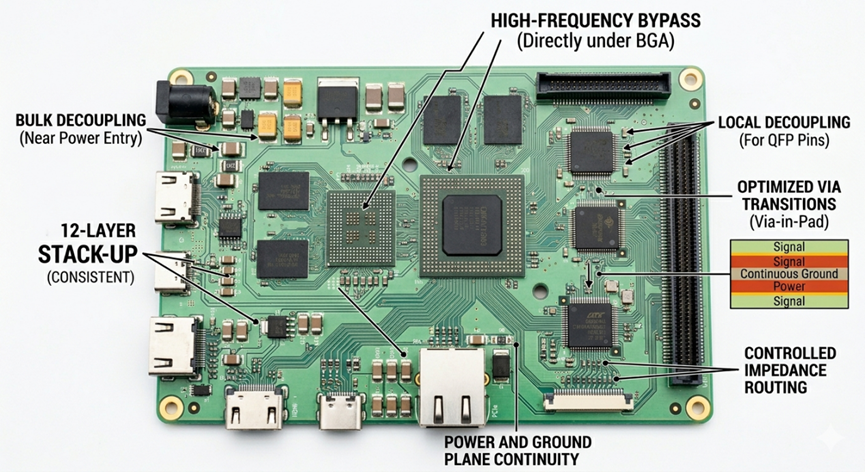
Well placed decoupling capacitors
All digital integrated circuits will draw current in bursts when switching. Without local energy storage, this will create noise and voltage drops on the power rails. This is where decoupling capacitors come in. They are physically small capacitors connected in parallel with the power (Vcc) and ground (Gnd) that store charge at a local level. When a digital IC switches and requires current, the decoupling capacitor can provide the current immediately through a short trace instead of having to travel along a length of noisy power trace.
Decoupling capacitors should be placed very close to the IC's power + and ground - pins. Connecting the decoupling capacitor to the Vcc and Gnd using short traces is essential to limit inductance. If there are long traces connecting the decoupling capacitor to the Vcc and Gnd leads, inductance will increase; thus causing the decoupling capacitor to function poorly. Ideally, a via to a solid ground plane adjacent to the decoupling capacitor should be used.
Capacitor value is another important consideration. Many designers will use multiple values of decoupling capacitors in their designs:
Values of decoupling capacitors:
0.01 μF - 0.1 μF to suppress high-frequency noise
1.0 μF - 10.0 μF for low-frequency noise stability
Using small and large value capacitors assures that all frequencies between high and low are suppressed. Designers typically use decoupling capacitors of at least one 0.1 µF per power pin, and generally use bulk devices for low-frequency noise dampening.
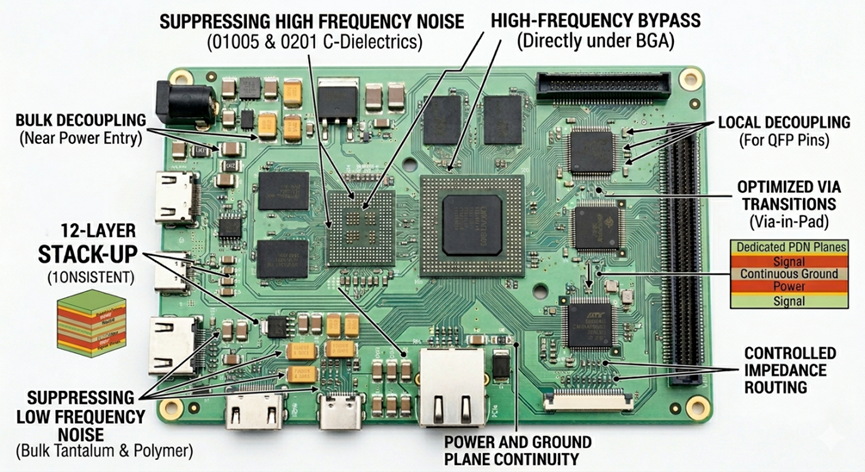
Decoupling capacitors to suppress noise at high and low frequencies
The type of capacitor should be considered as well. Multi-layer ceramic (MLCC) capacitors are highly recommended; MLCC's have low ESR and ESL and are preferred for decoupling applications. Mount MLCC in accordance with their orientation, and keep them as close as possible to the IC.
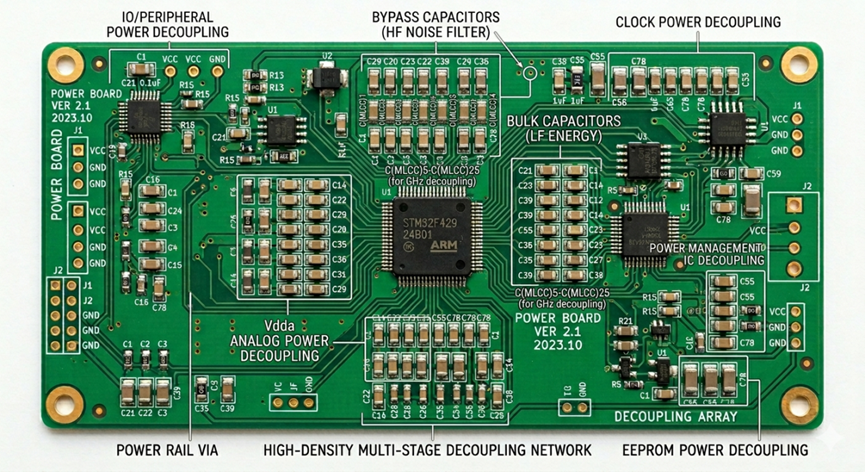
PCB with multi-layer ceramic (MLCC) capacitors
Ground return is very important. Without a solid, continuous ground plane, decoupling won't work.
Decoupling capacitors are critical, not optional! Properly placed decoupling capacitors and proper capacitor values will yield a clean and stable operating circuit.
Sign In Or Register Comment after
No comments yet. Be the first to comment!