


Termination Techniques: Series vs. Parallel for High-Speed Logic
 View
View
High-speed signals do not stop working in a trace. They keep reflecting and ringing and doing nothing but cause problems if there is no proper termination. Termination techniques are where series and parallel type of termination come into play.
With series termination, you place a resistor (usually in the range of 22 to 100 Ohms) very near the signal source. The purpose of the resistor is to match the source impedance to the trace impedance and reduce the reflection back into the source at the very beginning. This is a simple and low power solution that works very well for point-to-point digital interfaces like SPI or GPIO. The downside is you will have slightly slower edge rates due to the resistor creating an RC delay with the capacitance of the transmission line. However, with many designs this is an advantage rather than a disadvantage.
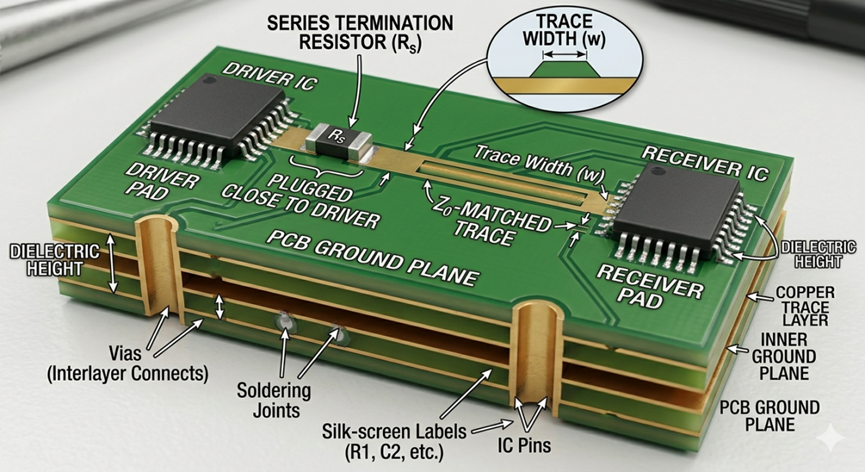
Series termination
For parallel termination, you place the resistor at the receiving end and typically match the trace impedance (50 Ohms to ground or reference voltage). The parallel termination absorbs incoming signals and keeps them from reflecting back down the line. This type of termination works best for very high speeds and/or long trace implementations where reflected signals would corrupt your data. The downside with parallel termination is when the line is driven you will have constant power through the resistor.
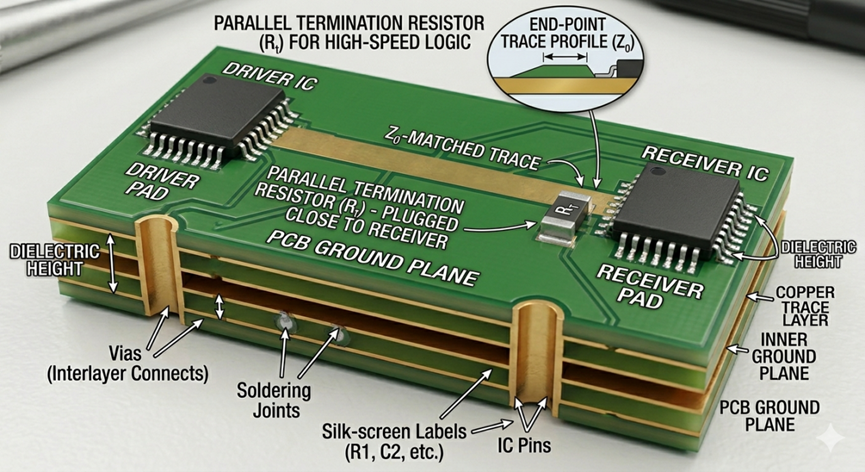
Parallel termination
To determine which option to choose, if a trace is short and the speed is moderate, series termination will usually work well and will save you power. If a trace is long, the speed is high, or the need for signal integrity is tightly controlled, then parallel termination will provide you with better control of reflections.
You should also think about topology. Series termination will perform best for point-to-point connections; however, parallel termination can accommodate the most demanding environments. In many instances, combining the two types of termination creates the best performance possible.
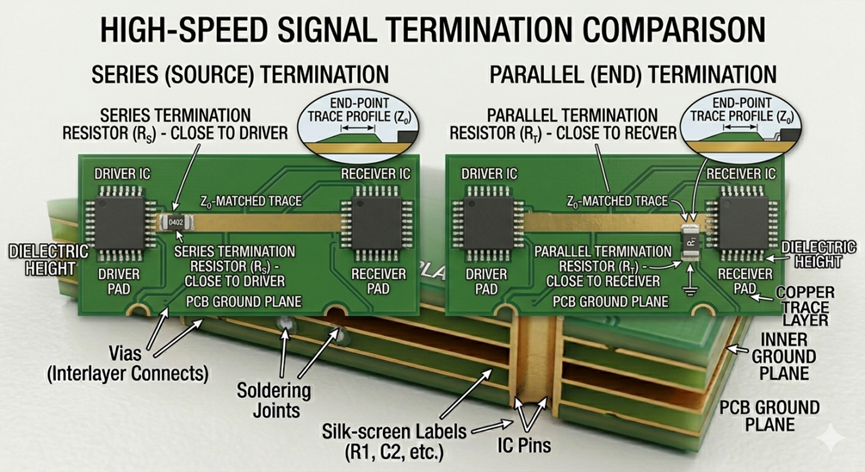
High speed signal termination comparison
Conclusion: at high speeds, you must terminate your signals; therefore, you need to choose wisely or you will have an oscilloscope display that is a train wreck.
Sign In Or Register Comment after
No comments yet. Be the first to comment!