


How to Use a VNA to Verify Your PCB Trace Impedance
 View
View
While you can design for controlled impedance, the only place you can verify that design is by measuring your PCB traces with a Vector Network Analyzer (VNA) for how they actually perform at high frequencies as opposed to how you think they should.
You should start by getting calibrated and performing a standard Short, Open, Load, Through (SOLT) calibration to eliminate or correct for any systematic error introduced by the ends of your test cables. Calibration is very important; if you do not perform this process before measuring your test cables, your measurement will be invalid.
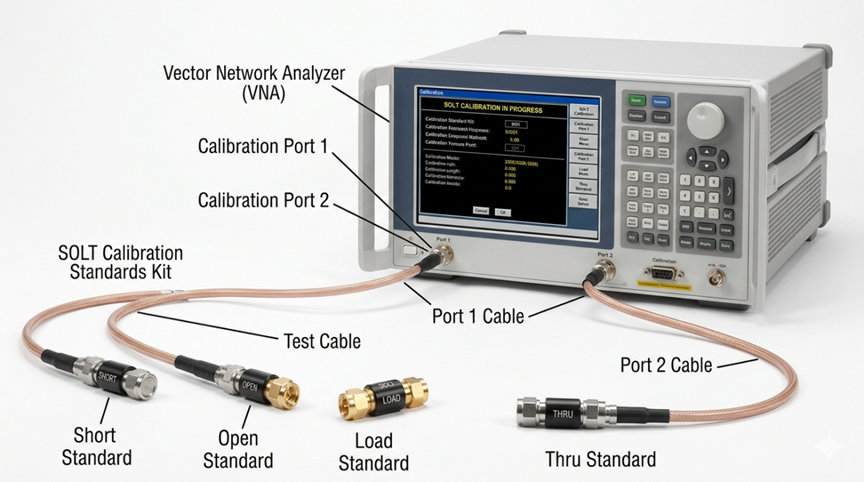
VNA SOLT calibration
After calibration, connect your PCB for measurement using appropriate fixtures such as SMA connectors or high quality probes (ensure you have a solid ground and avoid moving the cables, even minor changes can affect measurements). In general, for single-ended signals, you will measure S11 (return loss); for differential pairs you will use S-parameters such as Sdd11 and Sdd21.
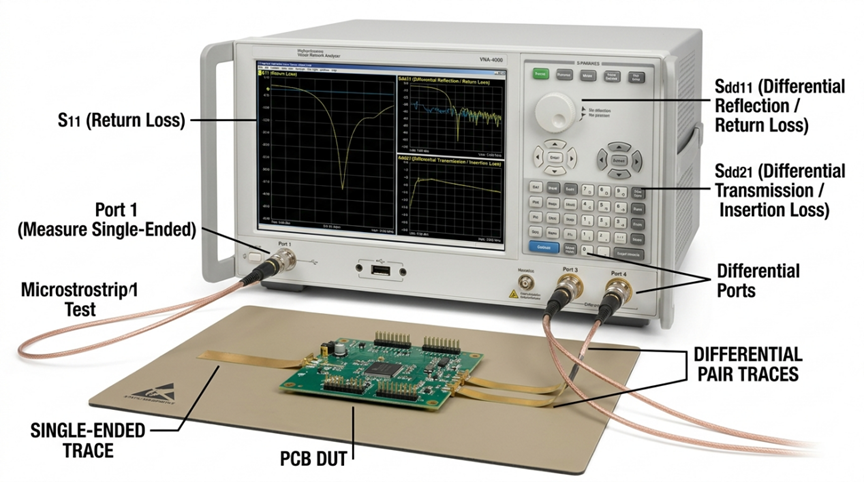
VNA measurements
You can derive the impedance of a trace from the reflected data, i.e., the amount of reflected power will provide evidence on whether your 50 Ω trace is well-matched (low reflections equal high return loss). If you are seeing notable reflections, then it's likely that your trace's impedance is not the expected value. In addition to this, you can also use Time Domain Reflectometry (TDR mode) on the VNA to visualize changes in trace impedance over its length; this will help you find points of discontinuity such as vias or changes in width.
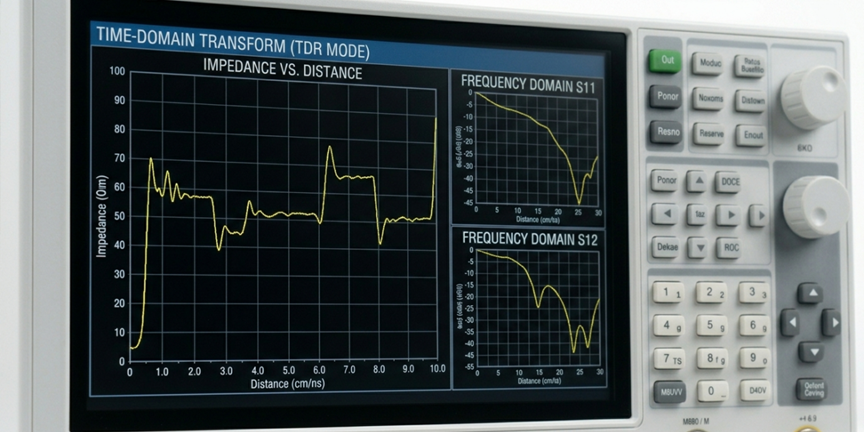
TDR mode on VNA
Also, Polygons, Launch Profiles, and Test Fixtures have an impact on results. Transition issues can appear to be an impedance mismatch when the Trace is actually correct.
Finally, you want to compare the measured data to your respective design targets. Small variations should be acceptable, but large differences usually mean that there is an issue with your stack-up, Trace Geometry, or manufacturing tolerance.
To summarize, the VNA will show you what an impedance looks like as an actual measured parameter versus as a theoretical parameter. It is the divergence from "should work" to "does work".
Sign In Or Register Comment after
No comments yet. Be the first to comment!