


ESD Protection and VBUS Filtering in Flight Controllers - Part 1
 View
View
Every single time you plug your Flight Controller into your computer to flash new firmware, download blackbox logs, or tune your PID loops, you are introducing a massive electrical risk to your main microcontroller. In the era of modern USB Type-C connectors, this risk is greater than ever before. Today, I am going to show you exactly how I designed the USB interface block in my schematic to protect the brain of the drone using strict Electrostatic Discharge protection and advanced VBUS Filtering.
The Physics of Electrostatic Discharge
To truly understand why we need protective circuitry, we first must understand the invisible enemy we are fighting: Electrostatic Discharge, commonly referred to as ESD.
When you walk across a carpet in your workshop, slide out of a fabric chair, or even just handle the carbon fiber frame of your drone, your body acts like a giant capacitor. Through a process called the triboelectric effect, friction causes your body to build up a massive imbalance of static electricity. You might not feel it, but your fingertip can easily carry a localized charge of well over 10000 Volts.
When you reach out to plug that metal USB cable into your Flight Controller, that 10000 Volts looks for the easiest path to ground. Often, a microscopic spark will jump from your finger, travel through the metal shielding of the USB connector, and strike directly into the D+ and D- data lines of the microcontroller.
Because the USB data pins on modern silicon chips are incredibly sensitive—designed to read delicate signals operating at just 3.3V—this massive high-voltage transient will instantly blow a microscopic hole through the internal silicon layer. This permanently destroys the USB peripheral inside the chip. Your drone might still fly, but it will never communicate with a computer again.
For a highly trusted, academic explanation of how static discharge destroys modern semiconductors and how the Human Body Model is calculated, you can check on this website from Texas Instruments: System-Level ESD Protection Guide.
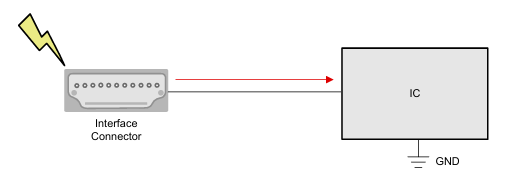
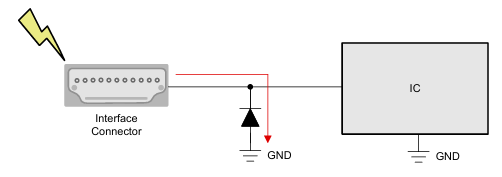
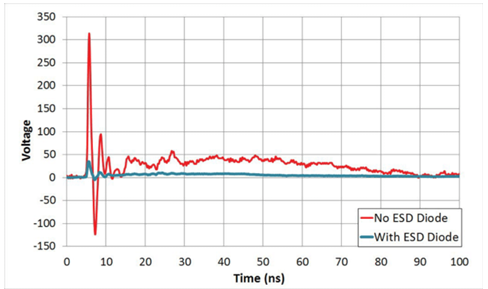
This images shown the massive, instantaneous spike in current that hits your board during an ESD event
The Anatomy of the Type-C Vulnerability
In the old days of drone building, we used Micro-USB connectors. While fragile, their internal pins were relatively far apart. Today, we use USB Type-C. Type-C is amazing for usability because it is reversible, but from a hardware design perspective, it is a nightmare.
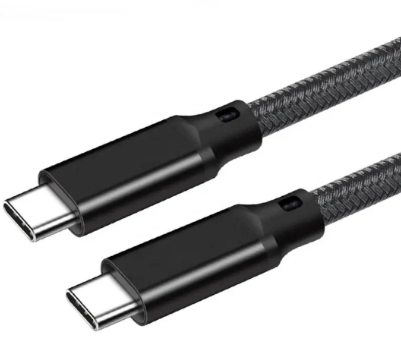
Modern USB Type-C receptacles feature 24 highly miniaturized pins packed into a very small footprint. Within this layout, the VBUS power pins, capable of delivering 5V to 20V in Power Delivery configurations, sit less than a millimeter from the highly sensitive data lines. If foreign debris enters the port or if a cable is inserted or removed at an improper angle, it creates a high risk of short-circuiting the power directly to the data pins. Without proper hardware protection, this event will result in severe, irreversible damage to the microcontroller.
Hardware Defense Part 1: Clamping the Spike with the USBLC6-2P6
To prevent these destructive voltage spikes from reaching the processor, we must place an invisible electrical shield right at the USB connector. We cannot just use normal diodes, because normal diodes are too slow. We need a component that reacts in nanoseconds.
In my Flight Controller schematic, I implemented a Transient Voltage Suppressor diode array. Specifically, I chose the absolute industry standard for this application: the USBLC6-2P6 from STMicroelectronics.
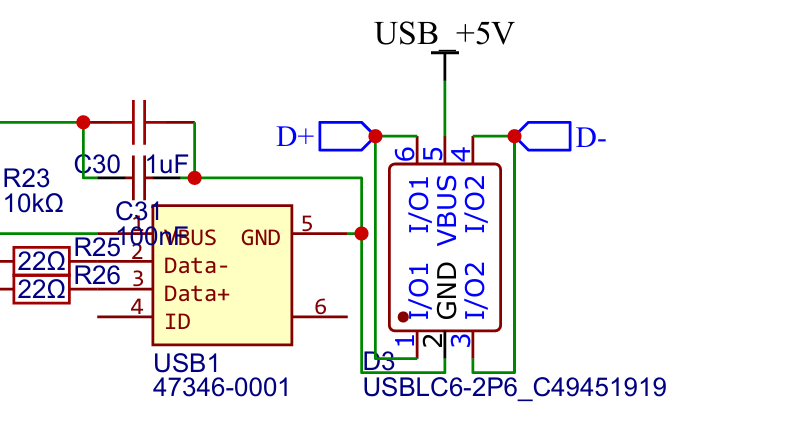
If you look at my design layout, this tiny 6-pin integrated circuit sits directly between the USB Type-C connector and the main MCU. It acts like a high-speed pressure relief valve. During normal operation, the USBLC6-2P6 has an incredibly low parasitic capacitance of around 1.2pF. This ultra-low capacitance means it is completely invisible to the high-frequency waves of the USB data stream, allowing our 480 Mbps high-speed signals to pass through without being distorted or slowed down.
However, the absolute nanosecond a high-voltage ESD spike or a short-circuit surge hits the D+ or D- line, the internal avalanche diodes inside the USBLC6-2P6 wake up. They "clamp" down instantly, dropping their resistance to near zero. They act as a massive short circuit that safely grabs that 10000 Volts and redirects the energy straight into the Ground plane of the PCB, completely bypassing and saving the microcontroller.
You can download the official datasheet for this magnificent protective component directly from the manufacturer here: USBLC6-2P6 Datasheet.
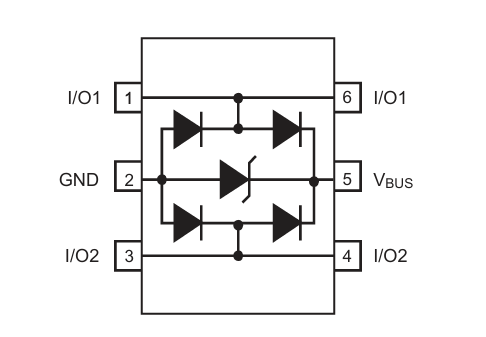
That images shown exactly how the internal diodes are cleverly routed to protect the I/O lines and dump the high voltage directly into the GND pin
Sign In Or Register Comment after
No comments yet. Be the first to comment!