


Why Engineers Rely on Linear Time-Invariant (LTI) System Models
 View
View
In typical applications of science and engineering, we have to process signals using systems. While most practical systems are nonlinear to some extent, they can be analyzed with acceptable accuracy by assuming linearity. In my experience, a good grounding in LTI system analysis is essential because it drastically simplifies our mathematical approach.
If we assume a system is Linear and Time Invariant, we unlock powerful analytical tools. The fundamental problem in the study of systems is how to analyze systems with arbitrary input signals. The solution, in the case of LTI systems, is to decompose the signal in terms of basic signals, such as the impulse or the sinusoid. Then, with knowledge of the response of a system to these basic signals, the response of the system to any arbitrary signal that you shall ever encounter in practice can be obtained.
For instance, using the convolution sum, the relationship between the input signal and the impulse response to find the output is defined perfectly as:

Furthermore, when dealing with complex exponential inputs, the relationship between the input and the output of an LTI system becomes a simple multiplication operation rather than a complex convolution. This mathematical property is exactly why we use it as the basis for signal decomposition. By mastering this assumption, your ability to design complex telemetry, control, and communication systems becomes incredibly efficient.
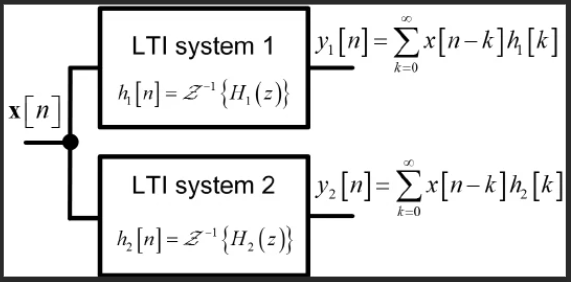
This diagram shown above perfectly illustrates how an arbitrary input is seamlessly processed by the characteristic impulse response of the system to generate a mathematically predictable output.
Sign In Or Register Comment after
No comments yet. Be the first to comment!