


The Transition from Continuous to Digital Signal Processing
 View
View
For most practical systems, input and output signals are continuous, and these signals can be processed using continuous systems. However, due to rapid advances in digital systems technology and fast numerical algorithms, it is highly advantageous to process continuous signals using digital systems by converting the input signal into a digital signal.
In my text, I always emphasize that a discrete signal is specified only at discrete values of its independent variable. For example, a continuous signal x(t) is represented only at t=nTs as x(nTs), where Ts is the sampling interval and n is an integer. The discrete signal is usually denoted as x(n), suppressing Ts in the argument of the function.
Consider the continuous complex exponential signal:

This mathematically well defined signal is predominantly used in signal and system analysis. To transition into the digital domain, we obtain the discrete signal by sampling the continuous signal, effectively replacing the variable t with nTs. Assuming a standard sampling interval, the discrete complex exponential signal elegantly becomes:
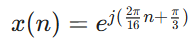
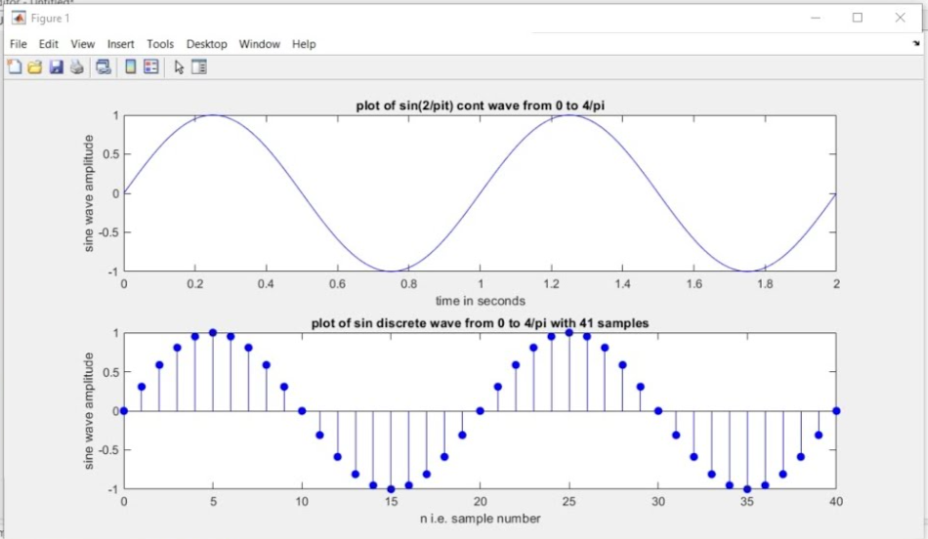
The graphical representation shown in your captured image perfectly visualizes the physical reality of replacing a continuous time variable with discrete mathematical steps.
Whether your discrete signal arises inherently or by sampling, the most important advantage is that it can be stored and processed efficiently using digital devices. This foundational transition from continuous to digital is precisely what enables the reliability of modern communication systems, ensuring that your RF transceivers and drone flight controllers operate with maximum computational efficiency.
Sign In Or Register Comment after
No comments yet. Be the first to comment!