


Understanding Convolution in LTI System Analysis
 View
View
In the analysis of linear time-invariant (LTI) systems, the most fundamental task involves determining the response of a system to an arbitrary input signal. My methodology emphasizes that if we possess the impulse response of a system, the output for any input can be calculated through the process of convolution. This operation serves as the definitive cornerstone of time-domain analysis in engineering.
Decomposing an input signal into a sum of weighted and shifted impulses allows us to compute the total output by summing the individual responses. For a discrete-time LTI system, the input-output relationship is defined by the convolution sum. In my text, this essential relationship is expressed exactly as:

The convolution process involves four primary mathematical steps: folding, shifting, multiplying, and summing. As you implement these steps in your design, you will observe how the impulse response characterizes the physical behavior of your hardware or signal processing algorithm.
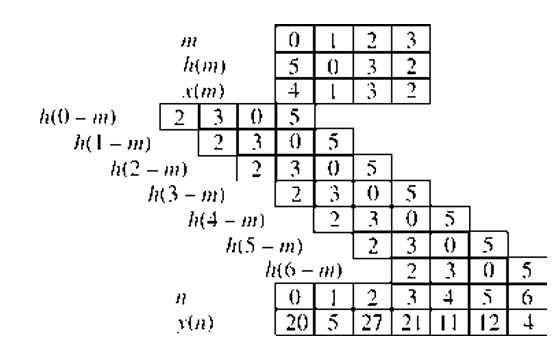
The illustration provides a clear visualization of these operations. This specific image demonstrates the folding and shifting of the impulse response sequence relative to the input sequence. By examining this diagram, the graphical interpretation of the sum of products becomes intuitive for any engineer designing digital filters or drone communication protocols. Mastery of this tool is a vital prerequisite before you move toward complex frequency-domain representations.
Sign In Or Register Comment after
No comments yet. Be the first to comment!