


Time-Domain vs. Frequency-Domain Analysis: A Brief Overview
 View
View
In typical applications of science and engineering, we have to process signals using systems. In my signals and systems course, I focus on presenting two primary methods of analysis that are essential for your professional career. Time-domain analysis involves studying the variation of a signal amplitude as a function of time. This approach is highly intuitive because most practical signals are continuous functions of time, such as the telemetry data from your drone flight controllers.
Conversely, frequency-domain analysis allows us to look inside the signal to understand its spectral composition. I believe that a good grounding in frequency-domain methods is required to specialize in communication and signal processing. The transition between these domains is governed by Fourier analysis. For a discrete sequence of length N, the forward transformation is represented exactly in my text as:

By transforming your signals, you can analyze the frequency response of a system with acceptable accuracy. The major advantage of this shift is that operations like convolution in the time domain are replaced by simple multiplication in the frequency domain. This makes complex analysis much easier when designing filters or analyzing signal integrity. Mastering the interplay between these two domains is essential for modern engineers to choose the most efficient analysis method for any given practical problem.
The comprehensive overview the different versions of Fourier analysis depending on whether the signal is continuous or discrete.
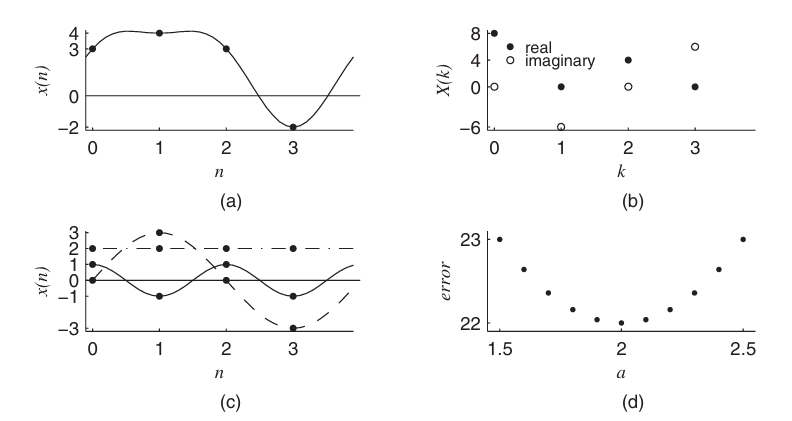
(a) A periodic waveform; (b) its frequency-domain representation; (c) the frequency components of the waveform in (a); (d) the square error in approximating the waveform in (a) using only the dc component with different amplitudes
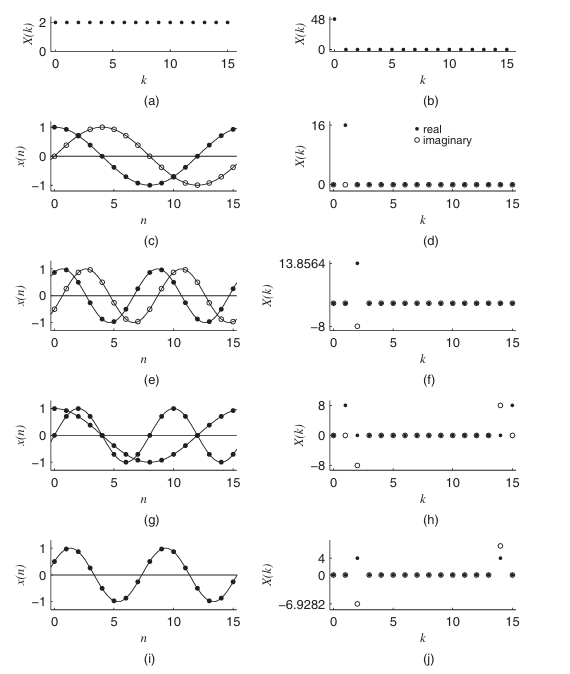
This visual demonstrates a periodic discrete sinusoid alongside its discrete-frequency spectrum.
Sign In Or Register Comment after
No comments yet. Be the first to comment!