


 View
View
In typical applications of science and engineering, I believe that we must represent arbitrary signals in terms of simple and well-defined basic signals. The two most fundamental signals that you will encounter in your engineering career are the unit impulse and the sinusoidal signal. These signals serve as the building blocks for representing and processing more complex information.
The discrete unit impulse signal, which I denote as  , is the simplest signal in discrete signal analysis. It is defined precisely in my text as:
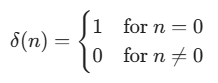
This signal is essential because any arbitrary signal can be represented as a sum of shifted and scaled impulses. This representation is known as the sifting property of the impulse. By understanding the response of a system to a single impulse, you can effectively determine its response to any practical signal you might encounter.
Similarly, sinusoidal signals are crucial for frequency domain analysis. A discrete sinusoid is expressed with the following mathematical formula:

In my study of linear time invariant systems, sinusoidal signals are preferred because they are eigenfunctions of these systems. When you apply a sinusoidal input to a system, the output is also a sinusoid of the same frequency. This unique property allows us to characterize a system entirely by its frequency response. Mastering these basic signals is a vital prerequisite for all advanced signal processing tasks.
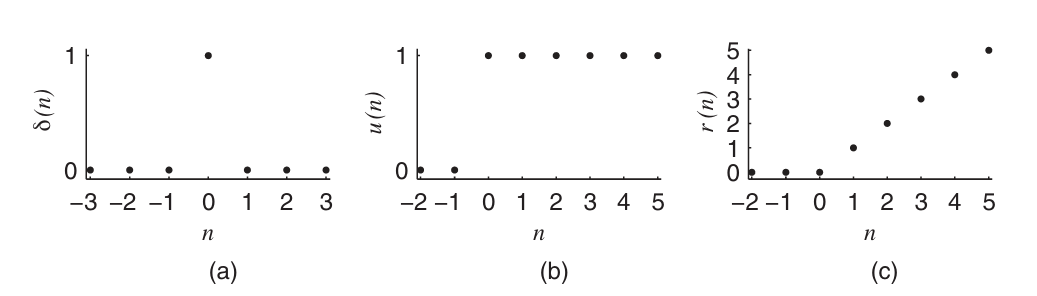
The illustration shows the discrete unit-impulse and unit-step signals clearly. 3 (a)The unit-impulse signal δ(n); (b)the unit-step signal u(n);(c)the unit-ramp signal r(n)
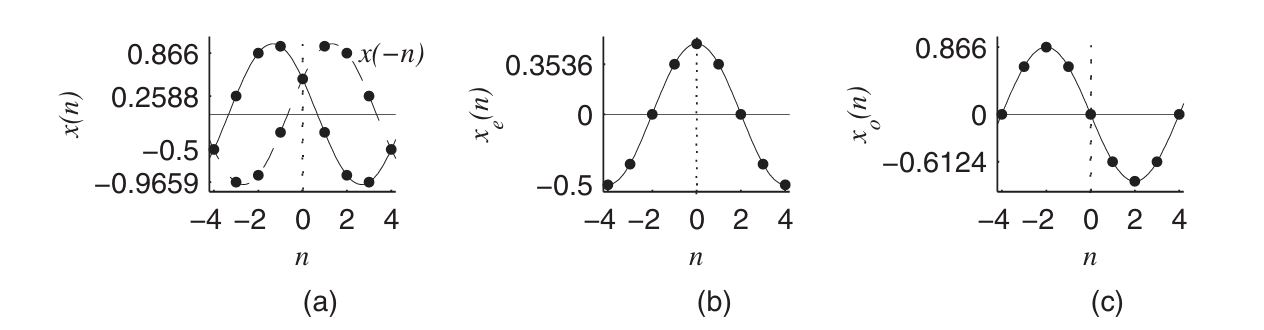
The waveforms a discrete sinusoid and its corresponding even and odd components.
Sign In Or Register Comment after
No comments yet. Be the first to comment!