


The Four Versions of Fourier Analysis
 View
View
In typical applications of science and engineering, we must choose the appropriate mathematical tool based on the characteristics of the signal we are processing. I believe that a clear understanding of the four versions of Fourier analysis is essential for your professional career in signal processing. These versions are distinguished primarily by whether the signal is continuous or discrete and whether it is periodic or aperiodic.
In my text, I classify these methods into four distinct categories. When you deal with continuous periodic signals, you utilize the Fourier Series (FS). If the signal is continuous and aperiodic, the Fourier Transform (FT) is the required tool. For your digital systems, we use the Discrete-Time Fourier Series (DTFS) for periodic sequences and the Discrete-Time Fourier Transform (DTFT) for aperiodic sequences.
The Discrete-Time Fourier Series is particularly important in digital engineering. The analysis equation for a discrete periodic signal with period N is defined exactly in my book as:

This equation allows you to determine the frequency components of a discrete signal with acceptable accuracy. It is crucial to remember that the properties of the signal in the time domain directly determine the properties of its representation in the frequency domain. For instance, periodicity in one domain always leads to discreteness in the other. Mastering this interplay will enable you to select the most efficient numerical algorithms for your specific engineering challenges.
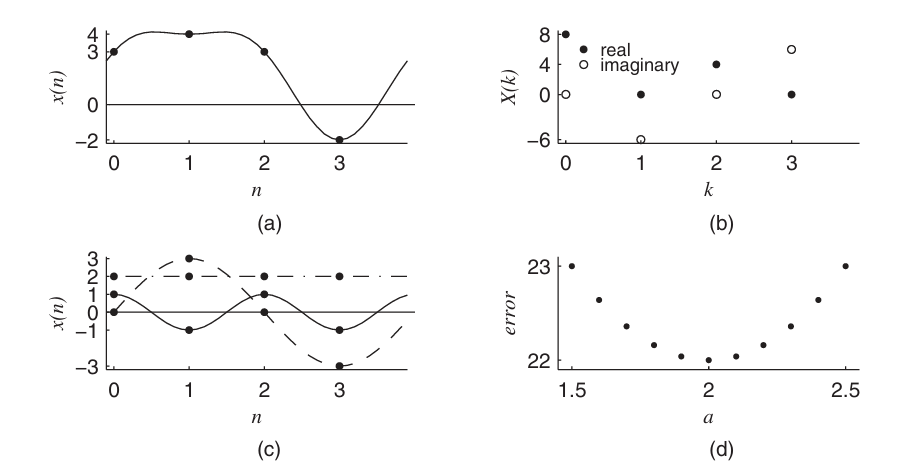
these four versions based on time and frequency characteristics. (a) A periodic waveform; (b) its frequency-domain representation; (c) the frequency components of the waveform in (a); (d) the square error in approximating the waveform in (a) using only the dc component with different amplitudes.
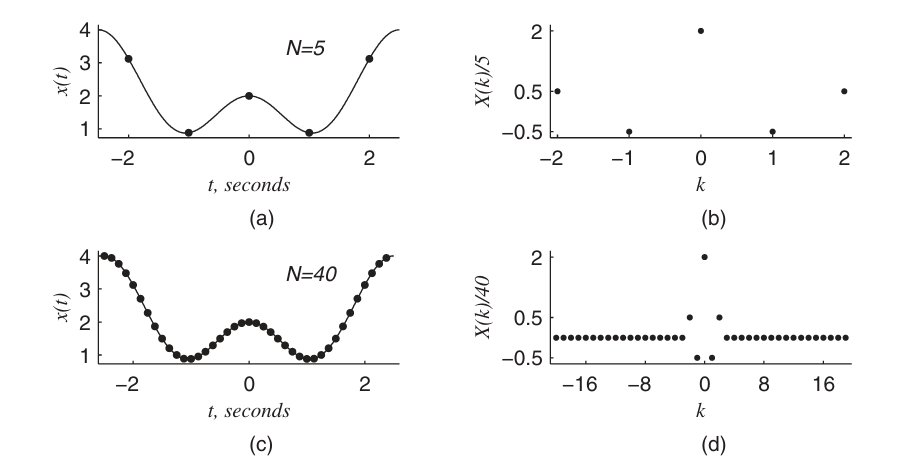
(a)Samples at intervals of 1s, of a periodic continuous signal x(t) with period 5s;
(b)its scaled DFT spectrum;
(c)samples of x(t) at intervals of 0.125s;
(d)its scaled DFT spectrum.
The diagram illustrates the relationship between a periodic discrete signal and its corresponding frequency spectrum.
Sign In Or Register Comment after
No comments yet. Be the first to comment!