


The Practicality of the Discrete Fourier Transform (DFT)
 View
View
In typical applications of science and engineering, the Discrete Fourier Transform (DFT) stands as the most vital tool for digital signal processing. While other Fourier versions are essential for theoretical understanding, the DFT is uniquely suited for computer implementation. This is because both the time-domain sequence and its frequency-domain representation are discrete and finite. In my professional view, mastering the DFT is a mandatory requirement for any engineer working with digital systems and numerical algorithms.
The DFT allows you to analyze the frequency content of a signal with acceptable accuracy using finite computational resources. In my text, the analysis equation for a discrete sequence of length N is defined exactly as:

The practicality of this transform arises from the fact that it can be computed extremely fast using the Fast Fourier Transform (FFT) algorithm. This efficiency is what enables real-time spectral analysis in your drone communication links and radar systems. When you process a finite set of samples from an analog signal, you are essentially performing a DFT to understand its spectral characteristics.
By using the DFT, you can perform operations such as linear filtering and correlation in the frequency domain with much less arithmetic effort than in the time domain. This computational advantage is the primary reason why digital signal processing has revolutionized modern engineering. Mastering the properties and implementation of the DFT will provide you with a powerful analysis tool for your future projects in telecommunications and embedded systems.
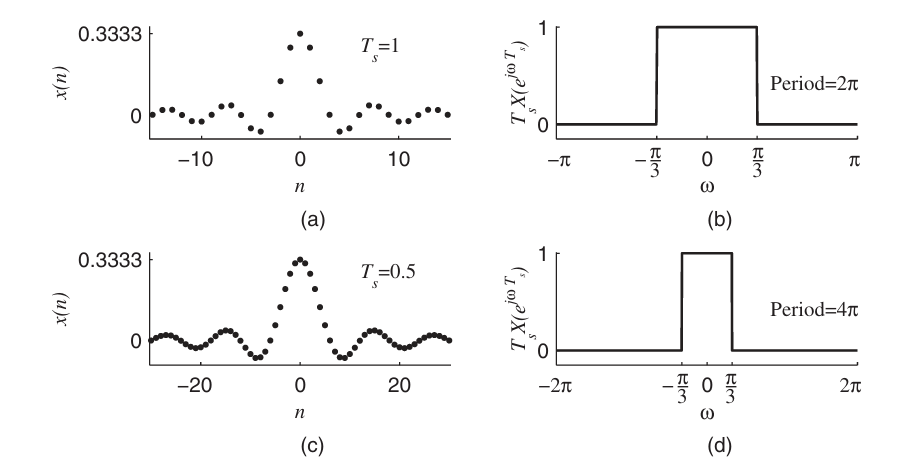
The visualization shown comparison between a finite-length sequence and its corresponding discrete frequency spectrum.
Sign In Or Register Comment after
No comments yet. Be the first to comment!