


Microcontroller vs Microprocessor - Project-Based Selection Guide
 View
View
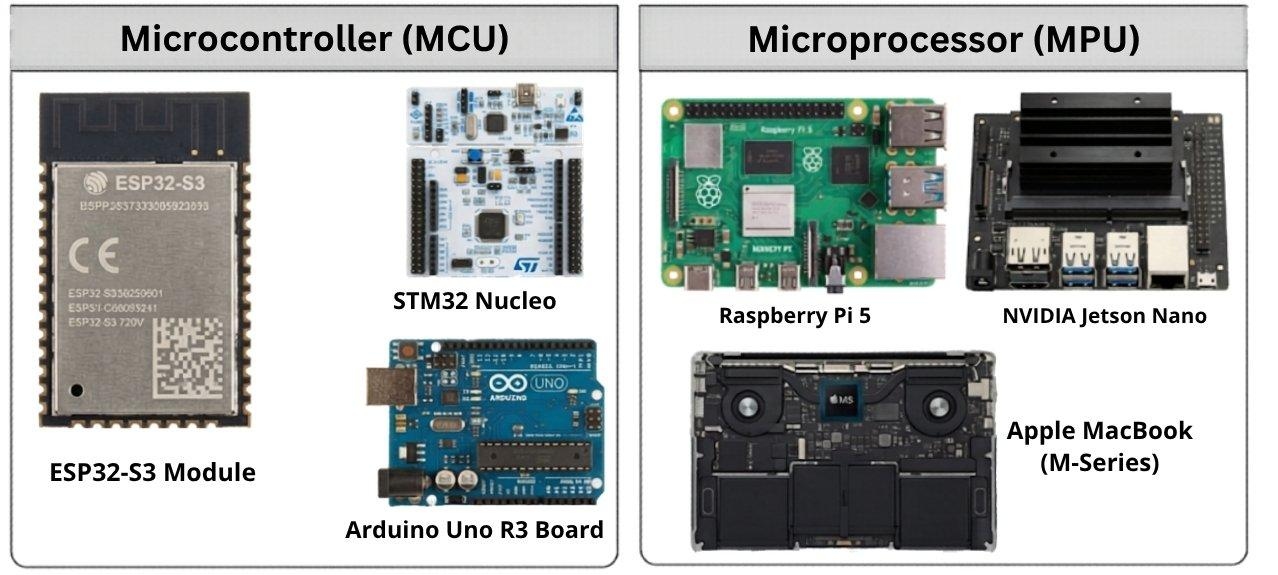
Instead of theory, here's how to choose based on real project scenarios:
🔋 Project 1: Battery-Powered IoT Sensor Node
(e.g., temperature + humidity + LoRa/WiFi)
Choose → Microcontroller (MCU)
Why:
- Ultra-low power (µA sleep modes)
- Built-in ADC, GPIO, communication interfaces
- Instant wake-up (no OS overhead)
📌 Examples:
- ESP32
- STM32L4
🤖 Project 2: Motor Control System
(e.g., BLDC motor, robotics, inverter)
Choose → Microcontroller (MCU)
Why:
- Deterministic real-time control
- Precise PWM + timers
- Low latency interrupt handling
📺 Project 3: Smart Display / HMI System
(e.g., touchscreen UI, dashboards)
Choose → Microprocessor (MPU)
Why:
- Requires OS (Linux/Android)
- Handles graphics + touch + networking
- Needs external RAM
📌 Example:
- Raspberry Pi 4
📷 Project 4: Camera / Vision System
(e.g., face detection, surveillance)
Choose → Microprocessor (MPU)
Why:
- High data throughput
- Image/AI processing
- Large memory + OS support
🔌 Project 5: Power / Energy System
(e.g., solar controller, UPS, BMS)
Choose → Microcontroller (MCU)
Why:
- Analog sensing (voltage/current)
- Real-time control loops
- High reliability
🌐 Project 6: IoT Gateway / Edge Device
Choose → Microprocessor (MPU)
Why:
- Runs Linux + networking stack
- Handles multiple devices + protocols
- Cloud connectivity + local processing
🔄 Project 7: Smart Industrial System (MCU + MPU Together)
(e.g., industrial automation panel, smart EV charger, advanced robot)
Choose → Hybrid (MCU + MPU)
Architecture:
-
MCU → Real-time control layer
- Sensors, actuators, safety loops
-
MPU → Application layer
- UI, cloud, analytics, networking
Why this split works:
- MCU guarantees deterministic timing
- MPU handles complex processing + OS tasks
- Improves system reliability and scalability
📌 Example combination:
- MCU: STM32F4
- MPU: Raspberry Pi 4
📌 Communication between them:
- UART / SPI / CAN / Ethernet
🔥 Core Decision Rule
Control + Real-time → MCU
Processing + OS + UI → MPU
Both needed → Split architecture (MCU + MPU)
🚀 Final Takeaway
- MCU = Efficiency, control, low power
- MPU = Performance, flexibility, complex systems
- MCU + MPU = Industrial-grade architecture
👉 Most advanced products today use a hybrid approach.
🔗 Reference
For a more detailed breakdown:
https://jlcpcb.com/blog/microcontroller-vs-microprocessor
Sign In Or Register Comment after
No comments yet. Be the first to comment!