


CT Sensor vs Hall Effect Sensor for Current Measurement: Which One to Choose?
 View
View
Current measurement is a fundamental requirement in many embedded and industrial systems. Two commonly used technologies are Current Transformer (CT) sensors and Hall Effect sensors. Each has distinct characteristics, advantages, and limitations depending on the application.
This article compares both sensor types to help engineers select the most suitable solution.
Working Principle
CT Sensor (Current Transformer)
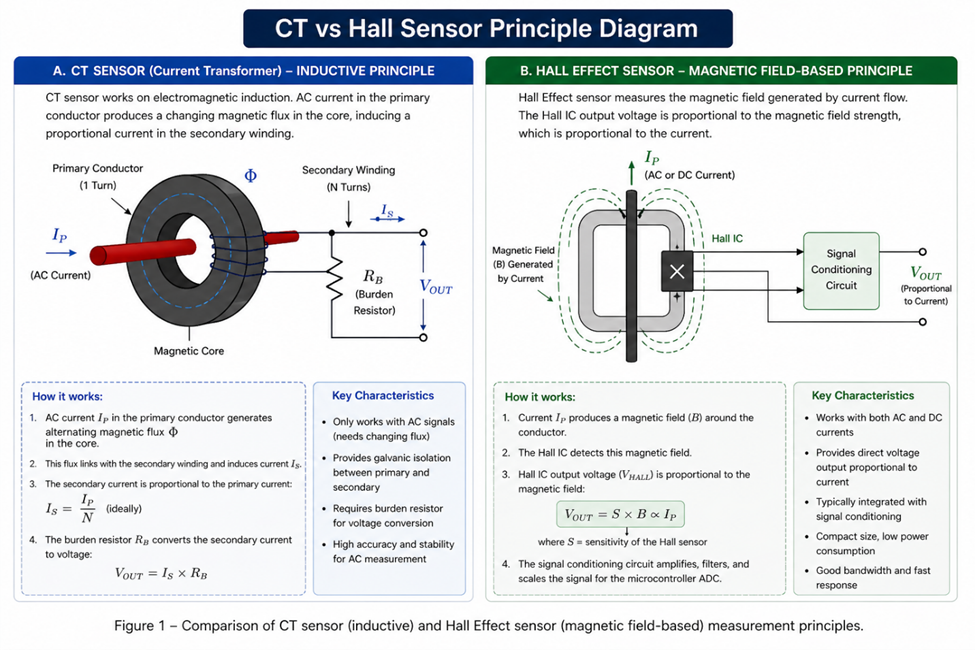
CT sensors operate based on electromagnetic induction. When AC current flows through the primary conductor, it induces a proportional current in the secondary winding.
Key characteristics:
- Only works with AC signals
- Provides isolated measurement
- Requires burden resistor for voltage conversion
Hall Effect Sensor
Hall Effect sensors measure magnetic fields generated by current flow. The sensor outputs a voltage proportional to the magnetic field strength.
Key characteristics:
- Works with both AC and DC
- Provides direct voltage output
- Typically integrated with signal conditioning
Measurement Capability
| Feature | CT Sensor | Hall Effect Sensor |
|---|---|---|
| AC Measurement | ✅Yes | ✅Yes |
| DC Measurement | ❌No | ✅Yes |
| Isolation | ✅High | ✅Moderate |
| Accuracy | High (AC) | Moderate–High |
| Cost | Low | Medium |
Signal Conditioning
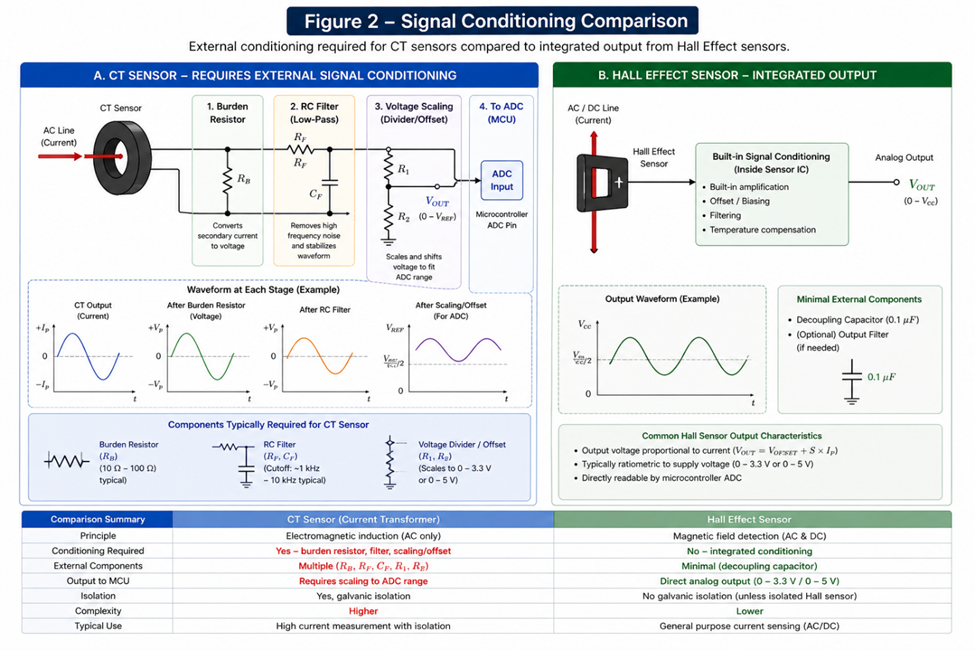
CT sensors require additional circuitry:
- Burden resistor
- Filtering (RC)
- Voltage scaling
Hall sensors typically provide:
- Analog voltage output
- Built-in amplification
- Minimal external components
Application Comparison
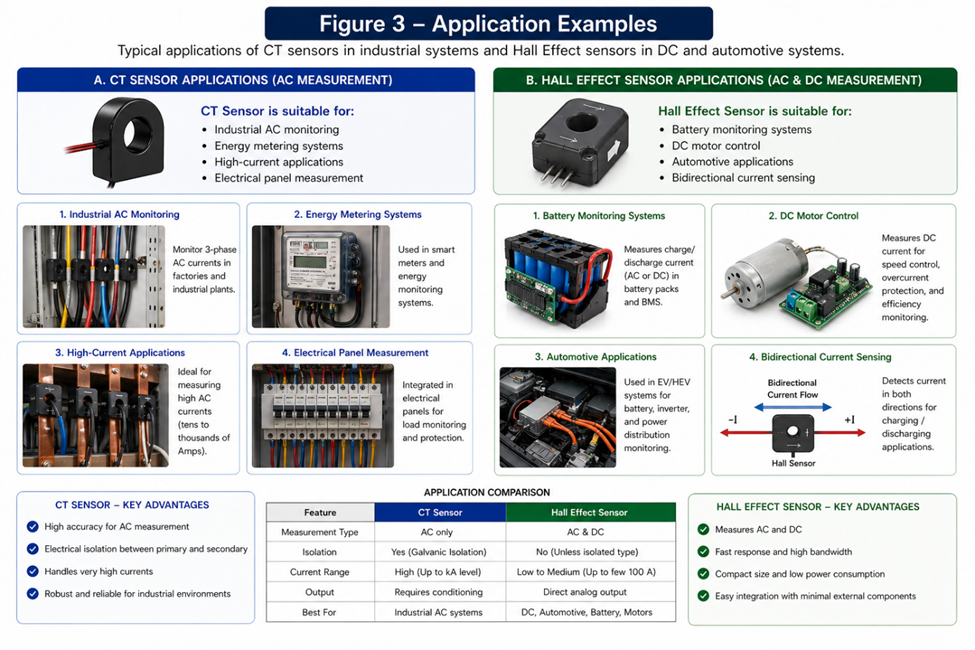
CT Sensor is suitable for:
- Industrial AC monitoring
- Energy metering systems
- High-current applications
- Electrical panel measurement
Hall Effect Sensor is suitable for:
- Battery monitoring systems
- DC motor control
- Automotive applications
- Bidirectional current sensing
Accuracy and Noise Consideration
- CT sensors provide stable readings for sinusoidal AC signals
- Hall sensors may introduce offset drift and noise
- CT sensors require calibration for burden resistor scaling
- Hall sensors require offset compensation for zero-current detection
Engineering Insight
Choosing the right sensor depends on system requirements:
- Use CT sensor for high-current AC measurement with isolation
- Use Hall Effect sensor for DC or bidirectional current measurement
For mixed systems (AC + DC), Hall Effect sensors are more flexible but come with higher cost and complexity.
Conclusion
Both CT and Hall Effect sensors are effective current measurement solutions, but their selection depends on the application. CT sensors are ideal for AC industrial monitoring, while Hall Effect sensors provide flexibility for both AC and DC systems.
Understanding these differences helps engineers design more accurate and efficient measurement systems.
#Sensors#
#CurrentMeasurement#
#CTSensor#
#HallEffect#
#EmbeddedSystem#
#AnalogSignal#
 #Sensors#
#CurrentMeasurement#
#CTSensor#
#HallEffect#
#EmbeddedSystem#
#AnalogSignal#
#Sensors#
#CurrentMeasurement#
#CTSensor#
#HallEffect#
#EmbeddedSystem#
#AnalogSignal#
Sign In Or Register Comment after
No comments yet. Be the first to comment!