


Relay vs Solid State Relay (SSR): Which One to Use in Automation Systems?
 View
View
Relays are widely used in automation systems to control electrical loads such as motors, lamps, and industrial equipment. Two common types are mechanical relays and solid state relays (SSR). While both serve the same purpose, their working principles and performance characteristics are significantly different.
This article compares both relay types to help engineers choose the right solution for their application.
Working Principle
Mechanical Relay
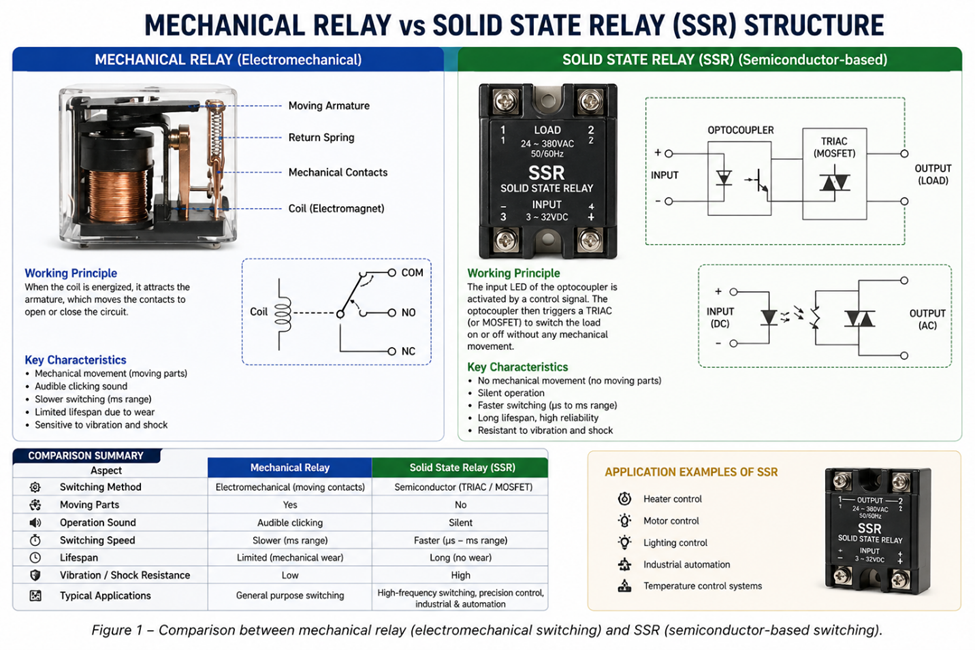
A mechanical relay uses an electromagnetic coil to physically switch contacts.
Key characteristics:
- Uses moving parts
- Provides electrical isolation
- Produces clicking sound during operation
Solid State Relay (SSR)
An SSR uses semiconductor components (triac, MOSFET, or optocoupler) to switch loads without moving parts.
Key characteristics:
- No mechanical movement
- Silent operation
- Faster switching
Performance Comparison
| Feature | Mechanical Relay | SSR |
|---|---|---|
| Switching Speed | Slow (ms) | Fast (µs) |
| Lifespan | Limited (wear) | Very long |
| Noise | Audible click | Silent |
| Heat Generation | Low | Higher |
| Power Consumption | Coil required | Low control power |
| Isolation | High | High (optical) |
Load Handling
Mechanical Relay
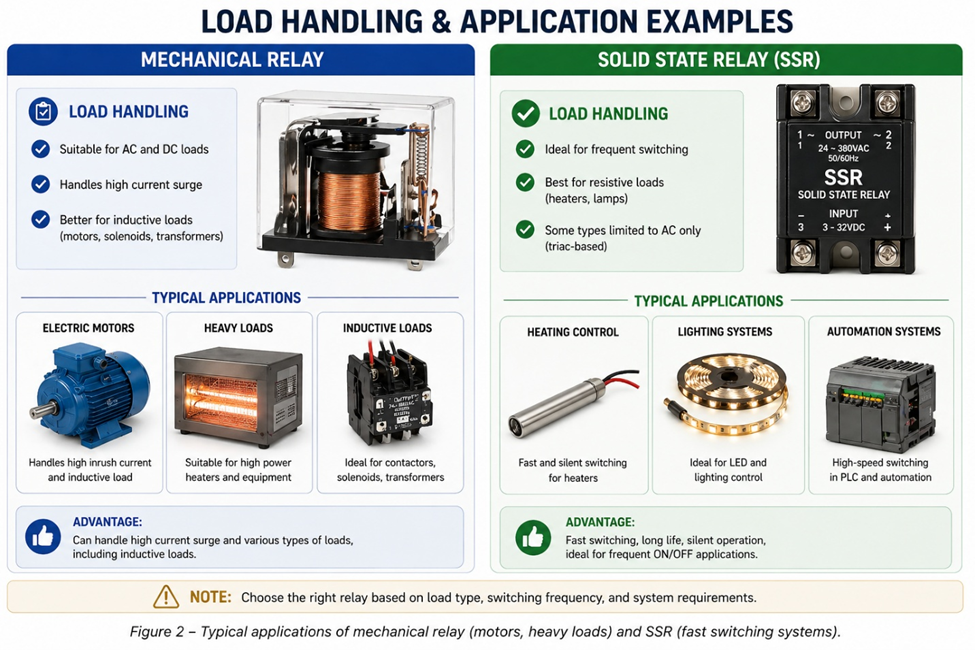
- Suitable for AC and DC loads
- Handles high current surge
- Better for inductive loads
SSR
- Ideal for frequent switching
- Best for resistive loads
- Some types limited to AC only (triac-based)
Advantages and Limitations
Mechanical Relay Advantages
- Low cost
- Handles high current
- Good isolation
Mechanical Relay Limitations
- Contact wear over time
- Slower switching
- Mechanical noise
SSR Advantages
- Long lifespan
- Fast switching
- No mechanical noise
SSR Limitations
- Heat dissipation required
- Higher cost
- Leakage current (important for low-load systems)
Engineering Considerations
Choose based on application:
- Use mechanical relay for:
- Motor control
- High current switching
- Low-frequency operation
- Use SSR for:
- High-speed switching
- Silent operation
- Long-term reliability
Thermal management is critical when using SSR, especially in high-current applications.
Both mechanical relays and SSRs are essential components in automation systems. Mechanical relays are robust and cost-effective for general-purpose switching, while SSRs provide faster, quieter, and more reliable operation for high-frequency switching applications.
Selecting the right relay depends on load type, switching frequency, and system requirements.
#Automation#
#Relay#
#SSR#
#EmbeddedSystem#
#PowerElectronics#
#ControlSystem#
 #Automation#
#Relay#
#SSR#
#EmbeddedSystem#
#PowerElectronics#
#ControlSystem#
#Automation#
#Relay#
#SSR#
#EmbeddedSystem#
#PowerElectronics#
#ControlSystem#
Sign In Or Register Comment after
No comments yet. Be the first to comment!