


The ESP Family, The Foundational Chips
 View
View
The ESP Family: From a $1 Wi-Fi Chip to a Full Microcontroller Ecosystem
Back in 2014, a strange blue module started appearing on AliExpress for under a dollar. It had "ESP-01" printed on it and claimed to turn any microcontroller into a Wi-Fi device with AT commands. Nobody expected that cheap little module to eventually power hundreds of millions of connected devices worldwide.
Let's Talk About Where This All Started
Espressif Systems is a Shanghai-based semiconductor company that, by most accounts, nobody in the West had heard of before 2014. Then they released the ESP8266, and everything changed. Not because it was the first Wi-Fi chip, but it wasn't. But because it was the first one that a hobbyist could afford, program, and build a real product with. The maker community went wild.
Fast forward a decade, and Espressif now has a family of chips that covers everything from a basic sub-dollar Wi-Fi SoC to an AI-accelerated dual-core processor with native USB and Octal-SPI RAM. They've gone from a niche Wi-Fi module maker to one of the most influential IoT semiconductor companies in the world. As of early 2026, Espressif shipped over 1 billion IoT chips cumulatively, a testament to the ecosystem's dominance. And the best part?
The development tools are excellent, the community is enormous, and the documentation makes sense.
If you're going to work with ESP chips, whether you're a student learning IoT, a maker building a project, or an engineer designing a commercial product, you need to understand the whole family. Not just "ESP32 good, ESP8266 old." There's nuance here and choosing the wrong chip will cost you time and money.
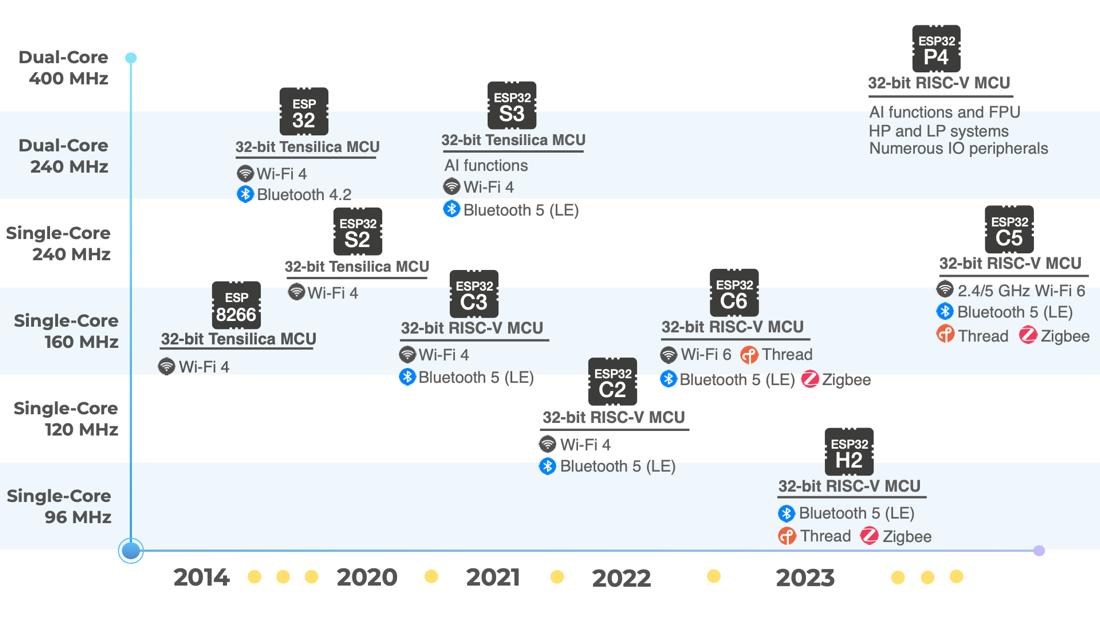
The Foundational Chips — What They Actually Are!
ESP8266 — The Legend That Won't Die
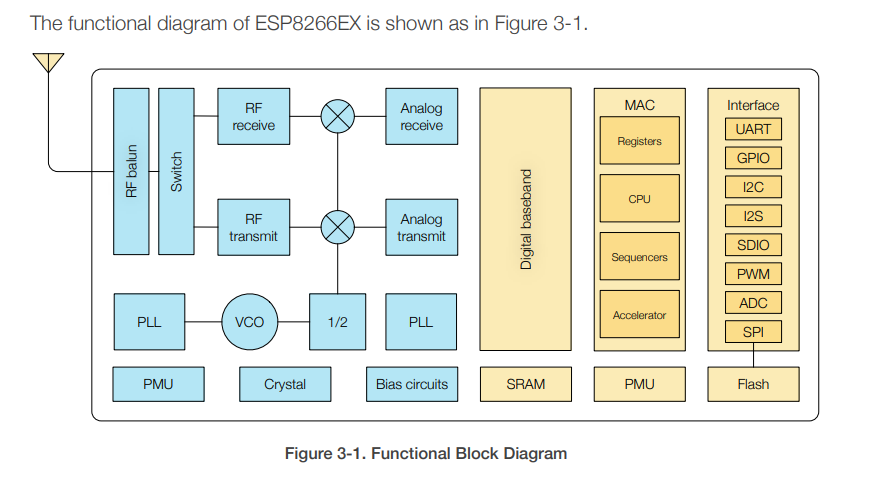
The ESP8266 integrates a single-core Tensilica L106 32-bit RISC processor clocked at 80 MHz (or 160 MHz when pushed), with on-chip SRAM and support for external SPI flash. It offers Wi-Fi (802.11 b/g/n) but no Bluetooth. The total on-chip SRAM is 160 KB, but only approximately 80 KB is available to the user application, the rest is reserved for the Wi-Fi stack and ROM. On paper, it sounds weak. In practice, for a sensor node that wakes up every five minutes, reads a value, posts it to MQTT, and goes back to deep sleep, it's more than enough.
The biggest gotcha with the ESP8266 is that your application code and the Wi-Fi stack share the same single core. Write blocking code, and you'll starve the Wi-Fi stack and get random disconnects. This is the number one reason beginners pull their hair out. Once you understand it and code around it (using non-blocking patterns, callbacks, or an RTOS), the chip is rock solid.
Sign In Or Register Comment after
No comments yet. Be the first to comment!