


Interrupt vs Polling in Embedded Systems: Which One Should You Use?
 View
View
In embedded system design, handling input signals efficiently is critical. Two common approaches are polling and interrupts. Both methods are widely used in microcontroller-based systems such as Arduino, ESP32, and STM32.
This article explains the differences, advantages, and when to use each method in real applications.
What is Polling?
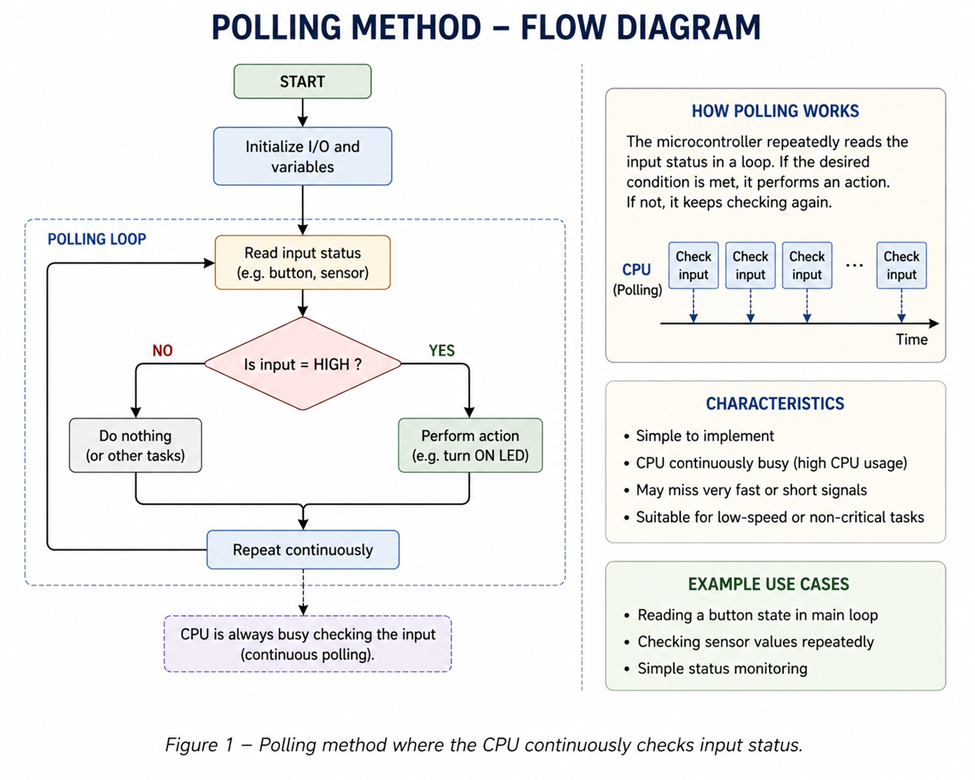
Polling is a method where the microcontroller continuously checks the status of an input.
Example:
- Reading a button state inside the main loop
- Checking sensor values repeatedly
Basic concept:
while (1) {
if (input == HIGH) {
// do something
}
}
Characteristics:
- Simple to implement
- CPU continuously busy
- May miss fast signals
What is Interrupt?
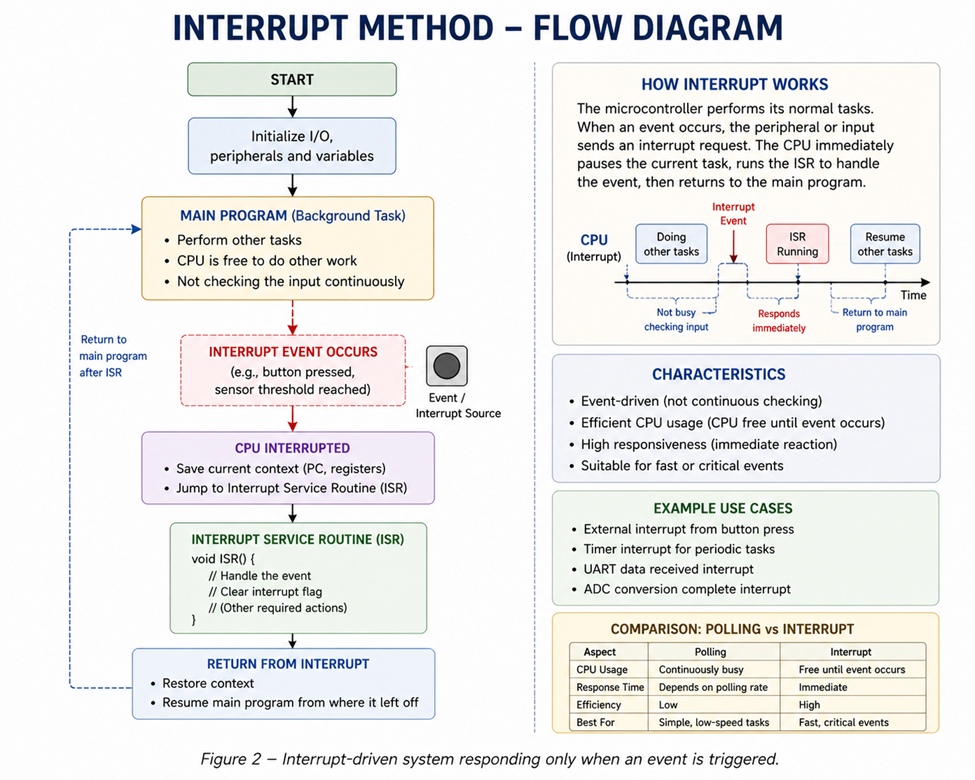
Interrupt allows the microcontroller to respond immediately when an event occurs.
Instead of checking continuously, the CPU is “notified” when needed.
Basic concept:
void ISR() {
// triggered when event occurs
}
Characteristics:
- Event-driven
- Efficient CPU usage
- High responsiveness
Key Differences
| Feature | Polling | Interrupt |
|---|---|---|
| CPU Usage | High | Efficient |
| Response Time | Slower | Immediate |
| Complexity | Simple | Moderate |
| Reliability | Lower (missed events) | High |
When to Use Polling
Polling is suitable for:
- Simple systems
- Slow-changing signals
- Non-critical tasks
- Beginner-level implementation
Example:
- Reading temperature every second
- Monitoring non-critical input
When to Use Interrupt
Interrupt is ideal for:
- High-speed signals
- Time-critical events
- Pulse counting (RPM, encoder)
- Communication systems
Example:
- Tachometer (RPM counter)
- Serial communication
- External trigger detection
Engineering Insight
Using interrupts improves system efficiency, but excessive interrupt usage can:
- Increase complexity
- Cause timing issues
- Lead to difficult debugging
Best practice:
- Use interrupts only for critical tasks
- Keep ISR short and efficient
- Handle processing in main loop
Practical Comparison Example
For a motor speed measurement system:
- Polling → may miss pulses at high RPM
- Interrupt → captures every pulse accurately
This is why interrupt-based design is preferred in measurement systems.
Polling and interrupt are both essential techniques in embedded systems. Polling offers simplicity, while interrupt provides efficiency and accuracy. The choice depends on system requirements, signal speed, and application complexity.
Understanding when to use each method is key to building reliable embedded systems.
#Microcontrollers#
#EmbeddedSystems#
#Interrupt#
#Polling#
#Firmware#
#Arduino#
 #Microcontrollers#
#EmbeddedSystems#
#Interrupt#
#Polling#
#Firmware#
#Arduino#
#Microcontrollers#
#EmbeddedSystems#
#Interrupt#
#Polling#
#Firmware#
#Arduino#
Sign In Or Register Comment after
No comments yet. Be the first to comment!