


IoT Domains, Communication Patterns, and Why Projects Fail
 View
View
IoT vs. IIoT vs. AIoT: Why the Labels Matter
Understanding the nuances between these acronyms is critical for establishing the correct reliability requirements, security postures, and safety margins for your design.
| Term | Domain | Key Characteristic | Example |
|---|---|---|---|
| IoT | Consumer/Commercial | User convenience, cost-sensitive | Smart thermostat, wearable, smart lock |
| IIoT | Industrial/Manufacturing | Reliability, functional safety, data fidelity | Predictive maintenance, SCADA, smart grid |
| AIoT | Any domain | ML inference at the edge (TinyML) | Face recognition, anomaly detection, keyword spotting |
| WoT | Web/Integration | Standard web protocols for device interoperability | RESTful device APIs, W3C Thing Description |
| V2X | Automotive | Ultra-low latency (<10ms), safety-critical | Vehicle-to-infrastructure (C-V2X) communication |
These distinctions matter immensely. They imply different reliability requirements (e.g., five-nines vs. best-effort), different security postures (hardware root of trust vs. symmetric key), and different consequences of failure. A smart light bulb failing to respond is an annoyance. An IIoT pressure sensor providing incorrect readings in a natural gas pipeline is a safety hazard. Design rigor must scale accordingly.
The IoT Communication Patterns
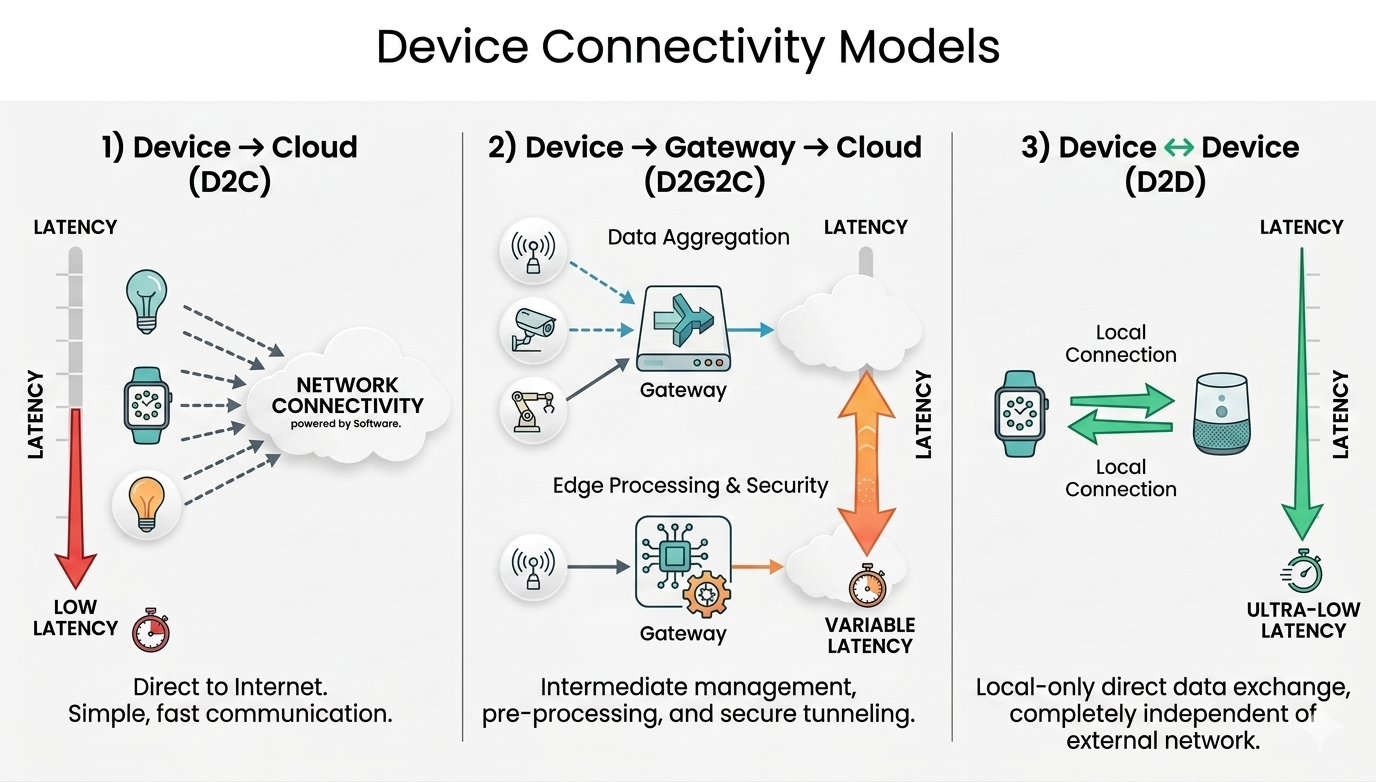
Device-to-Cloud (D2C) The Most Common
The device authenticates to a cloud broker (e.g., AWS IoT Core, Azure IoT Hub) using X.509 certificates or tokens, publishes telemetry over MQTT or HTTP, and subscribes to command topics. It is simple, scalable, and well-understood. The critical drawback: the device is completely dependent on internet connectivity. No WAN link equals no monitoring and no remote control.
Device-to-Gateway-to-Cloud (D2G2C), The Resilient Pattern
Resource-constrained devices (BLE sensors, Zigbee nodes, or legacy 4–20 mA transmitters) cannot connect directly to the internet. They communicate to a local gateway that performs protocol translation, data aggregation, and local processing. This is the pattern employed in serious industrial deployments. The gateway can operate autonomously during WAN outages, maintaining local control logic and caching data for later synchronization when connectivity is restored. This "Edge Computing" capability is mandated by the IEC 62264 standard for enterprise-control system integration.
Device-to-Device (D2D), For Real-Time Local Control
When latency requirements are strict (under 10 ms), a cloud round-trip is architecturally impossible. D2D is used in industrial control systems and robotics where actuators must respond immediately to sensor state changes. Zigbee binding and Thread networks are classic implementations of this low-latency local mesh.
Why IoT Projects Fail (And How to Not Be That Story)
I have witnessed many IoT projects fail. Not in dramatic, fiery explosions, but in quiet, frustrating ways: Devices that work perfectly on the lab bench but fail in the field due to RF co-channel interference or power supply ripple. Systems that scale seamlessly from 1 to 100 devices but collapse at 1,000 because the MQTT broker wasn't tuned for maximum concurrent connections or the database wasn't partitioned for write throughput. Sensors that drift out of specification within six months due to inadequate environmental stress screening. Firmware that accumulates memory leaks due to heap fragmentation and requires a watchdog timer reset every week.
The common thread in all these failures: decisions made during the prototyping phase that were never re-examined before production. "The prototype worked, so we shipped it."* Do not do this. Prototypes are designed to prove a concept. Products are designed to operate reliably, at scale, in the real world, for years. These are distinct engineering disciplines with distinct verification and validation (V&V) processes.
Before you ship a single unit, ensure you have: performed field-testing in the actual deployment environment (not just the office), stress-tested your backend at 10x the expected device count, instrumented your firmware with health metrics (e.g., heap usage, uptime, link quality), designed robust failure recovery paths (including watchdog timers and brown-out detection), and planned a secure Over-the-Air (OTA) update strategy. This is the essential work that separates a reliable product from a fragile prototype.
Sign In Or Register Comment after
No comments yet. Be the first to comment!