


Physical Layer Protocols and the Decision Framework
 View
View
IoT Protocols: The Definitive Engineering Guide to Choosing the Right One
Before, we covered application layer protocols, MQTT, HTTP, and CoAP. Now we move down the stack to the physical and data link layers, where bits travel across wires and radio waves. These choices determine power consumption, range, and infrastructure cos
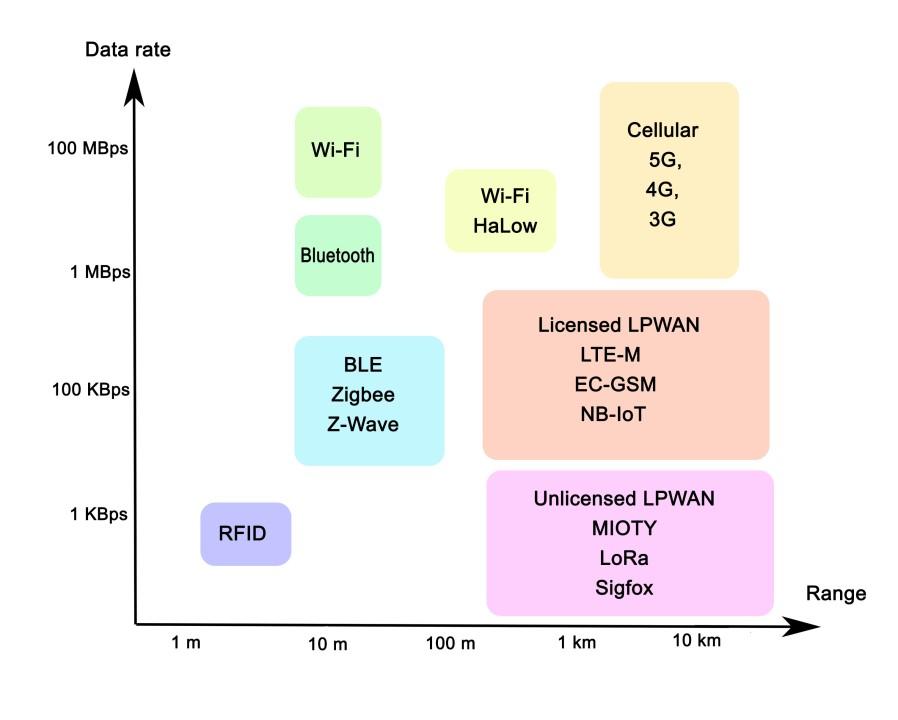
Physical Layer Protocols: How Bits Actually Travel
Wi-Fi: The Bandwidth Champion
802.11 b/g/n offers up to ~150 Mbps and ~100 m range indoor. In IoT, bandwidth is not the limit, power is. Current draw can reach 138–335 mA, making Wi-Fi suitable mainly for mains-powered or infrequent-transmission devices.
Best for: smart home hubs, cameras, high data sensors, cloud-connected devices needing low latency or high throughput.
BLE 5.x: The Battery-Friendly Workhorse
BLE 5 improved range (up to ~400 m with coded PHY), speed (up to 2 Mbps), and efficiency. It works in two modes: connection (wearables, continuous data) and advertising (beacons, tracking, broadcasts). BLE Mesh extends coverage via multi-hop networking.
Best for: wearables, proximity systems, low-power sensors, smart devices.
Zigbee / Thread: Mesh Networks for Smart Homes
Both use IEEE 802.15.4 at 2.4 GHz (~250 kbps, ~100 m per hop). Zigbee uses its own network layer, while Thread is IPv6-based via 6LoWPAN, making it more internet-native.
Thread is gaining strong adoption due to Matter (Apple, Google, Amazon, etc.). Border routers connect mesh to IP networks.
Best for: smart lighting, home automation, scalable mesh systems.
LoRa / LoRaWAN: Long Range, Ultra Low Power
LoRa uses chirp spread spectrum for long-range (15+ km) and very low data rates (~250 bps at max range). Devices can run for years on batteries.
LoRaWAN adds network management but is limited by duty cycle (often 1% in EU), restricting data volume heavily.
Best for: environmental monitoring, agriculture, slow sensor updates.
NB-IoT & LTE-M: Cellular IoT
Both use cellular networks with SIM-based connectivity.
- NB-IoT: very low power, high latency, tiny data, best for static sensors (meters, infrastructure).
- LTE-M: higher speed, lower latency, supports mobility and voice.
Costs scale per device via SIM subscriptions.
Best for: wide-area deployment without gateways.
RS-485 / Modbus: Industrial Standard
A wired, differential protocol resistant to noise. Supports long distances, up to 247 devices, and deterministic timing (1–10 ms cycles). Still widely used in factories.
Best for: industrial automation, reliable wired sensor networks.
The Decision Framework
| Use Case | Best Protocol | Why |
|---|---|---|
| Smart home device (mains powered) | Wi-Fi + MQTT | High bandwidth, easy integration, no infrastructure |
| Wearable / health monitor | BLE 5.x | Ultra-low power, paired to phone |
| Smart building sensors | Zigbee or Thread | Mesh, low power, no per-device cost |
| Agricultural field sensor | LoRaWAN | Kilometer range, year-long battery |
| Vehicle / asset tracking | LTE-M | Cellular coverage, mobility support |
| Industrial floor sensor | RS-485 / Modbus | Deterministic, EMI immune, proven |
| Consumer Smart home (new) | Thread / Matter | Future-proof, cross-ecosystem |
Sign In Or Register Comment after
No comments yet. Be the first to comment!