


UART vs I2C vs SPI: Communication Protocol Comparison
 View
View
Communication between components is essential in embedded systems. Three commonly used protocols are UART, I2C, and SPI. Each protocol has its own characteristics, advantages, and suitable use cases.
This article compares these protocols to help you choose the right one for your application.
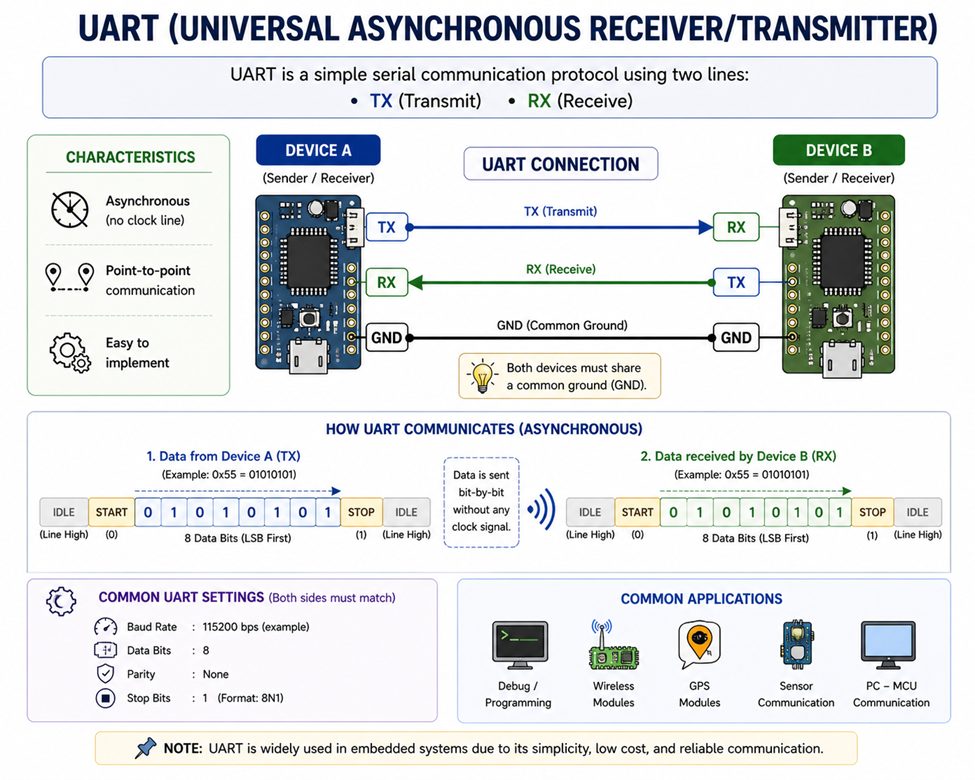
UART (Universal Asynchronous Receiver/Transmitter)
UART is a simple serial communication protocol using two lines:
- TX (Transmit)
- RX (Receive)
Characteristics:
- Asynchronous (no clock line)
- Point-to-point communication
- Easy to implement
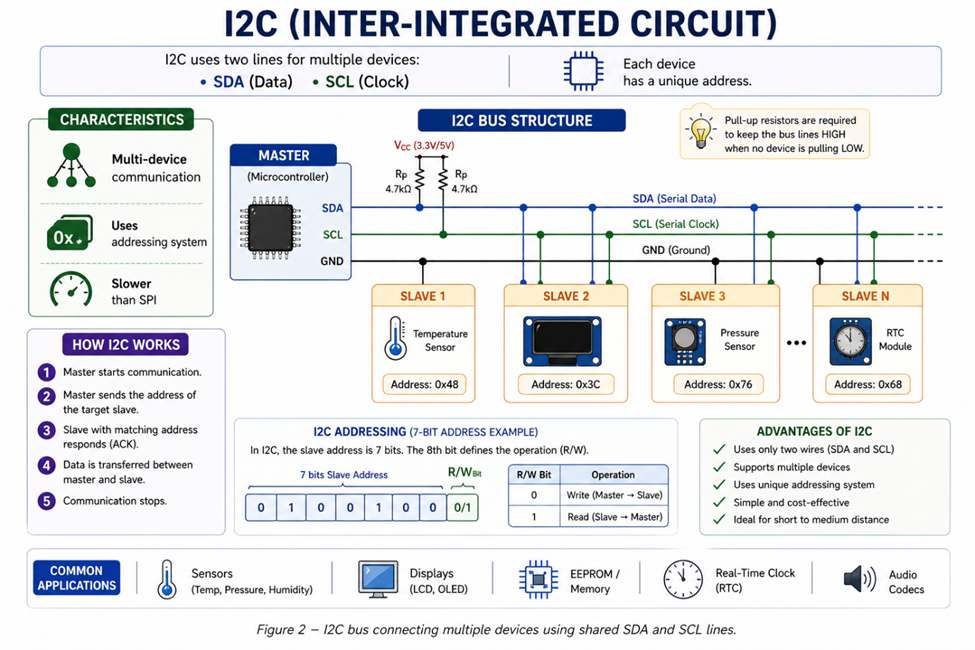
I2C (Inter-Integrated Circuit)
I2C uses two lines for multiple devices:
- SDA (Data)
- SCL (Clock)
Each device has a unique address.
Characteristics:
- Multi-device communication
- Uses addressing system
- Slower than SPI
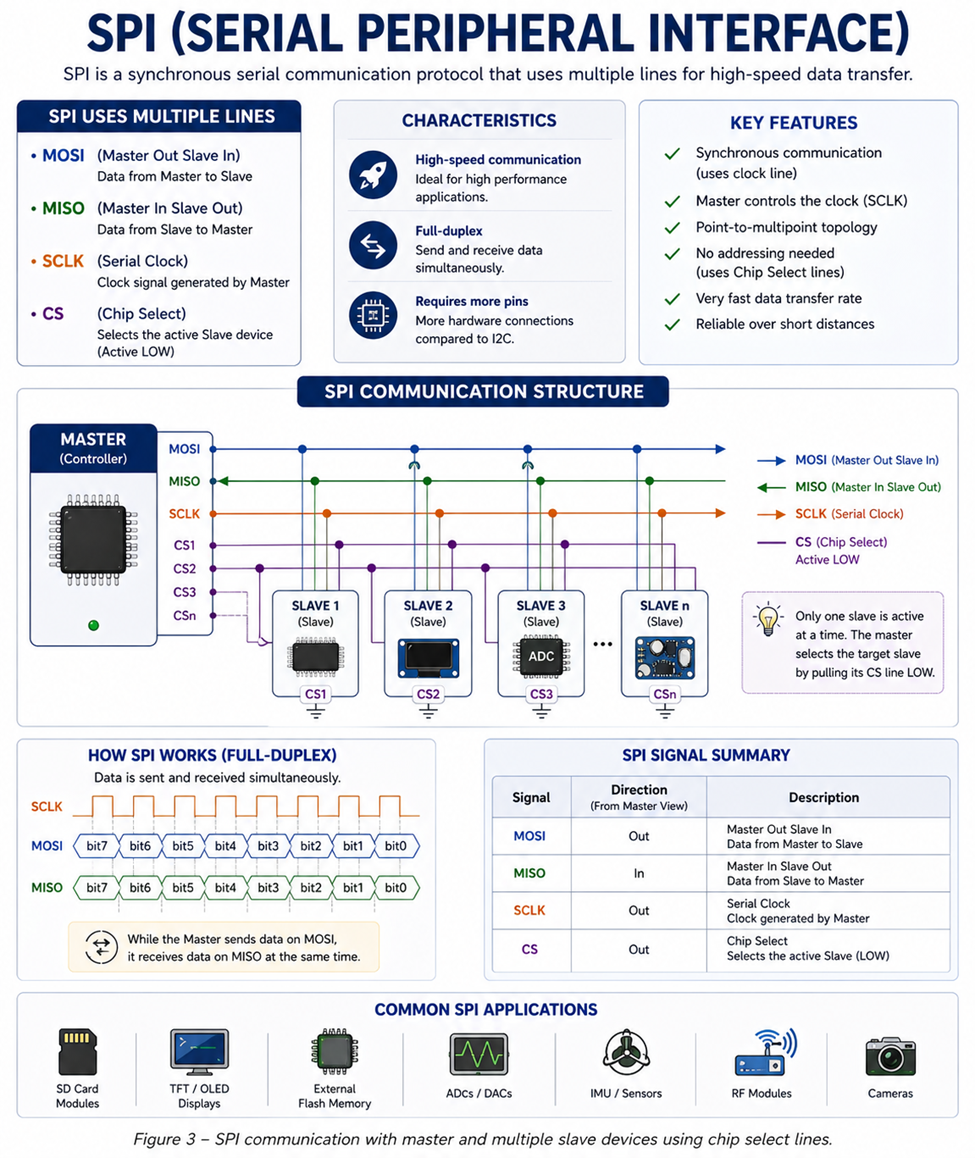
SPI (Serial Peripheral Interface)
SPI uses multiple lines:
- MOSI (Master Out Slave In)
- MISO (Master In Slave Out)
- SCLK (Clock)
- CS (Chip Select)
Characteristics:
- High-speed communication
- Full-duplex (send & receive simultaneously)
- Requires more pins
Comparison Table
| Feature | UART | I2C | SPI |
|---|---|---|---|
| Lines | 2 | 2 | 4+ |
| Speed | Medium | Low | High |
| Complexity | Low | Medium | Medium |
| Multi-device | No | Yes | Yes |
| Full Duplex | Yes | No | Yes |
When to Use Each Protocol
Use UART for:
- Simple communication
- Debugging (serial monitor)
- Device-to-device communication
Use I2C for:
- Multiple sensors
- Limited pin availability
- Moderate speed requirements
Use SPI for:
- High-speed data transfer
- Displays (TFT, OLED)
- Memory devices (SD card)
Engineering Insight
- UART is easiest but limited
- I2C saves pins but slower
- SPI is fastest but uses more wiring
Choosing the right protocol depends on system requirements such as speed, number of devices, and hardware complexity.
UART, I2C, and SPI are essential communication protocols in embedded systems. Understanding their differences allows engineers to design more efficient and reliable systems.
#Microcontrollers#
#UART#
#I2C#
#SPI#
#EmbeddedSystem#
#Communication#
 #Microcontrollers#
#UART#
#I2C#
#SPI#
#EmbeddedSystem#
#Communication#
#Microcontrollers#
#UART#
#I2C#
#SPI#
#EmbeddedSystem#
#Communication#
Sign In Or Register Comment after
No comments yet. Be the first to comment!