


What is Debouncing and Why It Matters in Digital Input
 View
View
In embedded systems, reading digital inputs such as buttons or switches seems simple. However, mechanical switches do not produce clean signals. Instead, they generate rapid fluctuations called bounce, which can cause multiple unintended triggers.
Debouncing is the process of eliminating these false signals to ensure reliable input detection.
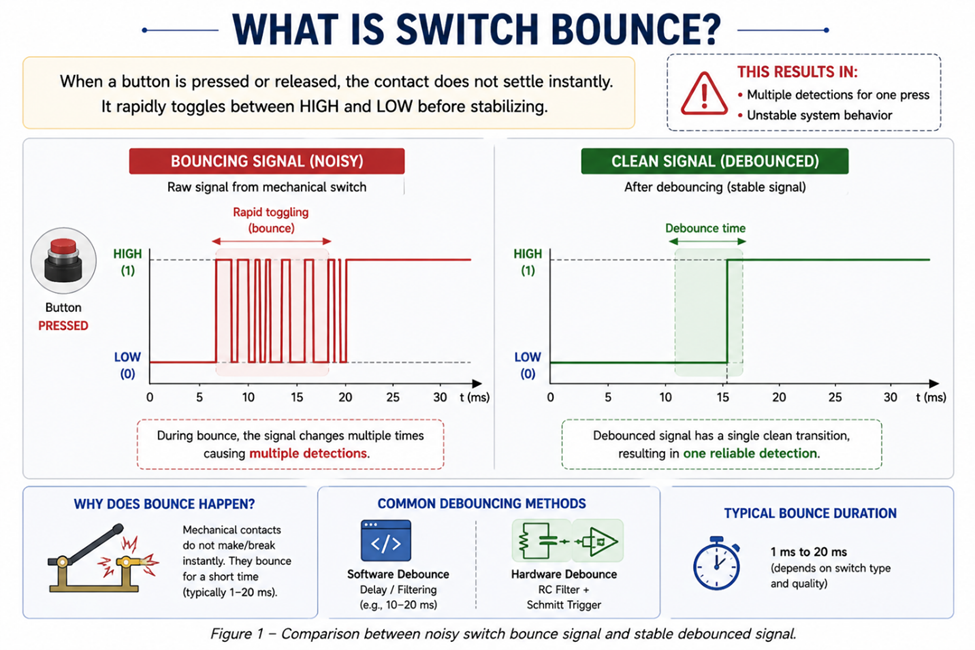
What is Switch Bounce?
When a button is pressed or released, the contact does not settle instantly. It rapidly toggles between HIGH and LOW before stabilizing.
This results in:
- Multiple detections for one press
- Unstable system behavior
Why Debouncing is Important
Without debouncing:
- Counters may increase multiple times
- Systems may misinterpret input
- Control logic becomes unreliable
Debouncing ensures that one physical press equals one digital event.
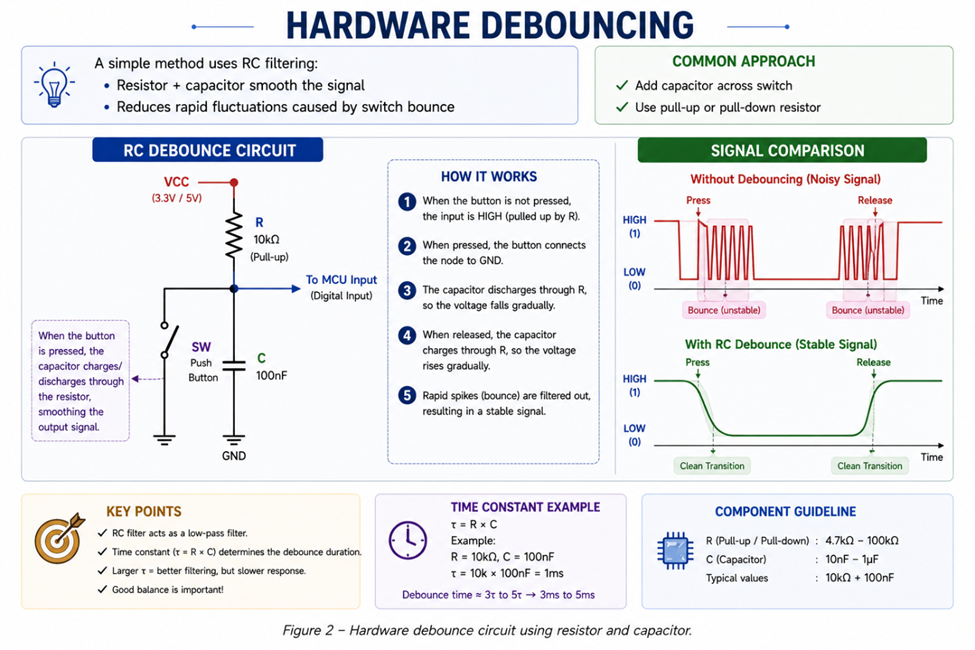
Hardware Debouncing
A simple method uses RC filtering:
- Resistor + capacitor smooth the signal
- Reduces rapid fluctuations
Common approach:
- Add capacitor across switch
- Use pull-up or pull-down resistor
Software Debouncing
More flexible and commonly used.
Basic idea:
- Detect input change
- Wait for short delay (e.g., 10–50 ms)
- Confirm stable state
Example (Arduino):
if (buttonState != lastState) {
  delay(20);
  if (buttonState == HIGH) {
  // valid press
  }
}
Advanced Debouncing
For better performance:
- Use timer-based debounce (non-blocking)
- Use state machine logic
- Combine with interrupt systems
Practical Applications
Debouncing is essential in:
- Push buttons
- Keypads
- Rotary encoders
- User interface systems
Engineering Insight
- Hardware debounce = stable but less flexible
- Software debounce = flexible but needs proper timing
- Best approach → combine both for critical systems
Debouncing is a simple but critical technique in embedded systems. Proper handling of switch input ensures reliable operation and prevents unexpected behavior in digital systems.
#Microcontrollers#
#Debouncing#
#EmbeddedSystem#
#DigitalInput#
#Arduino#
#Electronics#
 #Microcontrollers#
#Debouncing#
#EmbeddedSystem#
#DigitalInput#
#Arduino#
#Electronics#
#Microcontrollers#
#Debouncing#
#EmbeddedSystem#
#DigitalInput#
#Arduino#
#Electronics#
Sign In Or Register Comment after
No comments yet. Be the first to comment!