


Timer in Microcontrollers: Basic Concept and Use Cases
 View
View
Timers are fundamental components in microcontrollers used to measure time, generate delays, and control periodic events. Almost every embedded system relies on timers for tasks such as blinking LEDs, generating PWM signals, or handling time-based interrupts.
What is a Timer?
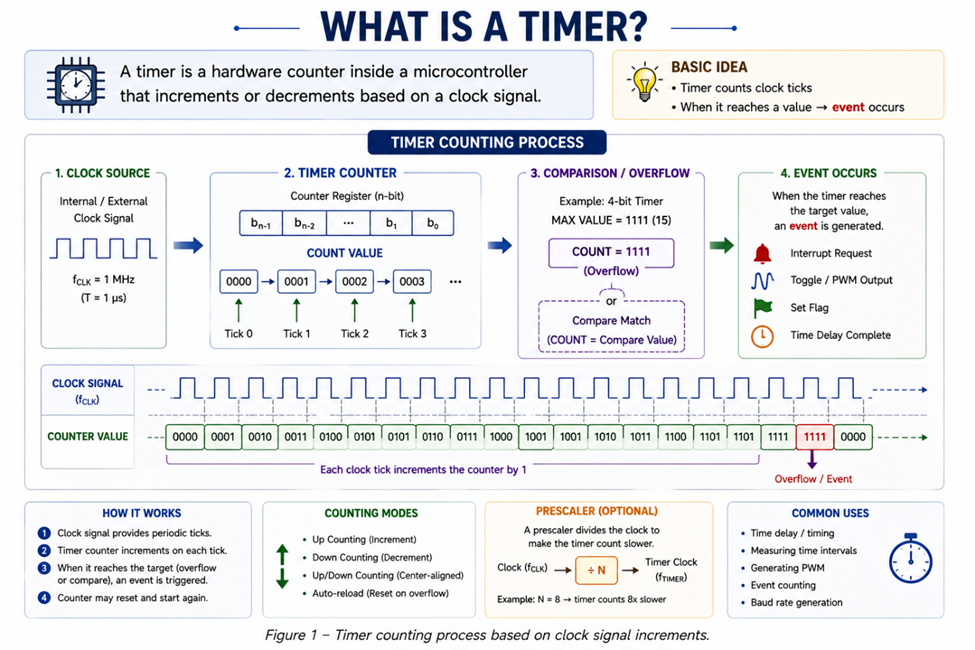
A timer is a hardware counter inside a microcontroller that increments or decrements based on a clock signal.
Basic idea:
- Timer counts clock ticks
When it reaches a value → event occurs
Types of Timers
1. Basic Timer
- Used for simple delay
- Counts up to a specific value
2. Timer with Interrupt
- Generates interrupt when overflow occurs
- Used for periodic tasks
3. PWM Timer
- Generates PWM signal
- Used for motor and LED control
Timer Operation
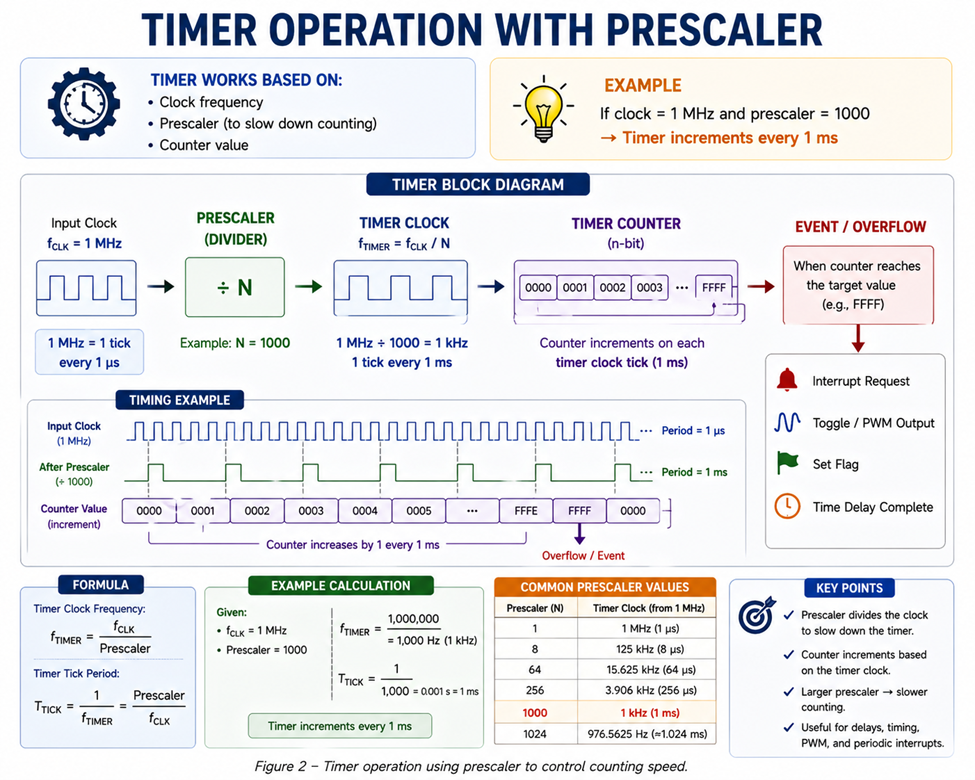
Timer works based on:
- Clock frequency
- Prescaler (to slow down counting)
- Counter value
Example:
If clock = 1 MHz and prescaler = 1000
→ Timer increments every 1 ms
Using Timer for Delay
Instead of using blocking delay functions, timers can generate precise delays.
Advantages:
- Non-blocking
- More accurate
- Efficient CPU usage
Timer Interrupt Example
Timers can trigger interrupts periodically.
Practical Applications
Timers are used in:
- LED blinking
- PWM generation
- Motor control
- Communication timing
- Real-time systems
Engineering Insight
- Avoid excessive use of delay()
- Use timer interrupt for real-time tasks
- Combine timer with interrupt for efficient systems
Timers are essential for controlling time-based operations in microcontrollers. Understanding how timers work enables engineers to build efficient, responsive, and real-time embedded systems.
#Microcontrollers#
#Timer#
#EmbeddedSystem#
#RealTimeSystem#
#Arduino#
#Electronics#
 #Microcontrollers#
#Timer#
#EmbeddedSystem#
#RealTimeSystem#
#Arduino#
#Electronics#
#Microcontrollers#
#Timer#
#EmbeddedSystem#
#RealTimeSystem#
#Arduino#
#Electronics#
Sign In Or Register Comment after
No comments yet. Be the first to comment!