


IoT Security: Real Threats and Why You Cannot Ignore This
 View
View
IoT Security: Real Threats, Real Defenses, and Why You Cannot Ignore This
October 21, 2016. A botnet called Mirai took down DNS provider Dyn. Twitter, Netflix, Reddit, The Guardian all became unreachable for millions of users. The campaign involved approximately 600,000 compromised IoT devices: IP cameras, DVRs, home routers. How were they compromised?
Default credentials. Username: admin. Password: admin. Or password. Or 12345. That's it. 600,000 devices, billions of dollars in economic impact, because manufacturers shipped products with default passwords, they never forced users to change.
The IoT Security Problem Is Structural
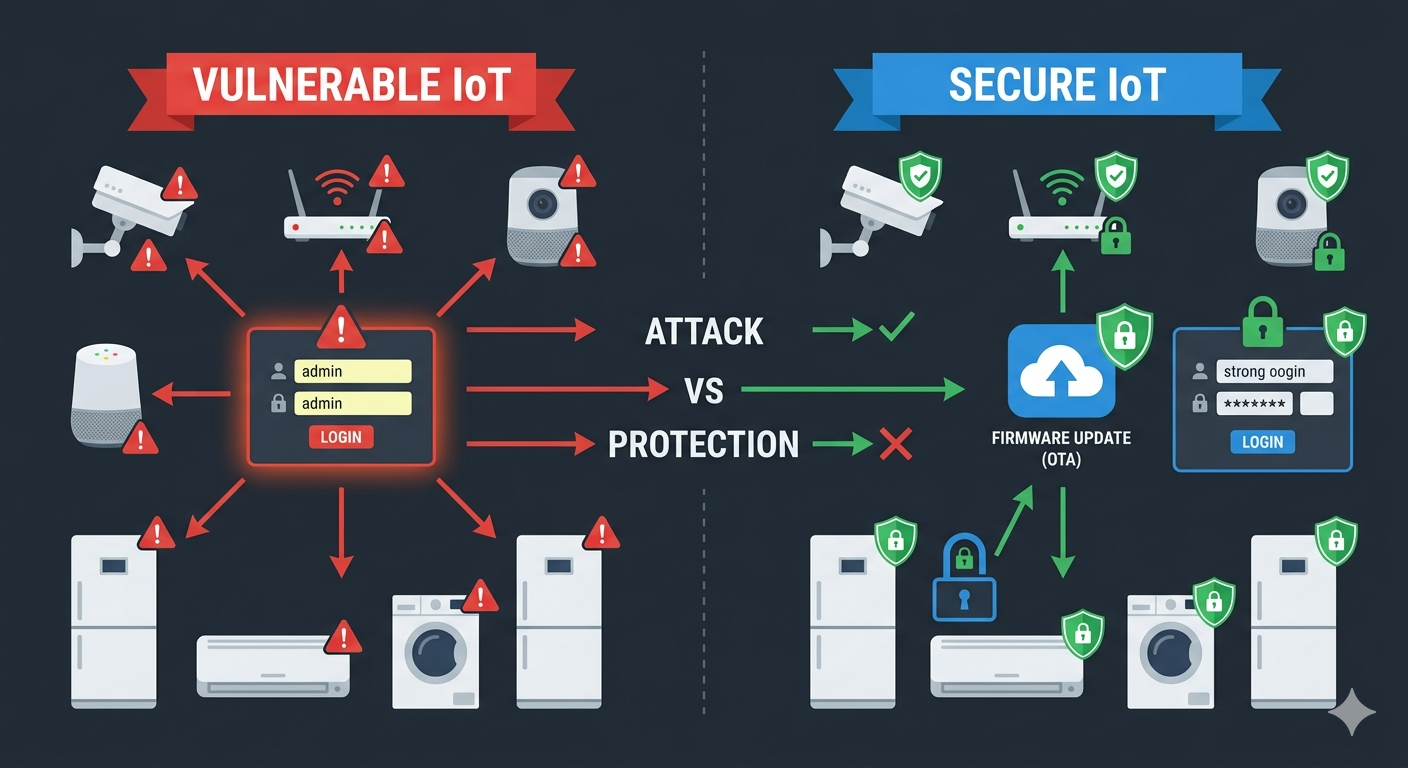
Most security vulnerabilities in traditional software, SQL injection, cross-site scripting (XSS), buffer overflows, result from developer mistakes that can often be fixed with a patch delivered over the network. IoT security vulnerabilities are frequently structural: they result from fundamental design decisions made before a single line of firmware was written and fixing them requires physically replacing hardware already deployed in the field.
Consider these scenarios:
• A network-connected device with no OTA update capability cannot be patched against newly discovered vulnerabilities.
• A device with hardcoded credentials in firmware cannot have those credentials rotated or revoked.
• A device with an unencrypted external flash chip cannot protect stored secrets retroactively, the data is already exposed.
These are not bugs; they are architectural failures. The engineering implication is clear: security must be a design constraint from day zero. It is not a feature to be added at the end of development. It is not a checklist item to be reviewed the week before launch. It is a fundamental requirement that we must shape every hardware component selection and every firmware architectural decision.
How Real Threat Actors Target IoT Devices?
Network Scanning and Default Credentials
Shodan is a search engine for internet-connected devices. It continuously scans the entire IPv4 address space and catalogs every device with open ports and identifiable banners. There are Shodan search queries that reliably return 100,000+ IP cameras, industrial control systems (ICS), and smart home hubs with exposed Telnet (port 23) or HTTP (port 80) administrative interfaces. A disturbing percentage of these are still running with factory default credentials.
This is not sophisticated hacking; it is automation. A simple Python script can iterate through a list of common default credential pairs (admin/admin, root/root, admin/password, support/support) against thousands of open Telnet or SSH ports per hour. The success rate remains depressingly high because many manufacturers prioritize "it works out of the box" over "it is secure by default.
Sign In Or Register Comment after
No comments yet. Be the first to comment!