


What is Pull-up and Pull-down Resistor and Why It Matters?
 View
View
In digital electronics, input pins must always have a defined logic state. Without proper configuration, inputs can become “floating,” resulting in unpredictable readings. This is where pull-up and pull-down resistors are used.
Pull-up Resistor
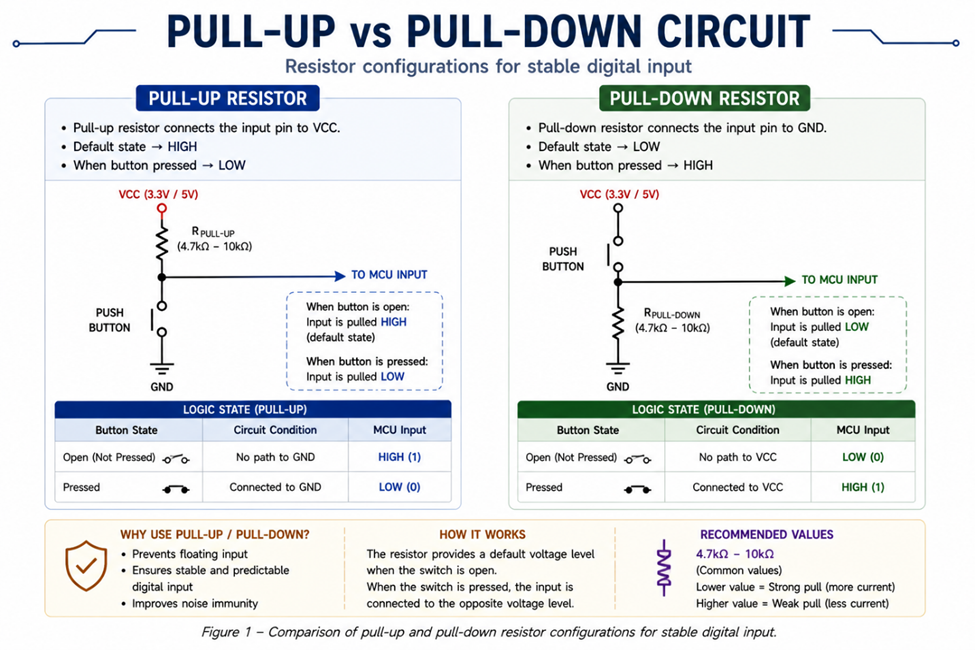
A pull-up resistor connects the input pin to VCC.
- Default state → HIGH
- When button pressed → LOW
Pull-down Resistor
A pull-down resistor connects the input pin to GND.
- Default state → LOW
- When button pressed → HIGH
Why It Matters
Without these resistors:
- Input becomes unstable
- Noise can trigger false signals
- System behaves unpredictably
This is especially critical in:
- Buttons
- Switches
- Digital sensors
Practical Insight
Most microcontrollers (Arduino, ESP32) provide internal pull-up resistors, which can simplify wiring.
However, external resistors are still preferred for:
- Better noise immunity
- Industrial applications
Pull-up and pull-down resistors are essential components for reliable digital input handling. They ensure stable logic levels and prevent unpredictable behavior in embedded systems.
#Microcontrollers#
#DigitalInput#
#Electronics#
#EmbeddedSystem#
 #Microcontrollers#
#DigitalInput#
#Electronics#
#EmbeddedSystem#
#Microcontrollers#
#DigitalInput#
#Electronics#
#EmbeddedSystem#
Sign In Or Register Comment after
No comments yet. Be the first to comment!