


The Anatomy of IoT: Definition and the Three Critical Layers
 View
View
What Is IoT? A Clear Definition and the Three Critical Layers
The term "Internet of Things" has been attached to everything from smart light bulbs to autonomous factories to agricultural sensors tracking soil conditions across large areas. It is one of the most overloaded terms in technology. Let’s clarify what IoT means from an engineering standpoint, and how to think about building systems that actually work.
Understanding IoT Beyond the Hype
IoT is the practice of connecting physical-world objects, sensors, actuators, machines, vehicles, buildings, and devices to digital infrastructure so that data can flow between the physical and digital worlds. These systems typically include four core capabilities:
- Sensing (measuring physical quantities)
- Computing (processing data locally and making decisions)
- Communicating (exchanging data via wired or wireless links)
- Actuating (performing actions in the physical world)
That is the engineering definition. A temperature sensor in a greenhouse sending data to a database is IoT. A factory machine reporting its cycle information to a management system is industrial IoT. A wearable device sending health readings to a user dashboard is also IoT.
The core idea is a closed loop:
Physical World → Digital Data → Processing → Physical World Response.
The term "Internet" in IoT is not always literal. Many systems rely on local networks, private servers, or mesh communication protocols such as Zigbee or Thread that do not require public internet access.
The Three Layers (and Why Getting Them Right Matters)
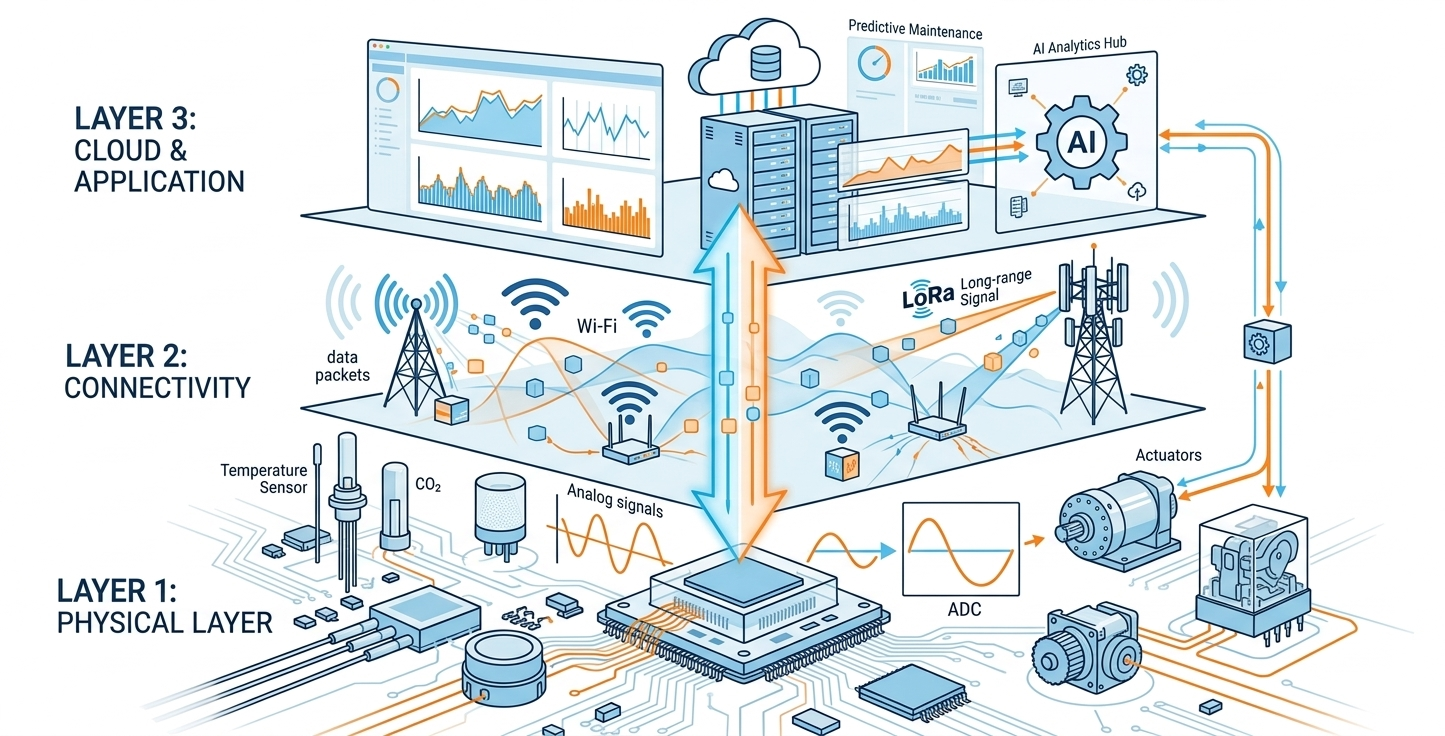
Layer 1: The Physical Layer, Where Data Is Created
This is the starting point of every IoT system. Sensors capture real-world signals, microcontrollers convert them into digital data, and actuators perform physical actions. The overall system quality depends heavily on this layer.
Key engineering factors include measurement accuracy, environmental variation, calibration, and hardware limitations such as power and cost.
Layer 2: Connectivity – The Hardest Engineering Layer
Moving data between devices is not simple. Wireless systems must handle interference, distance limits, and power constraints, while wired systems trade flexibility for stability and installation cost.
Choosing the right communication method is one of the most important decisions in IoT design. It directly affects performance, energy usage, and system architecture.
There is no single best solution, only trade-offs depending on the application.
Layer 3: The Cloud and Application Layer, Where Value Is Created
Raw data alone has no value. The real value comes from organizing, analyzing, and using that data to make decisions.
This layer is responsible for dashboards, insights, and system logic that turns collected data into useful outcomes.
Final Thought
A strong IoT system is not about optimizing one layer, but balancing all three. Weakness in any layer affects the whole system.
Sign In Or Register Comment after
No comments yet. Be the first to comment!