


1.5V Alkaline Battery SOC Measurement Technique
 View
View
1.5V Alkaline Battery SOC Measurement Technique:
For more info: https://www.hackster.io/sainisagar7294/1-5v-alkaline-battery-soc-measurement-technique-972b51
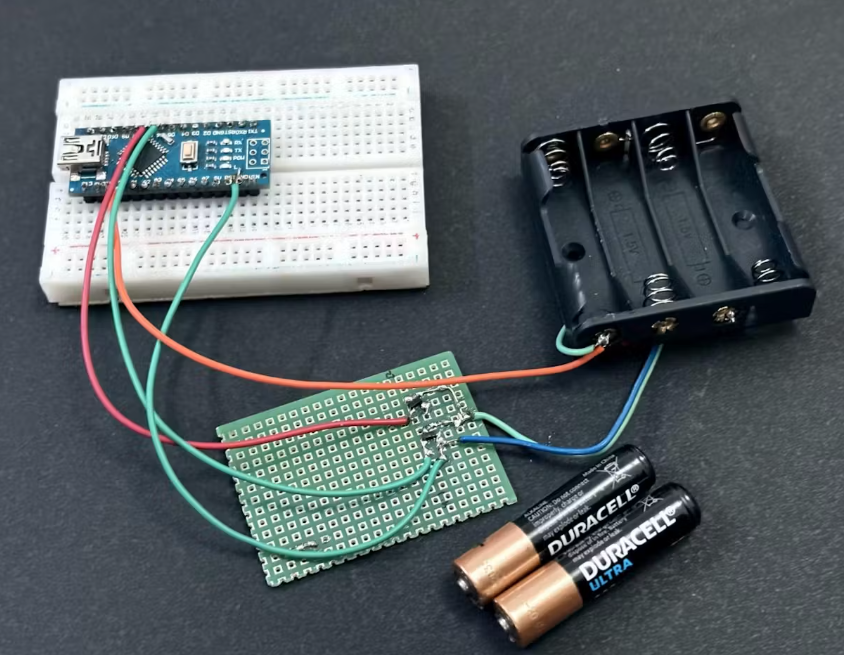
1.5V alkaline battery SoC measurement setup:
There are a lot of fuel gauges and battery chargers available for 3.7V lithium batteries, but when it comes to lower 1.5–1.2V batteries, there are very limited circuits and dedicated ICs. I want to estimate the battery life, but how is it possible with these non-rechargeable batteries? Unlike Li-ion batteries, alkaline batteries have a pretty flat voltage curve that depends on the load. The best possible and simplest one is estimation through voltage, but in combination with a load.
The two-step SoC approach:
● Voltage-based SoC (for long-term reference)
● ΔI (current difference) under two loads (for accuracy)
This approach is very low-cost and easy to implement, and suitable for all kinds of 1.5V alkaline batteries. But the cell-to-cell chemistry is not in our hands, so there may be an accuracy of 90–92% only. With only voltage measurement, we can reach an accuracy of ±70–80%, so we need more information than voltage alone. Instead of directly computing internal resistance, we observe how current collapses under different loads. I use two known load resistors, 22 Ω and 9.7 Ω; the values are not random at full swing they produce ΔI greater than 80 mA for better resolution. Fresh battery has high current difference; in weak battery currents converge then ΔI collapses.
Circuit diagram just 4 components
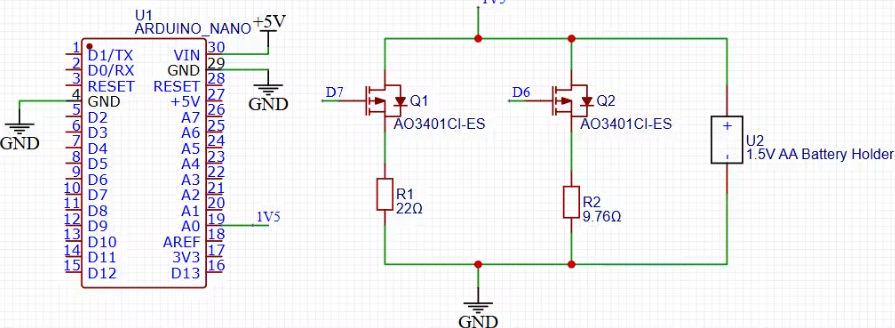
Components: a P-channel MOSFET, Arduino Nano, 2× 1.5V battery (one discharged to 50%), 9.7 Ω and 22 Ω resistors, and a power source. Just with 4 components you can build this circuit, and all the computations are done with the MCU. First the open-circuit voltage is measured by the Arduino's 10-bit ADC, then the 22 Ω load is turned on briefly, then the 9.7 Ω load; after that the computation is done on ΔI, and SoC is estimated.
Results
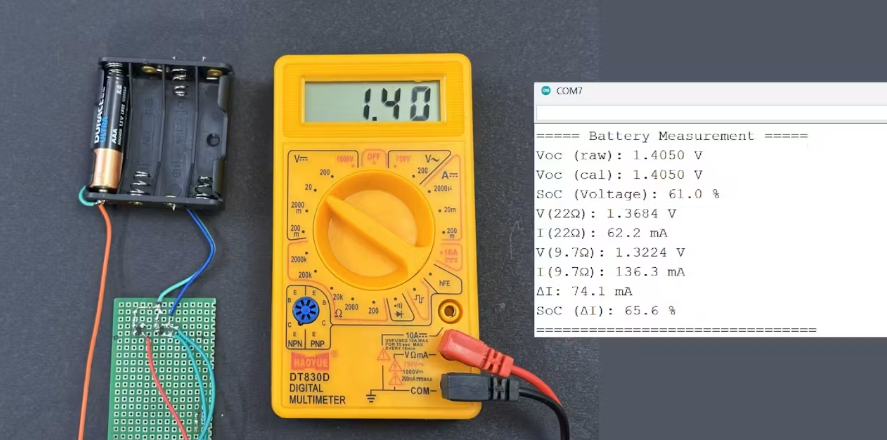
Test 1: discharged battery
Test 2: fully charged one
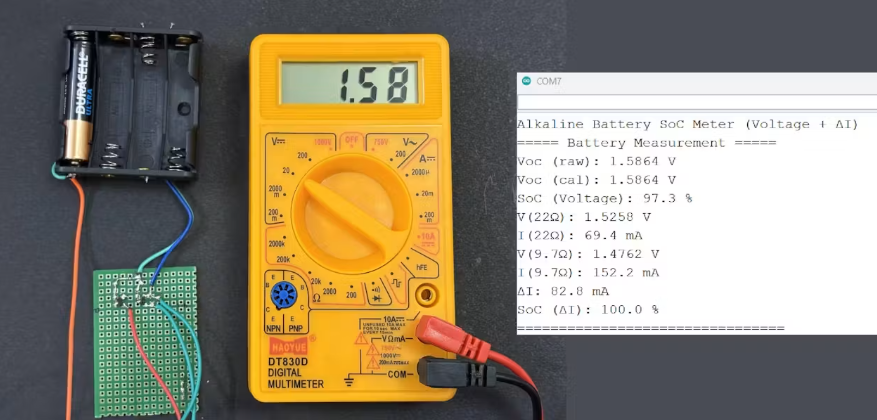
This project shows that you don’t need a fuel-gauge IC to estimate alkaline battery SoC accurately. By combining intelligent load switching, current measurement, and a little empirical modeling, we can build a low-cost alkaline battery SOC measurement tool. Still, if you need a proper SoC with 95–99% accuracy, then go for a fuel-gauge IC solution.
#alkaline battery SOC#
 #alkalinebatterySOC#
Sign In Or Register Comment after
No comments yet. Be the first to comment!