


When Pull-up and Pull-down Resistors Actually Matter
 View
View
Pull-up and pull-down resistors are among the smallest and least expensive components in digital electronics, yet they solve one of the most common causes of unstable digital inputs. Because these resistors don’t actively amplify signals or drive loads, beginners often underestimate their importance or even omit them entirely.
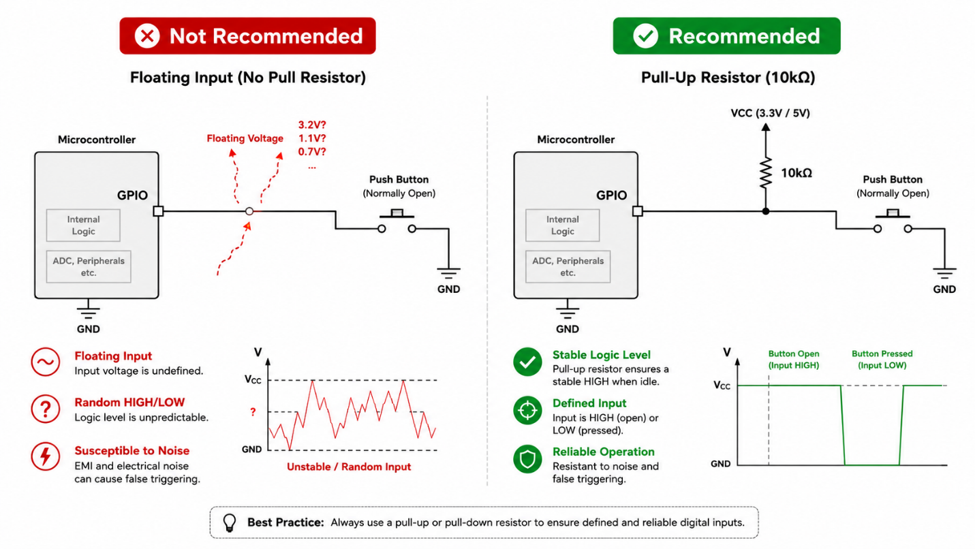
The problem appears when a digital input is left unconnected. Instead of reading a stable HIGH or LOW, the input becomes floating, allowing electrical noise from the surrounding environment to influence its voltage. As a result, a microcontroller may detect random button presses, unstable sensor outputs, or unexpected interrupts that are difficult to troubleshoot.
Fortunately, preventing floating inputs requires only a single resistor placed in the right location.
How Pull-up and Pull-down Resistors Work
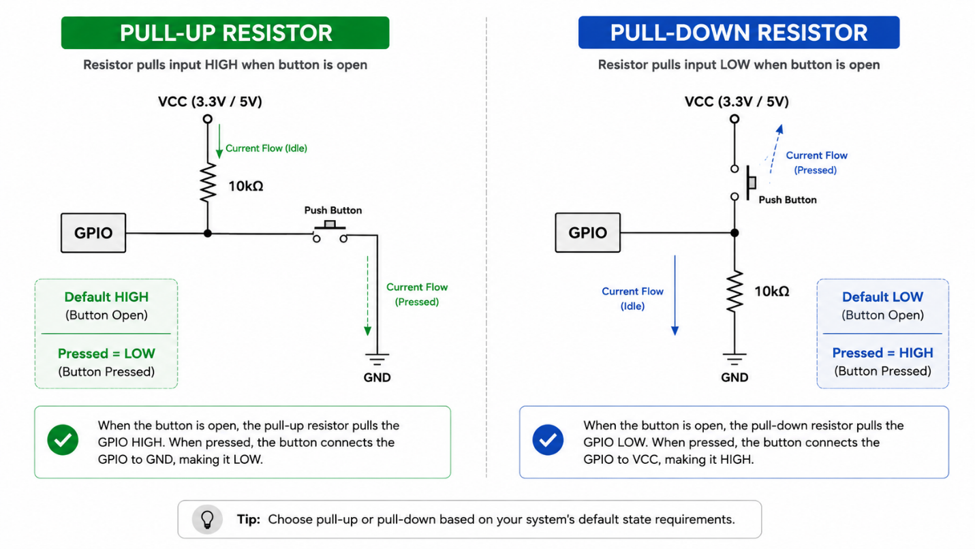
A pull-up resistor gently connects a digital input to the supply voltage, causing the input to read HIGH whenever no external device is driving the line. When a switch closes, the input is pulled LOW.
A pull-down resistor performs the opposite function. It connects the input to ground so the default state remains LOW until an external signal drives it HIGH.
Neither resistor is intended to force current through the circuit continuously. Instead, they provide a weak default reference voltage while allowing another device to override the logic level whenever necessary.
Where You’ll Commonly Find Them
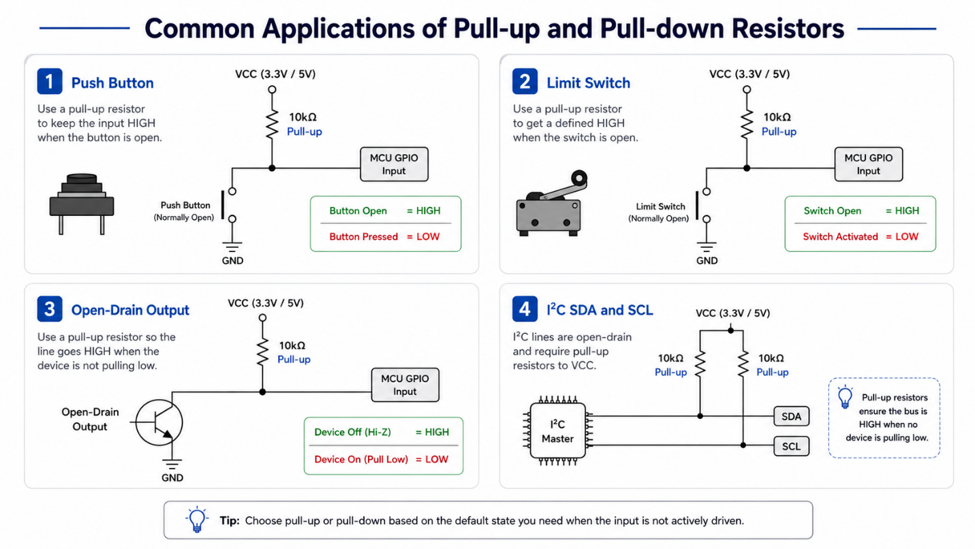
Pull resistors appear in many digital circuits, even if they’re not immediately obvious. Push buttons, limit switches, open-drain outputs, and interrupt inputs all rely on a defined default state to operate reliably.
One well-known example is the I²C communication bus. Because I²C devices use open-drain outputs, neither SDA nor SCL can drive the signal HIGH by themselves. External pull-up resistors are therefore required for normal communication.
Many modern microcontrollers also include configurable internal pull-up resistors. While these are convenient for many applications, external resistors may still be preferred when stronger pull strength or better noise immunity is required.
One Thing I Always Check
Whenever I review a schematic, I make it a habit to look at every digital input that connects to a switch, jumper, or external signal.
If the input doesn’t have a clearly defined default state, I immediately check whether a pull-up or pull-down resistor has been included. This quick review only takes a few minutes, but it often prevents intermittent problems that are much harder to diagnose after the hardware has been assembled.
Conclusion
Pull-up and pull-down resistors may be simple components, but they play an essential role in digital circuit reliability. By ensuring that every input has a defined logic level, they help eliminate floating inputs, reduce unpredictable behavior, and make embedded systems far more stable during everyday operation.
 #Electronics#
#Microcontroller#
#EmbeddedSystems#
#DigitalElectronics#
#PullUpResistor#
#PullDownResistor#
#ElectronicTips#
#Electronics#
#Microcontroller#
#EmbeddedSystems#
#DigitalElectronics#
#PullUpResistor#
#PullDownResistor#
#ElectronicTips#
Sign In Or Register Comment after
No comments yet. Be the first to comment!