


One Simple Circuit That Lets a Microcontroller Measure High Voltages
 View
View
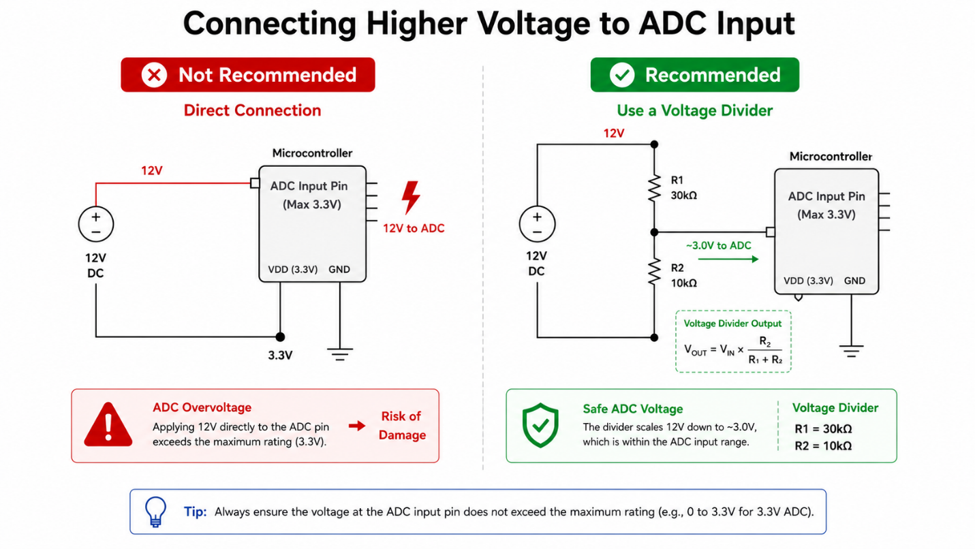
Microcontrollers are excellent at measuring analog voltages through their built-in Analog-to-Digital Converter (ADC). However, there's one important limitation: the ADC input can only tolerate voltages within the operating range of the microcontroller, typically 3.3V or 5V.
Connecting a higher voltage directly to an ADC pin can produce incorrect readings and, in many cases, permanently damage the microcontroller. Fortunately, solving this problem requires only two resistors arranged as a voltage divider.
Although the circuit is extremely simple, understanding how and when to use it correctly is essential for anyone working with embedded systems or measurement applications.
How a Voltage Divider Works
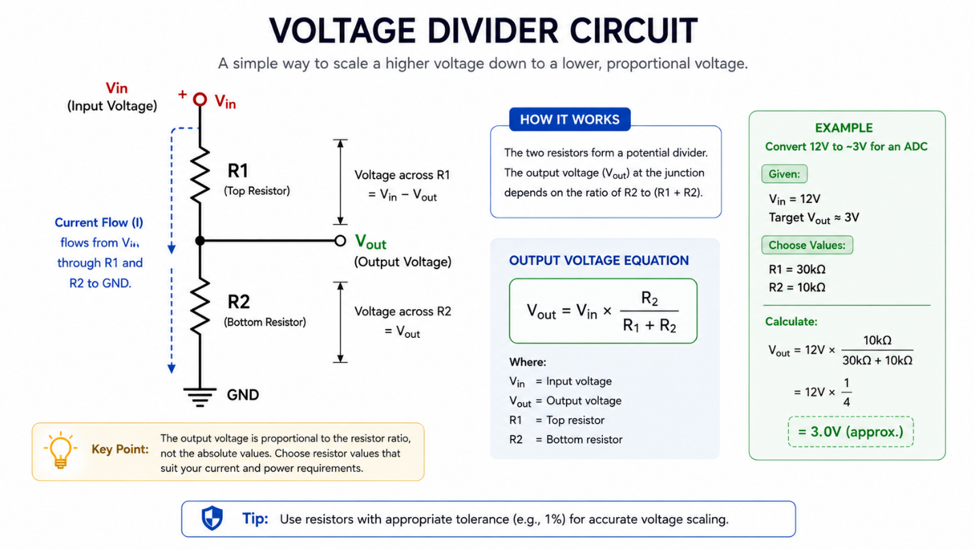
A voltage divider consists of two resistors connected in series. The output voltage is taken from the connection between the two resistors, producing only a fraction of the input voltage.
By selecting the proper resistor values, a higher voltage can be scaled into the safe operating range of the ADC without requiring additional active components.
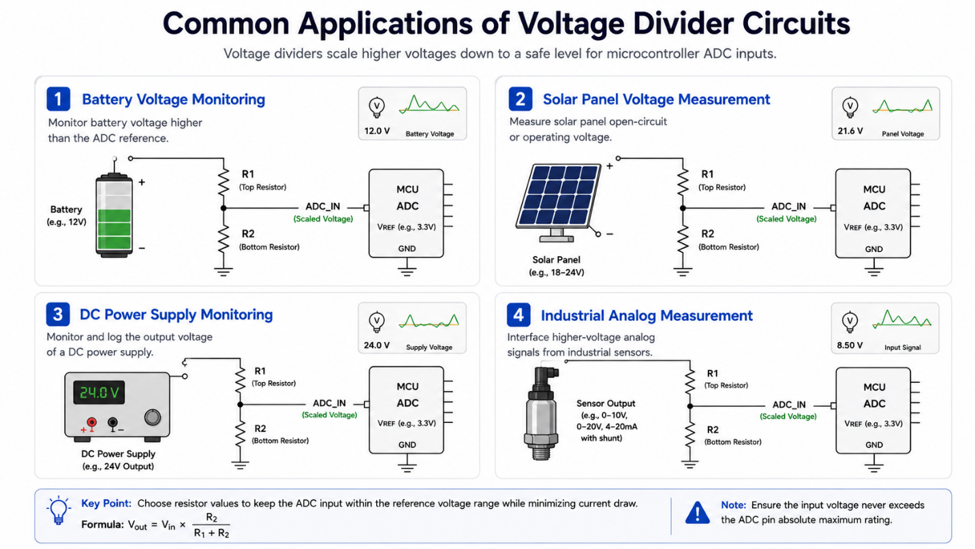
This principle is widely used in battery monitoring, power supply measurement, solar energy systems, and many industrial sensing applications.
Common Applications
Voltage dividers appear in far more projects than many people realize.
They are commonly used to monitor battery voltage in portable devices, measure power supply levels in IoT systems, detect automotive battery voltage, and provide analog feedback in industrial control systems.
When combined with an ADC, a simple pair of resistors allows a microcontroller to monitor voltages that would otherwise be far beyond its measurement range.
One Thing I Always Check
Whenever I design a voltage measurement circuit, I verify two things before connecting it to the ADC.
First, I calculate the maximum output voltage to ensure it never exceeds the ADC input limit. Second, I select resistor values that provide accurate measurements without unnecessarily increasing current consumption.
These quick checks help protect the microcontroller while producing reliable analog readings.
Conclusion
A voltage divider is one of the simplest circuits in electronics, yet it enables a microcontroller to measure voltages far beyond its own operating range. Understanding this basic technique is an essential skill for anyone designing embedded systems, battery-powered devices, or electronic measurement circuits.
#ElectronicTips# #Microcontroller# #ADC# #VoltageDivider# #EmbeddedSystems# #Electronics#
 #ElectronicTips#
#Microcontroller#
#ADC#
#VoltageDivider#
#EmbeddedSystems#
#Electronics#
#ElectronicTips#
#Microcontroller#
#ADC#
#VoltageDivider#
#EmbeddedSystems#
#Electronics#
Sign In Or Register Comment after
No comments yet. Be the first to comment!