


An Optocoupler Does More Than Just Isolate a Circuit
 View
View
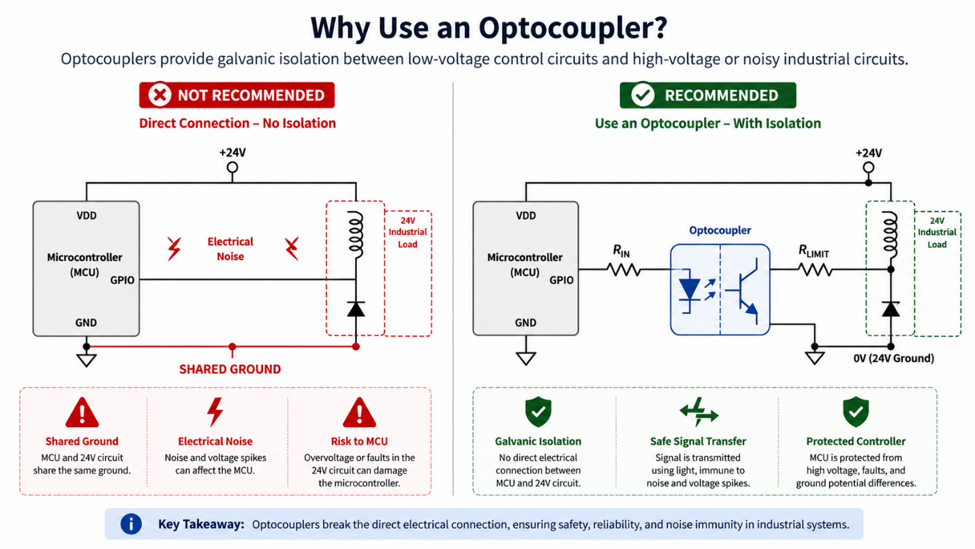
One of the biggest challenges in electronic design is connecting low-voltage control circuits to high-voltage or electrically noisy systems without compromising safety or reliability. Direct electrical connections can expose microcontrollers to voltage spikes, ground potential differences, and electrical noise that may cause communication errors or even permanent damage.
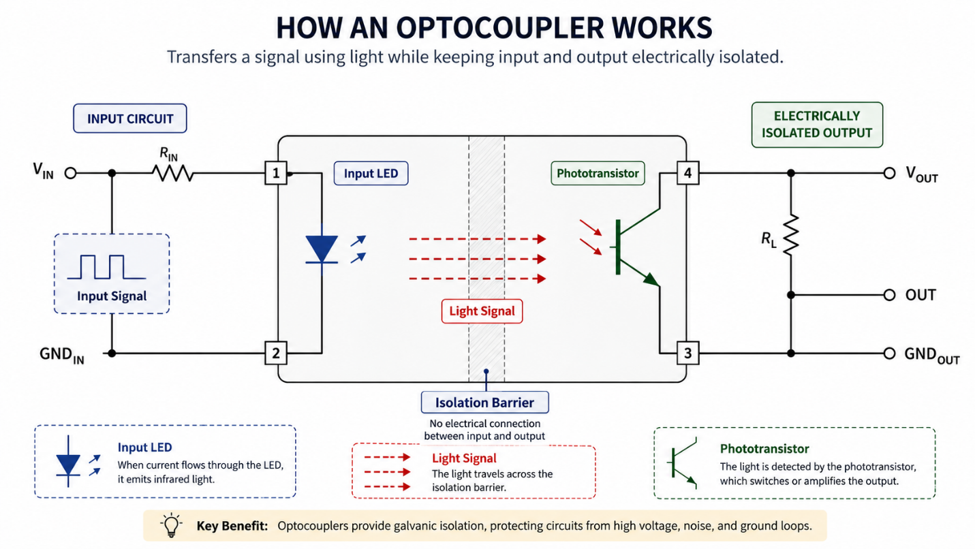
An optocoupler, also known as an opto-isolator, solves this problem by transferring signals using light instead of a direct electrical connection. Inside the package, an LED converts the electrical signal into light, while a phototransistor (or another photosensitive device) receives that light and recreates the signal on the isolated side.
Although the signal passes through the device, there is no direct electrical path between the input and output circuits, making optocouplers an essential component in industrial automation, power electronics, and embedded systems.
Why Electrical Isolation Matters
Electrical isolation protects sensitive electronics from hazardous voltages and unwanted electrical interference. It also helps eliminate problems caused by different ground potentials between two systems.
For example, a 3.3V microcontroller can safely control a 24V PLC input or monitor an industrial sensor through an optocoupler without sharing the same electrical ground.
Isolation becomes especially important in applications involving AC mains, motor drives, industrial automation, battery management systems, and high-power switching circuits.
Common Applications
Optocouplers are found in many products that require safe signal isolation.
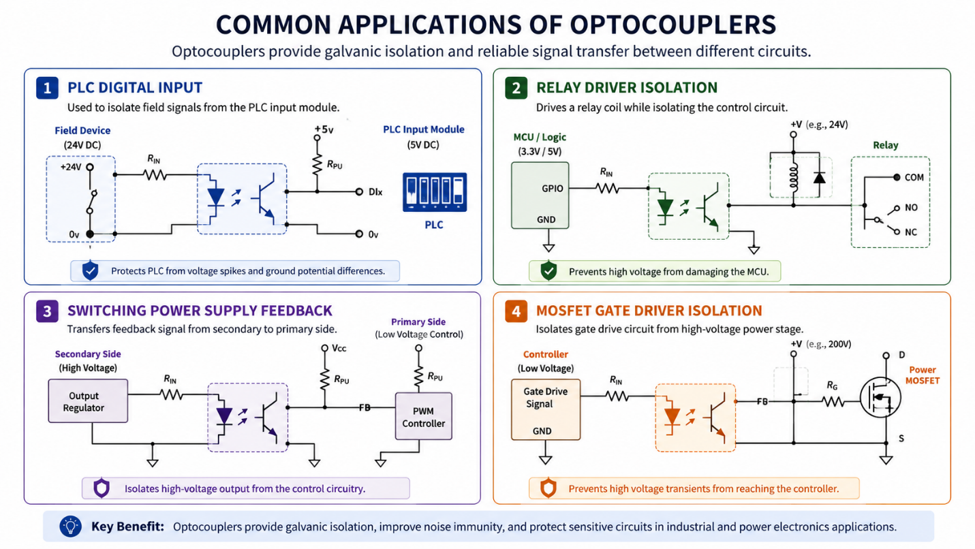
Typical applications include PLC input and output modules, relay driver circuits, MOSFET and IGBT gate drivers, switching power supplies, industrial communication interfaces, and zero-cross detection circuits.
Although modern digital isolators are becoming increasingly popular for high-speed communication, optocouplers remain one of the most economical and widely available isolation solutions for general-purpose embedded systems.
Recommended Devices
The following optocouplers are commonly used in embedded and industrial electronics.
| Device | Output Type | Typical Applications |
|---|---|---|
| PC817 | Phototransistor | General-purpose signal isolation |
| EL817 | Phototransistor | Embedded systems and industrial control |
| TLP281 | Phototransistor | PLC interfaces and digital inputs |
| 6N137 | High-speed Logic Output | High-speed digital communication and SPI isolation |
When selecting an optocoupler, consider the isolation voltage, current transfer ratio (CTR),** switching speed**, and output type to ensure it matches your application's requirements.
An optocoupler does much more than separate two circuits. It protects sensitive electronics, improves system reliability, and enables safe communication between low-voltage controllers and high-voltage equipment. Choosing the right optocoupler for the application can significantly improve both safety and long-term performance.
#ElectronicTips# #ElectronicComponents# #Optocoupler# #Isolation# #EmbeddedSystems# #IndustrialElectronics#
 #ElectronicTips#
#ElectronicComponents#
#Optocoupler#
#Isolation#
#EmbeddedSystems#
#IndustrialElectronics#
#ElectronicTips#
#ElectronicComponents#
#Optocoupler#
#Isolation#
#EmbeddedSystems#
#IndustrialElectronics#
Sign In Or Register Comment after
No comments yet. Be the first to comment!