


Reed Switch vs Hall Effect Sensor: Which One Fits Your Project?
 View
View
When designing a system that detects the presence or movement of a magnet, two components are commonly considered: the reed switch and the Hall effect sensor. At first glance, they appear to perform the same task both can detect a magnetic field. However, their operating principles, performance, and typical applications are quite different.
Choosing the wrong sensor may lead to reduced reliability, slower response, or unnecessary circuit complexity. Understanding the strengths and limitations of each device makes it much easier to select the right solution for your project.
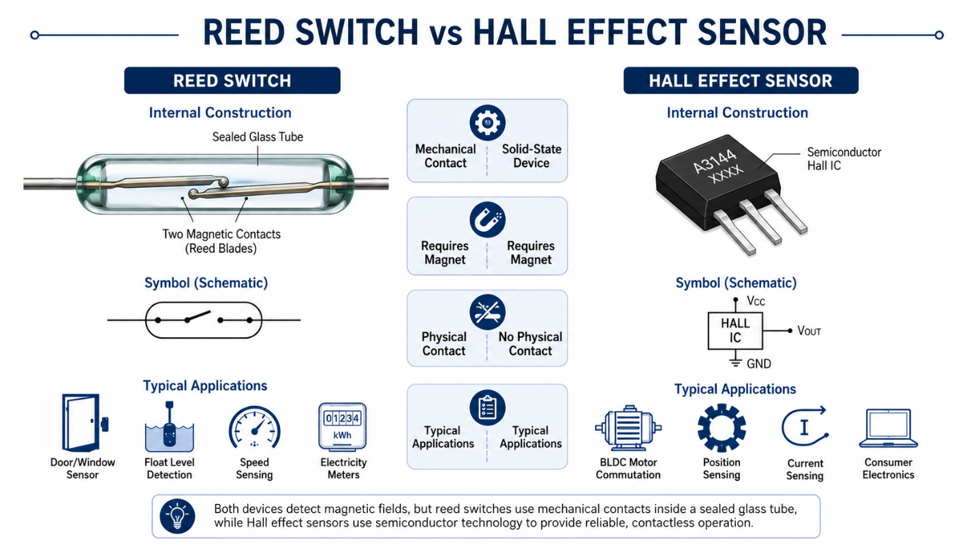
How They Work
A reed switch contains two thin metal contacts sealed inside a glass tube. When a magnetic field approaches, the contacts attract each other and close the circuit. Once the magnet moves away, the contacts separate again.
A Hall effect sensor works differently. Instead of moving contacts, it uses a semiconductor element that detects changes in magnetic flux and converts them into an electrical signal. Since there are no moving parts, Hall sensors generally offer faster operation and longer service life.
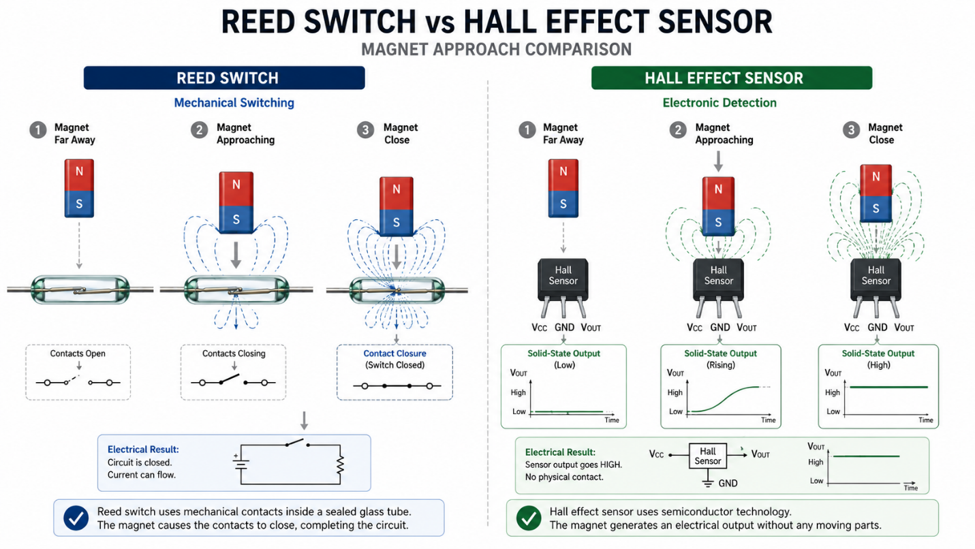
Which One Should You Choose?
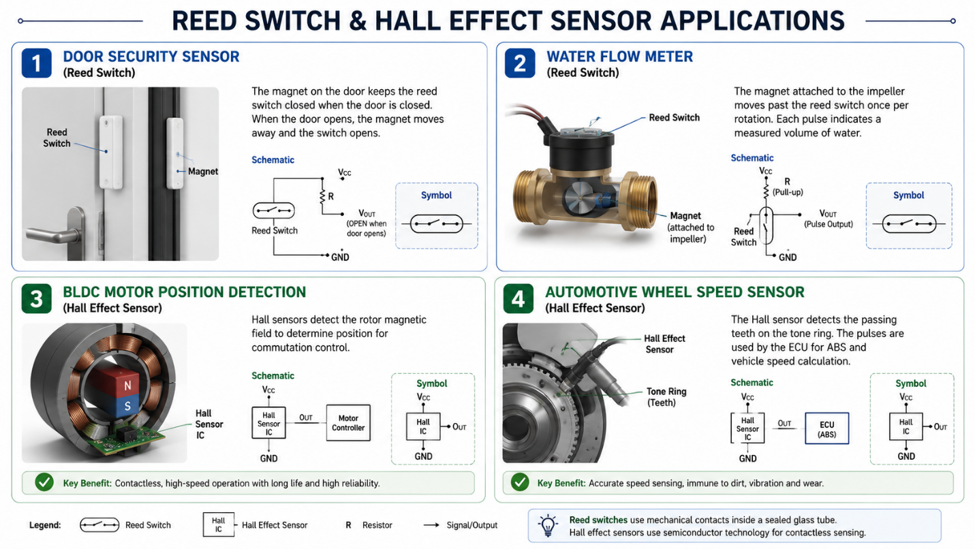
A reed switch is often the better choice when simplicity, low cost, and zero standby power consumption are the highest priorities. It is commonly used in door sensors, window alarms, and simple position detection systems.
A Hall effect sensor is better suited for applications requiring high switching frequency, long operating life, or continuous position sensing. It is widely used in brushless DC motors, automotive wheel speed sensors, joystick modules, and industrial automation.
Rather than asking which sensor is better, the more useful question is which one better matches the requirements of your application.
Quick Comparison
| Feature | Reed Switch | Hall Effect Sensor |
|---|---|---|
| Operating Principle | Mechanical Contact | Solid-State |
| Power Consumption | None | Requires Supply Voltage |
| Switching Speed | Moderate | Very Fast |
| Mechanical Wear | Yes | No |
| Output | Contact | Digital or Analog |
Recommended Devices
Some commonly used devices include:
| Device | Type | Typical Applications |
|---|---|---|
| MKA-14103 | Reed Switch | Door sensors, magnetic switches |
| ORD2210V | Reed Switch | General magnetic sensing |
| A3144 | Digital Hall Sensor | Speed sensing, BLDC motors |
| SS49E | Linear Hall Sensor | Position and magnetic field measurement |
Always consider the required sensing distance, switching speed, environmental conditions, and expected operating lifetime before selecting a magnetic sensor.
Although reed switches and Hall effect sensors can both detect magnetic fields, they are designed for different situations. Reed switches offer a simple and power-free solution, while Hall effect sensors provide faster, more reliable operation for modern electronic systems. Selecting the right sensor depends on the performance your application requires—not simply on whether it can detect a magnet.
#SensorsAndActuators# #ReedSwitch# #HallEffectSensor# #EmbeddedSystems# #Electronics# #MagneticSensor#
 #SensorsAndActuators#
#ReedSwitch#
#HallEffectSensor#
#EmbeddedSystems#
#Electronics#
#MagneticSensor#
#SensorsAndActuators#
#ReedSwitch#
#HallEffectSensor#
#EmbeddedSystems#
#Electronics#
#MagneticSensor#
Sign In Or Register Comment after
No comments yet. Be the first to comment!