


A Good RF Circuit Can Still Perform Poorly with a Bad Antenna Layout
 View
View
When developing wireless products, engineers often focus on selecting the right communication module whether it's Wi-Fi, Bluetooth, LoRa, Zigbee, or GNSS. However, the performance of the entire system depends on more than just the RF chipset.
A poorly placed antenna can significantly reduce communication range, decrease signal strength, and make wireless connections unreliable, even if the software and hardware are working correctly. In many cases, the problem isn't the module itself but the surrounding PCB layout and mechanical design.
Understanding a few basic antenna placement principles can greatly improve wireless performance without changing the RF module.
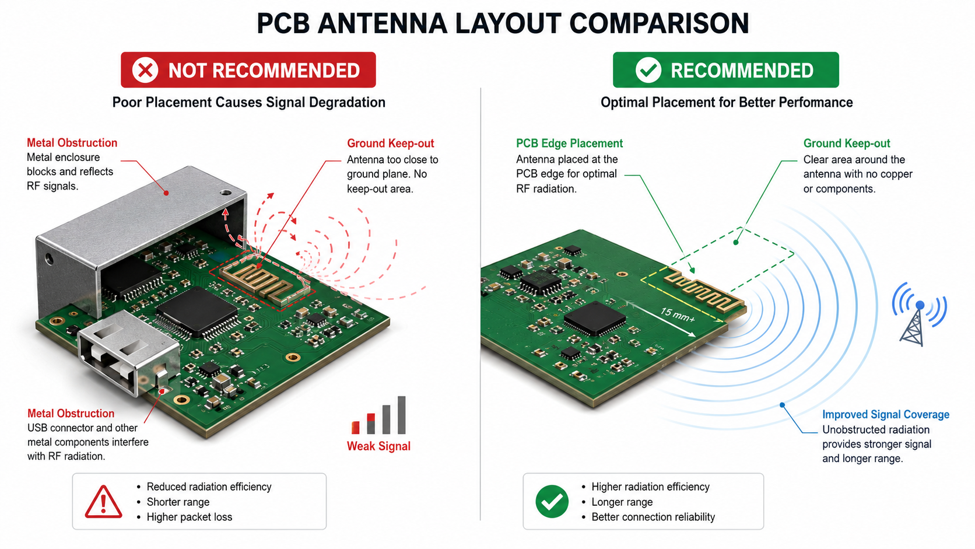
Why Placement Matters
Unlike ordinary digital traces, an antenna intentionally radiates electromagnetic energy. Nearby metal objects, batteries, displays, and large ground planes can alter their radiation pattern and reduce efficiency.
Many RF module manufacturers recommend placing the antenna at the edge of the PCB while keeping the surrounding area free from copper pours and tall components. Following these recommendations helps the antenna operate closer to its intended performance.
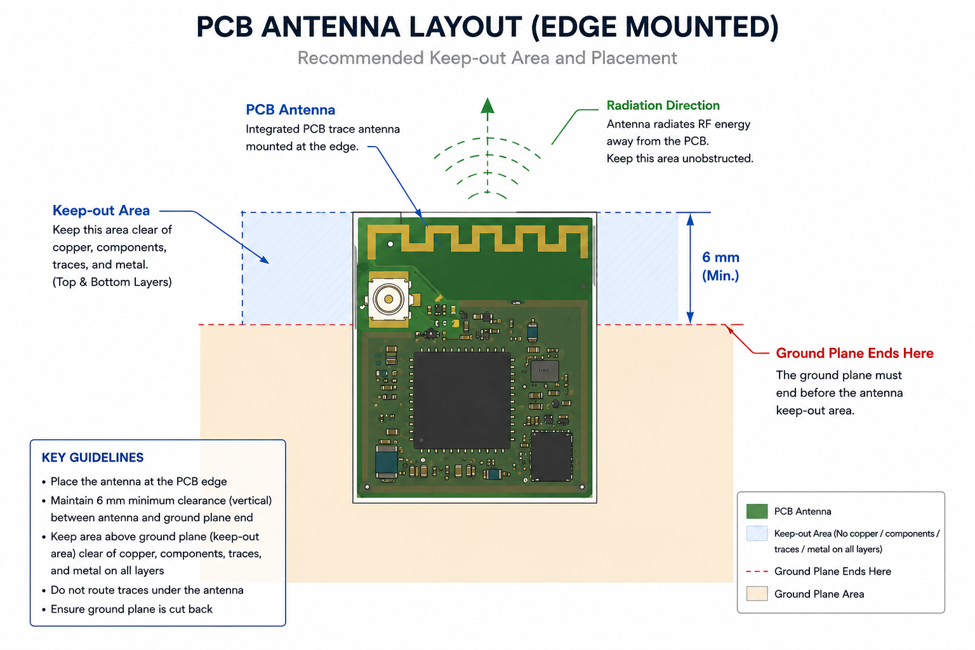
Common Applications
Good antenna layout practices apply to many wireless systems, including ESP32 development boards, Bluetooth Low Energy devices, LoRa sensor nodes, Zigbee controllers, GPS receivers, and cellular IoT modules.
Although different frequencies require different antenna designs, the general principle remains the same: provide the antenna with enough free space to radiate efficiently.
Recommended RF Modules
Several popular wireless modules already include integrated PCB antennas.
| Module | Wireless Standard | Typical Applications |
|---|---|---|
| ESP32-WROOM-32 | Wi-Fi + Bluetooth | IoT devices |
| ESP32-C3 | Wi-Fi + BLE | Low-power embedded systems |
| SX1278 | LoRa | Long-range telemetry |
| u-blox NEO-6M | GPS | Position tracking |
Always follow the layout recommendations provided in each module's hardware design guide rather than copying another PCB design.
Wireless performance depends on much more than the RF module itself. Proper antenna placement, adequate keep-out spacing, and avoiding nearby obstructions are simple design practices that can noticeably improve communication range and signal reliability.
#RFAndWireless# #PCBDesign# #ESP32# #LoRa# #Bluetooth# #AntennaDesign#
 #RFAndWireless#
#PCBDesign#
#ESP32#
#LoRa#
#Bluetooth#
#AntennaDesign#
#RFAndWireless#
#PCBDesign#
#ESP32#
#LoRa#
#Bluetooth#
#AntennaDesign#
Sign In Or Register Comment after
No comments yet. Be the first to comment!