


One Small Mistake Can Instantly Damage Your Circuit: Reverse Polarity Protection Explained
 View
View
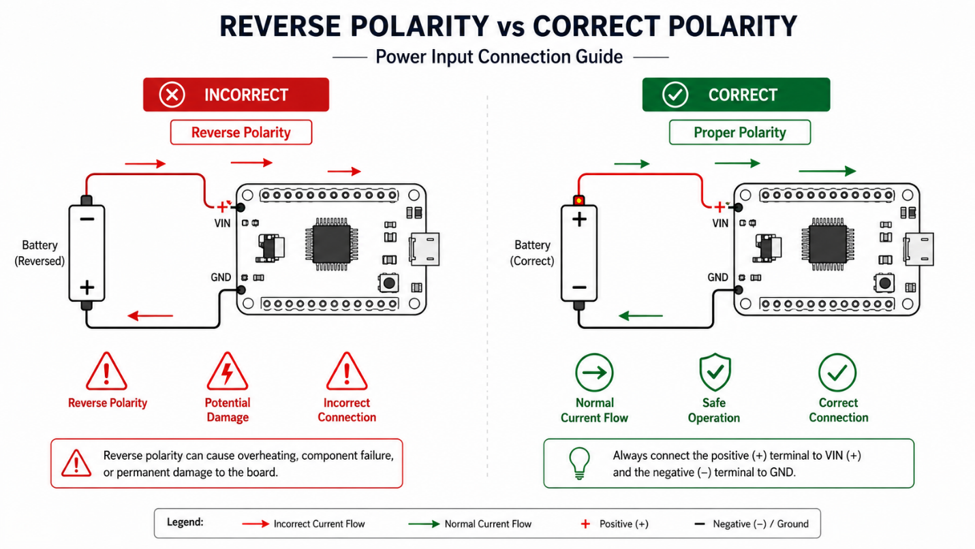
Few wiring mistakes are as frustrating as accidentally reversing the power supply. Whether you're testing a prototype on the workbench, connecting a battery in the field, or installing industrial equipment, swapping the positive and negative terminals can instantly destroy voltage regulators, microcontrollers, sensors, and other sensitive components.
The good news is that preventing this type of failure is usually simple. By adding a small protection circuit, designers can significantly improve the robustness of their products and reduce the risk of costly hardware damage.
Reverse polarity protection is commonly found in commercial electronics, but it's often forgotten in DIY projects and early-stage prototypes.
Common Protection Methods
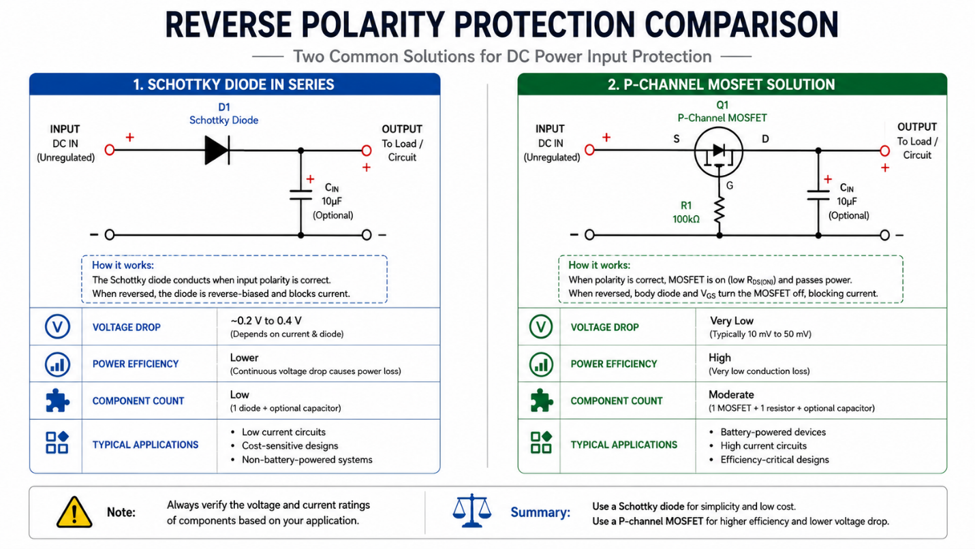
Several techniques can protect a circuit from accidental reverse polarity.
The simplest solution is a series diode, which blocks current when the supply is connected incorrectly. While inexpensive, this method introduces a forward voltage drop that slightly reduces efficiency.
A more advanced approach uses a P-channel MOSFET, allowing current to flow with very low voltage loss during normal operation while automatically blocking reverse current when the supply is reversed. This technique is widely used in battery-powered products because it combines excellent protection with high efficiency.
Where Reverse Polarity Protection Is Used
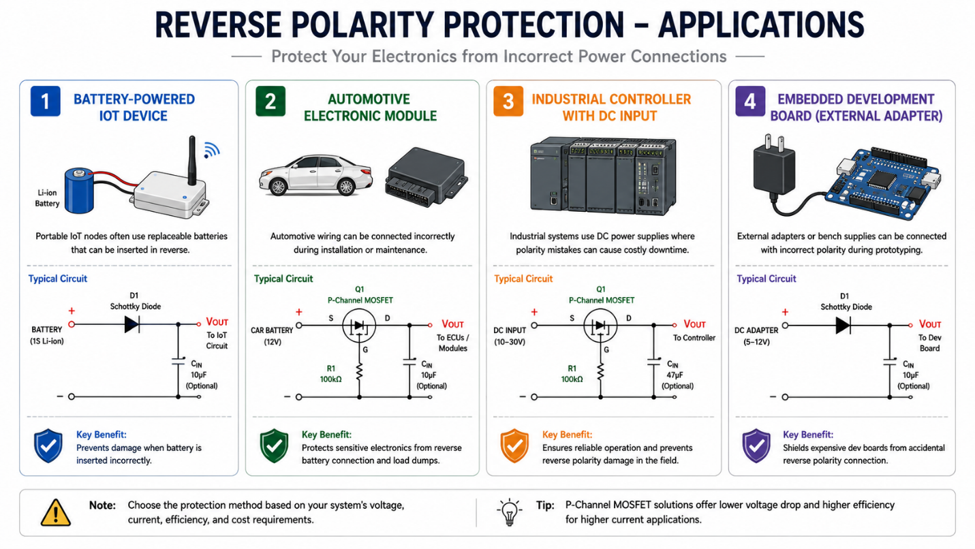
Reverse polarity protection is common in products that use removable power sources or external connectors.
Typical examples include battery-powered IoT devices, automotive electronics, development boards, industrial controllers, portable test equipment, and DC-powered consumer products.
Adding only a few components during the design stage can prevent expensive repairs and improve product reliability in real-world environments.
Recommended Components
Depending on the application's current and efficiency requirements, several devices are commonly used.
| Device | Type | Typical Applications |
|---|---|---|
| 1N5819 | Schottky Diode | Low-current reverse polarity protection |
| SS34 | Schottky Diode | DC input protection up to several amperes |
| AO3407A | P-Channel MOSFET | Compact embedded products |
| IRF4905 | P-Channel MOSFET | High-current automotive and industrial systems |
When selecting a protection device, consider the maximum input voltage, expected load current, voltage drop, thermal performance, and available PCB space.
Reverse polarity is one of the simplest wiring mistakes, yet it can cause some of the most expensive failures. Adding appropriate protection during the design stage requires only a few extra components, but it can dramatically improve the durability and reliability of electronic products in everyday use.
#PowerAndEnergy# #ReversePolarity# #CircuitProtection# #MOSFET# #PowerElectronics# #EmbeddedSystems#
 #PowerAndEnergy#
#ReversePolarity#
#CircuitProtection#
#MOSFET#
#PowerElectronics#
#EmbeddedSystems#
#PowerAndEnergy#
#ReversePolarity#
#CircuitProtection#
#MOSFET#
#PowerElectronics#
#EmbeddedSystems#
Sign In Or Register Comment after
No comments yet. Be the first to comment!