


Ground Loops: A Hidden Source of Noise in Electronic Systems
 View
View
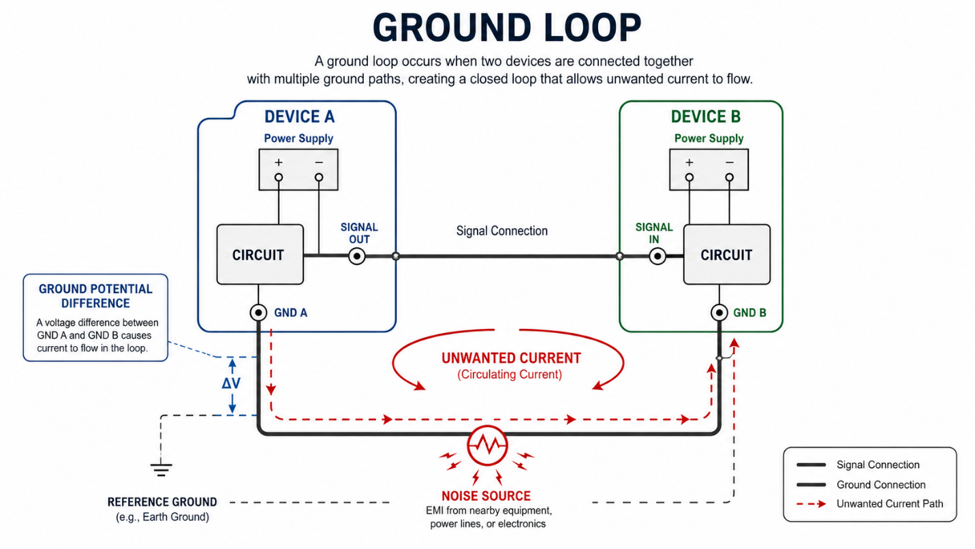
One of the most common yet least understood problems is the ground loop. Although every device may appear to be connected to ground correctly, multiple return paths can create small voltage differences that introduce unwanted current flow. These currents can generate measurement errors, audible hum in audio equipment, communication instability, or increased electromagnetic interference (EMI).
Ground loops are especially common in industrial automation, instrumentation, audio systems, and mixed-signal electronics where multiple power sources or long cable connections are involved.
Why Ground Loops Cause Problems
Ideally, every ground connection should remain at the same electrical potential. PCB traces, cables, and connectors all have a small amount of resistance and inductance. When current flows through these paths, tiny voltage differences develop between different ground points.
Sensitive analog circuits may interpret these voltage differences as part of the signal itself. Likewise, communication interfaces can become less reliable when reference voltages shift unexpectedly.
Although the voltage differences are usually small, they can become significant when measuring millivolt-level sensor signals or transmitting data over long cables.
Reducing Ground Loop Problems
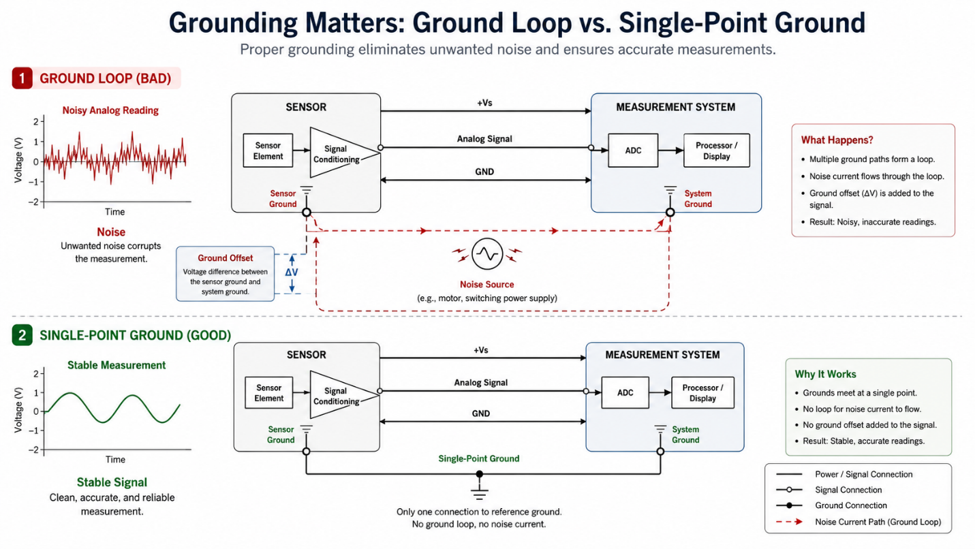
Completely eliminating ground loops is not always possible, especially in large industrial installations. However, several design practices can greatly reduce their impact.
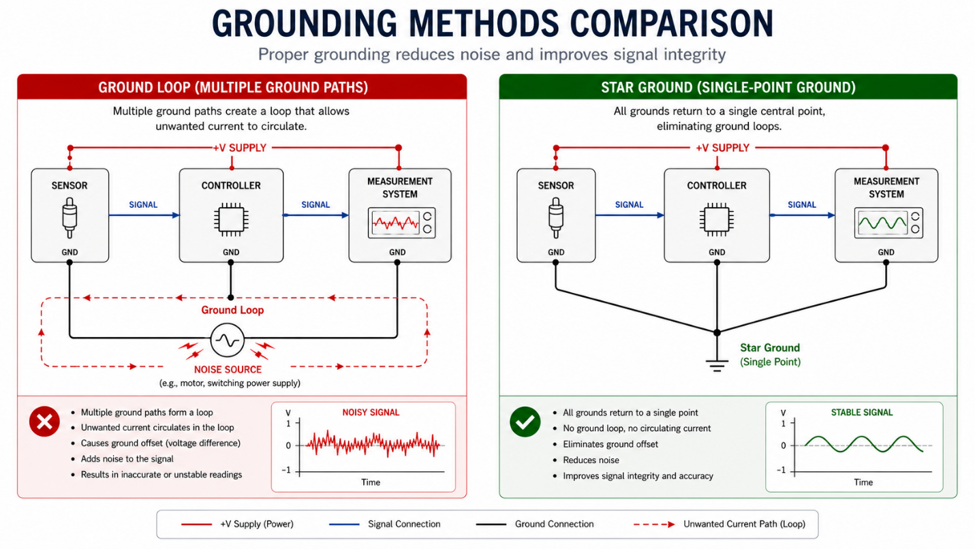
Using a single-point (star) grounding strategy, minimizing unnecessary ground return paths, isolating sensitive analog circuits, and employing differential signal transmission where appropriate are all effective techniques. In some applications, galvanic isolation using optocouplers or isolated communication interfaces can also prevent unwanted ground currents from flowing between systems.
Practical Tips
When troubleshooting unexplained electrical noise, don't immediately replace sensors or redesign the PCB.
Instead, ask a few simple questions:
- Are multiple-ground paths connected between the same devices?
- Do analog and power return currents share the same path?
- Is the equipment connected to different power supplies?
- Would signal isolation or differential measurement improve the system?
In many cases, identifying the ground loop solves the problem without changing the circuit itself.
Ground loops rarely appear in schematics, but they often reveal themselves during testing and installation. Understanding how return currents flow and designing grounding systems carefully can significantly improve measurement accuracy, communication reliability, and overall system performance.
#AnalogAndSignal# #GroundLoop# #SignalIntegrity# #EMI# #IndustrialElectronics# #Electronics#
 #AnalogAndSignal#
#GroundLoop#
#SignalIntegrity#
#EMI#
#IndustrialElectronics#
#Electronics#
#AnalogAndSignal#
#GroundLoop#
#SignalIntegrity#
#EMI#
#IndustrialElectronics#
#Electronics#
Sign In Or Register Comment after
No comments yet. Be the first to comment!