


Why Open-Drain Outputs Need Pull-up Resistors
 View
View
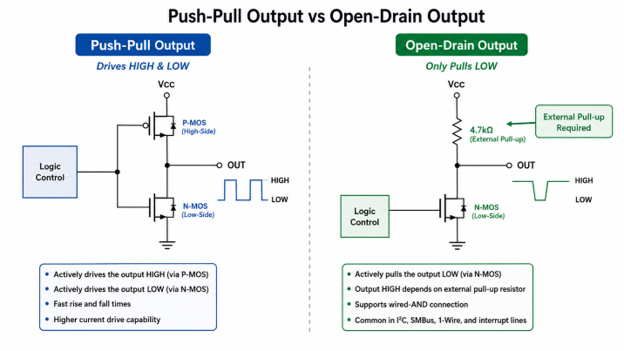
When a digital output changes state, most engineers expect it to actively drive the signal either HIGH or LOW. This is true for push-pull outputs, which are commonly used on microcontrollers. However, not every digital output works this way.
Many integrated circuits, sensors, and communication interfaces use open-drain outputs instead. Unlike push-pull outputs, an open-drain pin can only pull the signal LOW. It cannot drive the line HIGH by itself.
Without a pull-up resistor, the output simply remains floating when the transistor turns off. This often leads to unstable logic levels and communication failures, especially for engineers encountering open-drain circuits for the first time.
Understanding why pull-up resistors are required helps explain how buses such as I²C allow multiple devices to share the same communication lines safely.
Why Open-Drain Exists
Although push-pull outputs are faster, open-drain outputs provide an important advantage: multiple devices can safely share the same signal line.
The line remains in a HIGH state via the pull-up resistor as long as no device actively pulls it down. Once any device forces the line LOW, the whole bus drops to LOW safely, eliminating the risk of conflicting outputs.
This principle is widely used in I²C communication, interrupt lines, reset circuits, and wired-AND logic.
Engineering Note
If two push-pull outputs accidentally drive opposite logic levels at the same time, excessive current can flow between the devices. Open-drain outputs avoid this problem by allowing devices to pull the line LOW only.
Choosing the Right Pull-up Resistor
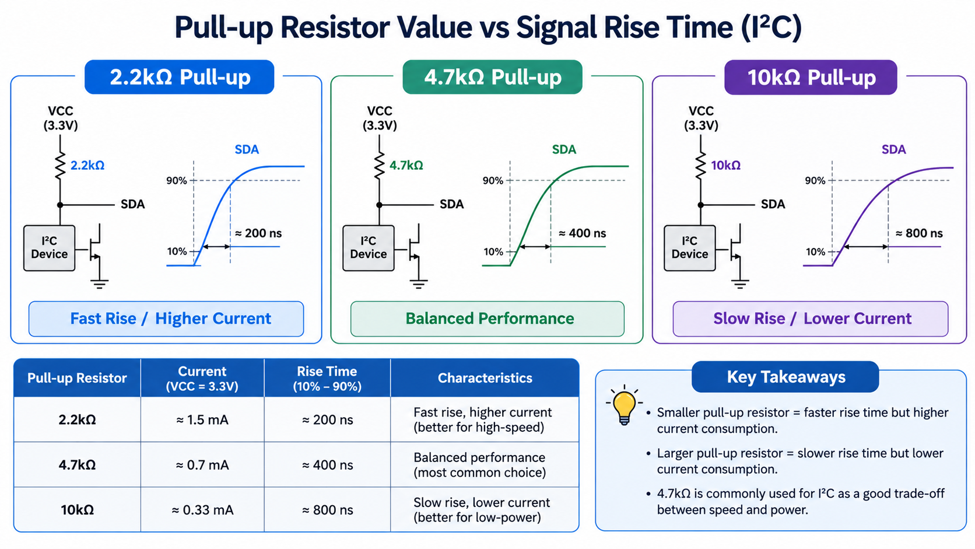
The value of the pull-up resistor affects both power consumption and signal rise time.
A resistor that is too large causes slow rising edges, especially on buses with high capacitance. A resistor that is too small increases current consumption whenever the line is pulled LOW.
For many embedded applications, values between 2.2 kΩ and 10 kΩ are commonly used, with 4.7 kΩ being one of the most popular choices for standard I²C buses.
Recommended Devices
Open-drain outputs are commonly found in many digital ICs and communication devices.
| Device | Output Type | Typical Applications |
|---|---|---|
| PCF8574 | Open-Drain | I²C GPIO Expander |
| MCP23017 | Open-Drain Interrupt Output | GPIO Expansion |
| BME280 | Open-Drain I²C Interface | Environmental Sensor |
| AT24C256 | Open-Drain I²C Interface | EEPROM Memory |
Always consult the device datasheet to determine whether external pull-up resistors are required, as some development boards already include them on the PCB.
Open-drain output may seem unusual at first because they cannot generate a HIGH level on their own. However, this simple architecture enables multiple devices to safely share a communication line, making it ideal for buses such as I²C and other shared digital interfaces. Understanding how pull-up resistors work with open-drain output helps engineers design more reliable embedded systems.
#EmbeddedSystems# #OpenDrain# #I2C# #PullUpResistor# #Microcontroller# #Electronics#
 #EmbeddedSystems#
#OpenDrain#
#I2C#
#PullUpResistor#
#Microcontroller#
#Electronics#
#EmbeddedSystems#
#OpenDrain#
#I2C#
#PullUpResistor#
#Microcontroller#
#Electronics#
Sign In Or Register Comment after
No comments yet. Be the first to comment!