


Incremental vs Absolute Encoder: Choosing the Right Position Sensor
 View
View
When a system needs to know the position or movement of a motor, simply detecting rotation is often not enough. Industrial machines, robotics, CNC systems, and automation equipment require accurate position feedback to control speed, direction, and movement.
Two common solutions are incremental encoders and absolute encoders. Although both measure rotation, they provide information in very different ways.
Choosing between them depends on whether the system only needs relative movement information or requires the exact position immediately after startup.
How Incremental Encoders Work
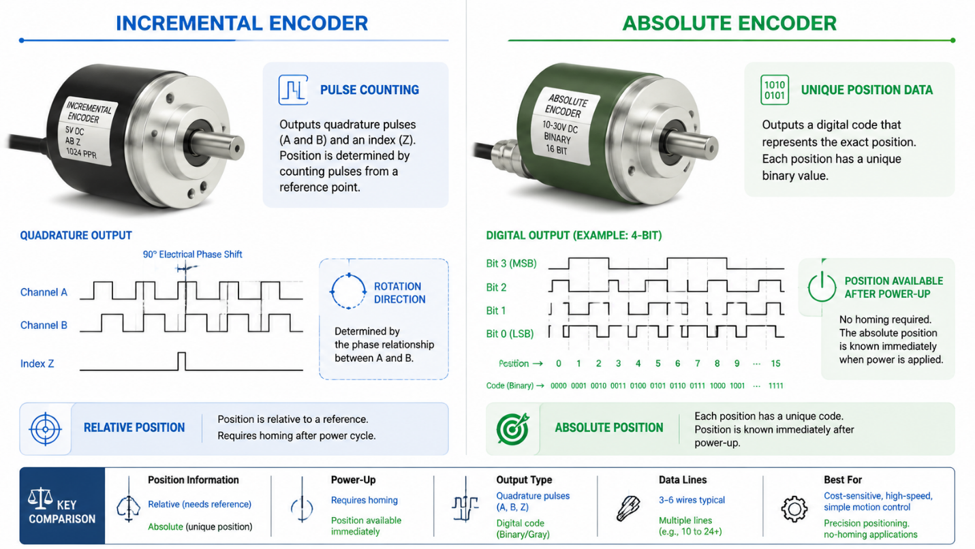
An incremental encoder generates pulses as the shaft rotates. The controller counts these pulses to determine movement distance and uses the phase difference between two channels (A and B) to determine rotation direction.
The main advantage is simplicity and cost. Because the output only represents changes in position, incremental encoders are widely used in motor speed control, conveyor systems, and motion applications where the reference position can be established during startup.
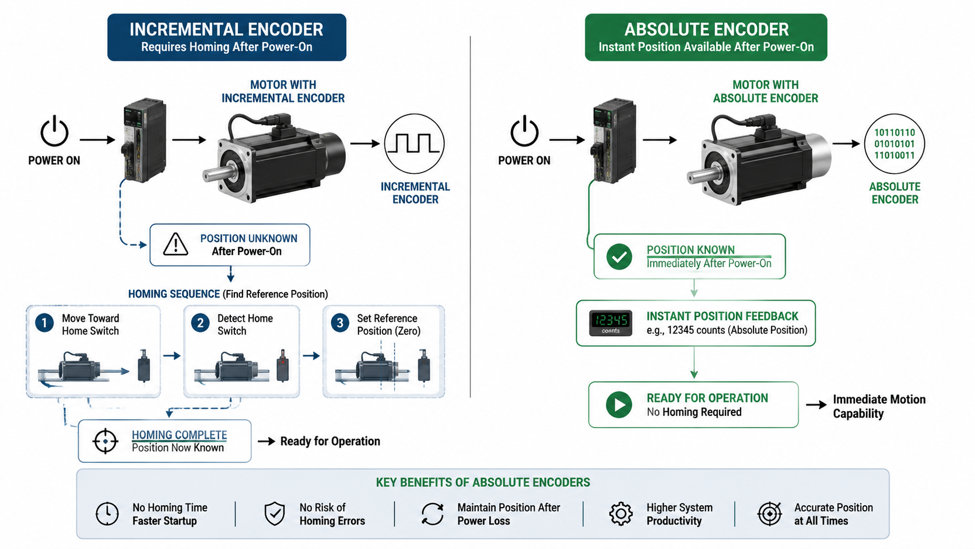
However, if power is removed, the controller loses the stored position unless the system performs a homing procedure.
How Absolute Encoders Work
An absolute encoder provides a unique digital value for each shaft position. Even after power loss, the system can immediately know the current position without needing to move back to a reference point.
This makes absolute encoders valuable in applications where position accuracy and startup reliability are critical, such as robotic arms, servo systems, and precision machinery.
The trade-off is increased cost and more complex communication requirements.
Quick Comparison
| Feature | Incremental Encoder | Absolute Encoder |
|---|---|---|
| Output | Pulse Signal | Position Code |
| Startup Position | Requires Reference | Available Immediately |
| Cost | Lower | Higher |
| Complexity | Simple | More Advanced |
| Common Use | Speed & Motion Control | Precision Positioning |
Recommended Devices
| Device | Type | Typical Application |
|---|---|---|
| Omron E6B2-CWZ6C | Incremental Encoder | Motor speed and position |
| Autonics E40S Series | Incremental Encoder | Industrial automation |
| AS5048A | Absolute Magnetic Encoder | Precision rotary position |
| AMS AS5600 | Absolute Magnetic Encoder | Embedded position sensing |
Engineering Tip
If your system can safely perform home after startup, an incremental encoder is often the more economical choice. If losing position after power failure is unacceptable, an absolute encoder is usually worth the additional cost.
Incremental and absolute encoders are not competitors; they solve different engineering problems. Incremental encoders provide a simple and cost-effective way to measure movement, while absolute encoders provide immediate position awareness and higher reliability. Selecting the correct type depends on the application's accuracy requirements, startup behavior, and system complexity.
#SensorsAndActuators# #Encoder# #MotionControl# #Automation# #EmbeddedSystems# #Electronics#
 #SensorsAndActuators#
#Encoder#
#MotionControl#
#Automation#
#EmbeddedSystems#
#Electronics#
#SensorsAndActuators#
#Encoder#
#MotionControl#
#Automation#
#EmbeddedSystems#
#Electronics#
Sign In Or Register Comment after
No comments yet. Be the first to comment!