


Why Microcontrollers Reset When the Voltage Drops for a Moment
 View
View
One of the most confusing problems with embedded systems is a device that randomly restarts without any obvious software error. The firmware appears stable, the code works correctly, and the circuit functions normally most of the time. However, the microcontroller suddenly resets during motor startup, wireless transmission, or when another load is activated.
In many cases, the problem is not the firmware it is the power supply stability.
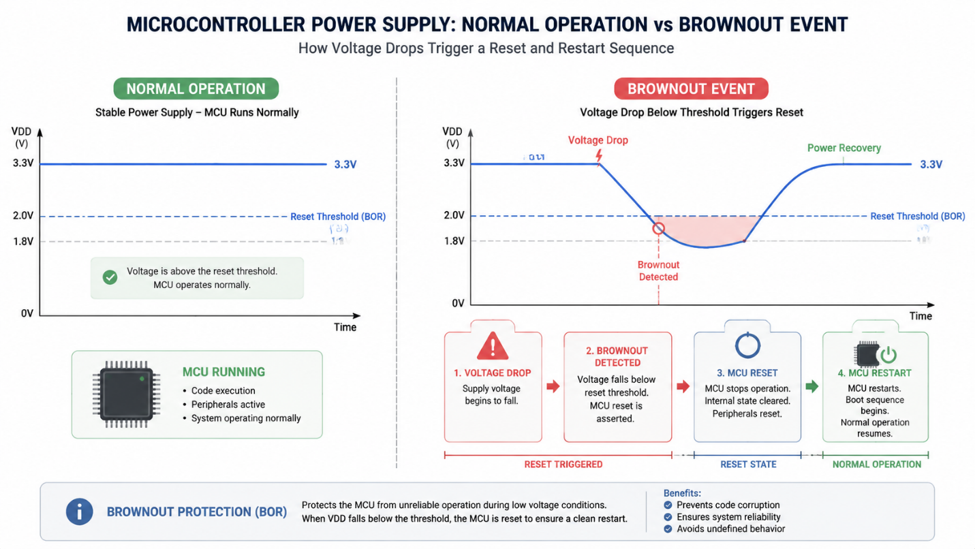
A short voltage drop, known as a brownout, can force a microcontroller to restart automatically. Although the voltage dip may only last a few milliseconds, it can interrupt normal operation and create difficult-to-debug failures.
Understanding why brownouts happen and how to prevent them is an important part of reliable embedded system design.
Why Brownouts Happen
Microcontrollers can experience brownouts when the supply voltage temporarily drops below the minimum operating voltage.
Several situations can cause this:
- Motors or relays are drawing a sudden current surge.
- Wireless modules are transmitted at high power.
- Weak power regulators.
- Long power cables causing voltage drop.
- Insufficient decoupling capacitors.
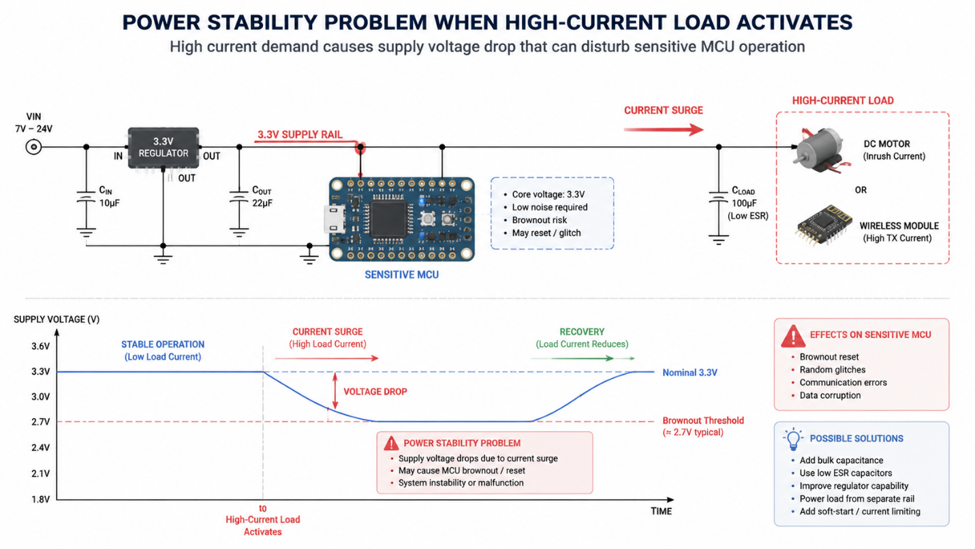
For example, an ESP32 may operate normally during idle mode but reset when Wi-Fi transmission begins because the current demand suddenly increases.
How to Prevent Brownout Resets
Preventing brownouts usually requires improving the power system rather than changing the firmware.
Common solutions include:
1. Improve Power Supply Capacity
The regulator should provide enough current with sufficient voltage margin. Choosing a regulator based on average current may cause problems during peak loads.
2. Add Proper Decoupling
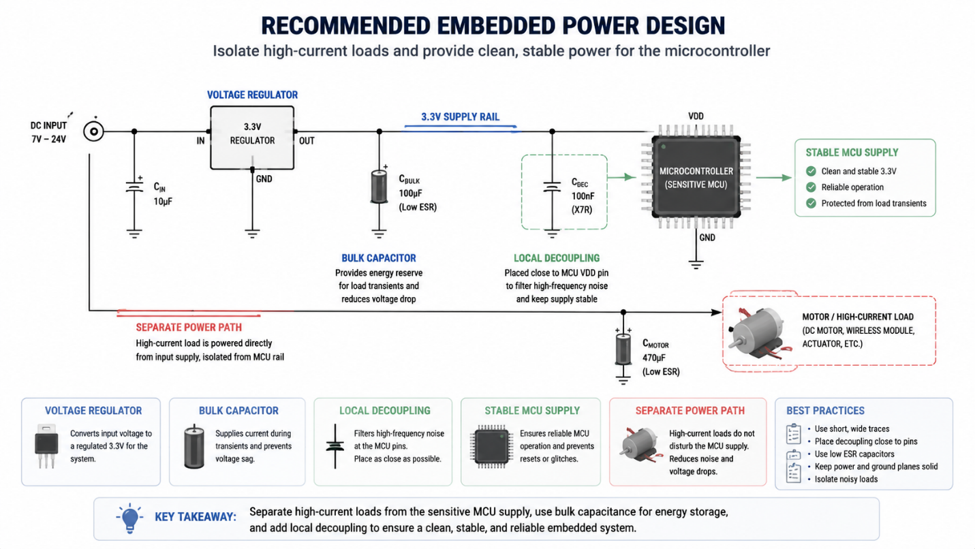
Small ceramic capacitors near the MCU power pins help handle fast transient current changes, while larger capacitors provide additional energy storage.
3. Separate Noisy Loads
Motors, relays, and switching circuits should avoid sharing sensitive MCU power paths whenever possible.
4. Monitor Supply Voltage
Some systems use voltage monitoring ICs or internal brownout detection features to ensure controlled recovery.
Recommended Devices
| Device | Type | Typical Application |
|---|---|---|
| TPS62160 | Buck Converter | Compact MCU power supply |
| MCP1700 | LDO Regulator | Low-current embedded systems |
| TPS3839 | Voltage Supervisor | Reset monitoring |
| MAX809 | Reset IC | Microcontroller reset control |
Engineering Tip
A reset problem that appears randomly is often a power problem in disguise. Before debugging firmware, check the supply voltage during the exact moment the failure occurs.
Brownout resets are one of the most common reliability issues in embedded systems. They are often caused by short voltage disturbances that are invisible when measuring only the average supply voltage.
By designing a stable power system, placing capacitors correctly, and understanding load behavior, engineers can prevent unexpected resets and build embedded devices that operate reliably in real-world conditions.
#EmbeddedSystems# #Microcontroller# #Brownout# #PowerIntegrity# #ESP32# #STM32# #Electronics#
 #EmbeddedSystems#
#Microcontroller#
#Brownout#
#PowerIntegrity#
#ESP32#
#STM32#
#Electronics#
#EmbeddedSystems#
#Microcontroller#
#Brownout#
#PowerIntegrity#
#ESP32#
#STM32#
#Electronics#
Sign In Or Register Comment after
No comments yet. Be the first to comment!