


Latch vs Flip-Flop: Why Digital Designers Don't Treat Them the Same
 View
View
When learning digital electronics, the terms latch and flip-flop are often introduced together because both can store a single bit of information. As a result, many beginners assume they are interchangeable components.
Although they perform a similar function, their operating principles are fundamentally different. A latch responds whenever it enables signal is active, while a flip-flop updates its output only on a clock edge. This difference has a significant impact on timing, reliability, and overall digital system design.
Understanding when to use a latch or a flip-flop helps engineers build more predictable and reliable synchronous digital systems.
Understanding the Difference
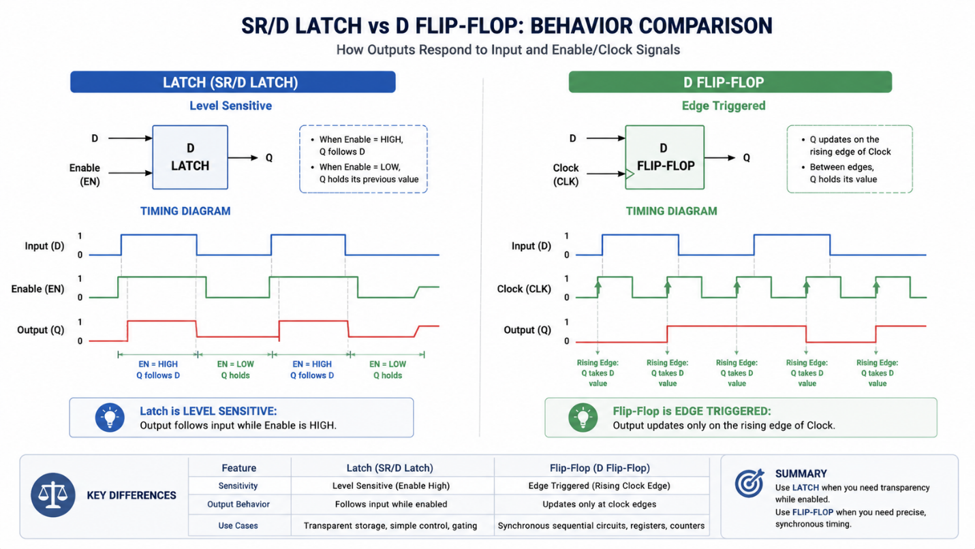
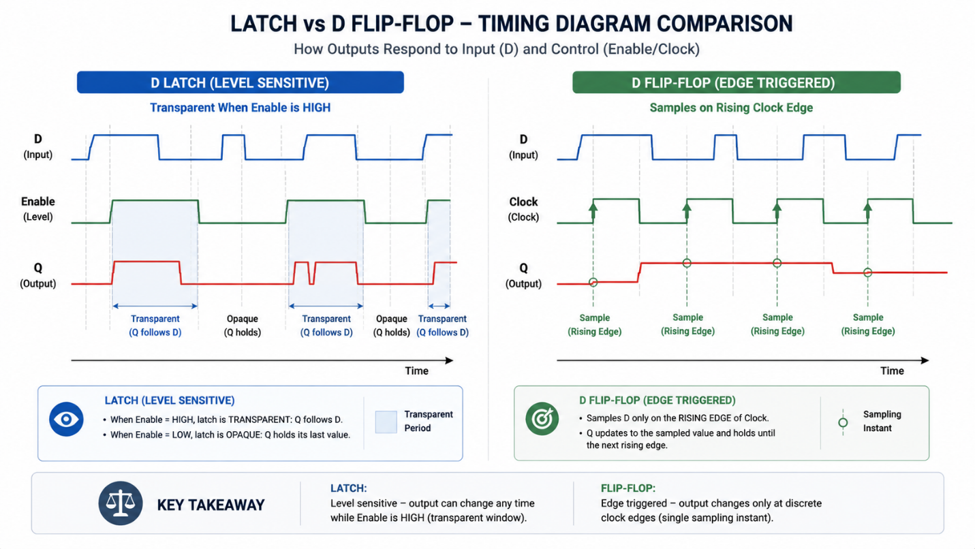
A latch is a level-sensitive storage element. When it enables input to be active, the output continuously follows the input. Once the enable signal becomes inactive, the current state is stored.
A flip-flop is edge-triggered. Instead of continuously monitoring the input, it captures the input only at a specific clock transition, such as the rising edge.
Because of this behavior, flip-flops provide much more predictable timing in synchronous digital systems.
Where Each One Is Used
Latches are commonly found inside integrated circuits where high speed and lower hardware complexity are important.
Flip-flops are far more common in FPGA designs, microprocessors, counters, registers, finite state machines, and synchronous digital logic because they provide deterministic timing.
For most embedded system designers, flip-flops are encountered far more frequently than discrete latches.
Engineering Note
Most modern FPGA and synchronous digital designs are built primarily around edge-triggered flip-flops because they simplify timing analysis and reduce the risk of race conditions.
Quick Comparison
| Feature | Latch | **Flip-Flop ** |
|---|---|---|
| Trigger Type | Level Sensitive | Edge Triggered |
| Timing Control | Enable Signal | Clock Edge |
| Complexity | Lower | Higher |
| Common Application | Internal Logic | Registers, Counters, CPUs |
Recommended Devices
| Device | Type | Typical Application |
|---|---|---|
| 74HC373 | Octal Transparent Latch | Address/data buffering |
| 74HC573 | Octal Latch | Bus interface |
| 74HC74 | Dual D Flip-Flop | Registers and sequential logic |
| 74LS74 | Dual D Flip-Flop | Educational digital circuits |
Always verify the required logic family, operating voltage, and propagation delay when selecting digital logic ICs.
Although latches and flip-flops both store digital data, they are designed for different timing strategies. Latches offer simple level-sensitive storage, while flip-flops provide precise edge-triggered operation for synchronous systems. Understanding this distinction helps engineers design digital circuits that are easier to analyze, debug, and expand.
#EmbeddedSystems# #DigitalLogic# #FlipFlop# #Latch# #DigitalElectronics# #Electronics#
 #EmbeddedSystems#
#DigitalLogic#
#FlipFlop#
#Latch#
#DigitalElectronics#
#Electronics#
#EmbeddedSystems#
#DigitalLogic#
#FlipFlop#
#Latch#
#DigitalElectronics#
#Electronics#
Sign In Or Register Comment after
No comments yet. Be the first to comment!