


Inductive vs Capacitive Proximity Sensor: Which One Should You Use?
 View
View
In industrial automation, detecting the presence of an object without physical contact is a common requirement. Sensors are used in conveyor systems, machine tools, packaging equipment, and production lines to detect position, counting, and movement.
Two popular types of proximity sensors are inductive sensors and capacitive sensors. Although both can detect objects without direct contact, they work using different detection principles and are suitable for different materials.
Choosing the wrong sensor type can result in unreliable detection, especially when the target material or environment changes.
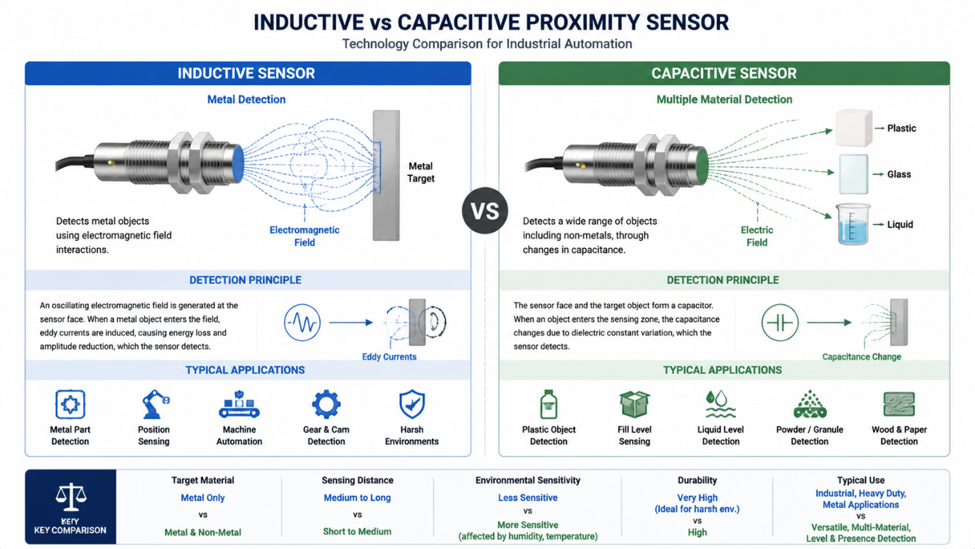
How Inductive Sensors Work
Inductive proximity sensors generate a high-frequency electromagnetic field from a coil inside the sensor.
When a metal object enters this field, eddy currents are generated inside the target material. The sensor detects this change and switches its output.
Because the detection principle depends on metal interaction, inductive sensors are highly reliable for:
- Steel parts
- Aluminum components
- Machine positioning
- Industrial counting applications
However, they cannot detect non-metallic objects such as plastic or wood.
How Capacitive Sensors Work
Capacitive proximity sensors detect changes in electrical capacitance caused by nearby objects.
Unlike inductive sensors, they can detect many different materials, including:
- Plastic
- Glass
- Paper
- Wood
- Liquids
- Powder materials
This makes capacitive sensors useful for level detection and material presence sensing.
The disadvantage is that they can be more sensitive to environmental conditions such as humidity, dust, and incorrect sensitivity adjustmen
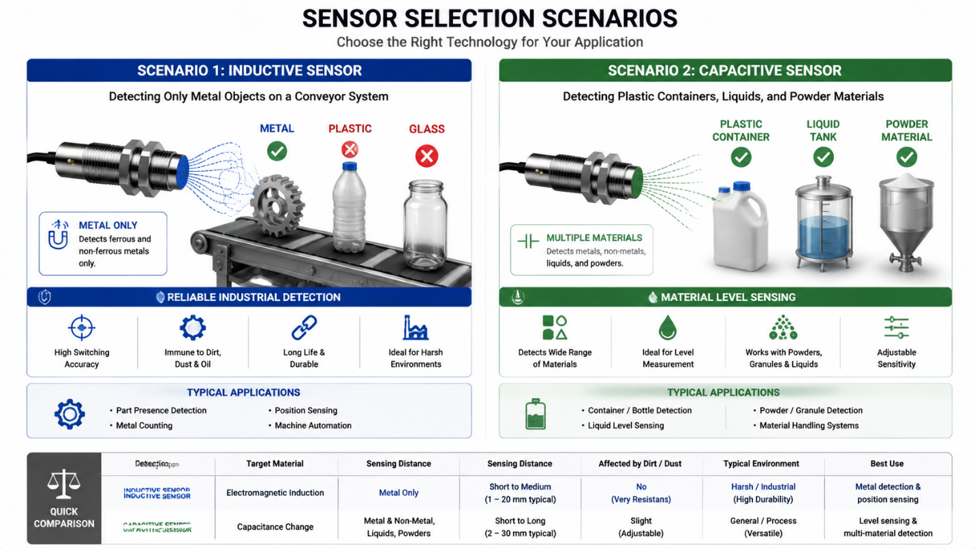
Quick Comparison
| Feature | Inductive Sensor | Capacitive Sensor |
|---|---|---|
| Detection Target | Metal Only | Many Materials |
| Detection Distance | Short to Medium | Short to Medium |
| Environmental Stability | Excellent | Moderate |
| Common Use | Machine Automation | Level Detection |
| Adjustment | Simple | More Sensitive |
Recommended Devices
| Device | Type | Typical Application |
|---|---|---|
| Omron E2E Series | Inductive Sensor | Industrial metal detection |
| Autonics PR Series | Inductive Sensor | Machine automation |
| Pepperl+Fuchs CJ Series | Capacitive Sensor | Material detection |
| Turck BC Series | Capacitive Sensor | Industrial sensing |
Engineering Tip
If your target object is always metal, an inductive sensor is usually the safer choice. If the target material can change, a capacitive sensor provides more flexibility but requires better calibration.
Inductive and capacitive proximity sensors both provide contactless detection, but they solve different engineering problems. Inductive sensors offer excellent reliability for metal detection, while capacitive sensors provide broader material detection capability.
The best sensor choice depends not only on what needs to be detected, but also on the environment, required reliability, and maintenance conditions.
#SensorsAndActuators# #ProximitySensor# #IndustrialAutomation# #InductiveSensor# #CapacitiveSensor# #Electronics#
 #SensorsAndActuators#
#ProximitySensor#
#IndustrialAutomation#
#InductiveSensor#
#CapacitiveSensor#
#Electronics#
#SensorsAndActuators#
#ProximitySensor#
#IndustrialAutomation#
#InductiveSensor#
#CapacitiveSensor#
#Electronics#
Sign In Or Register Comment after
No comments yet. Be the first to comment!