


Bulk Capacitor vs Decoupling Capacitor: Why Your Circuit Needs Both
 View
View
Many electronic designs include several capacitors around the power supply, but not every capacitor has the same purpose. A common mistake is assuming that adding one large capacitor is enough to stabilize the entire circuit.
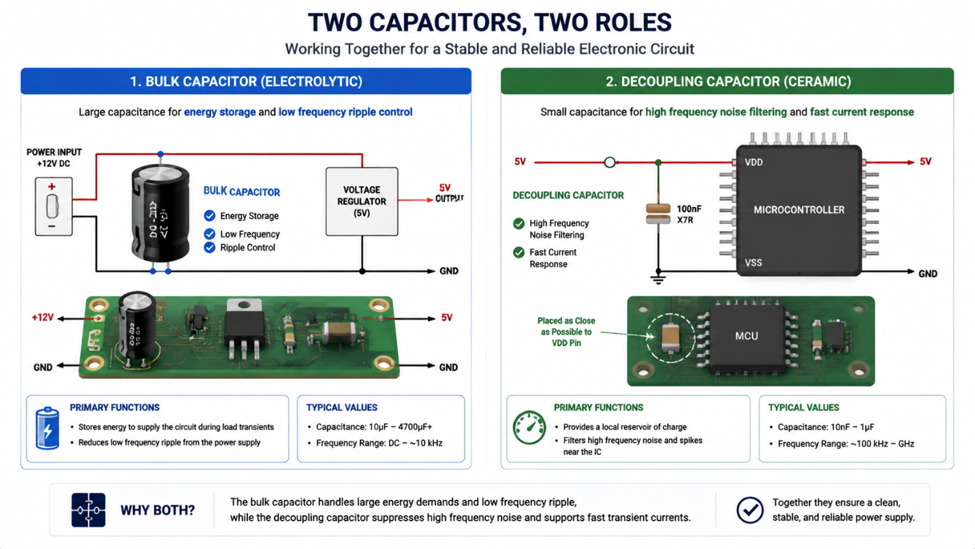
Different capacitors handle different types of electrical disturbances. A bulk capacitor provides energy during larger load changes, while a decoupling capacitor handles fast transient noise generated by digital switching.
Using the wrong capacitor type or placing it in the wrong location can lead to unstable microcontrollers, communication errors, and unexpected resets.
Understanding the difference between these two capacitors helps engineers design cleaner and more reliable power systems.
Understanding Bulk Capacitors
A bulk capacitor is designed to store a larger amount of electrical energy and support the circuit during sudden changes in current demand.
Typical examples include:
- Power input filtering
- Motor driver circuits
- Voltage regulator outputs
- Battery-powered systems
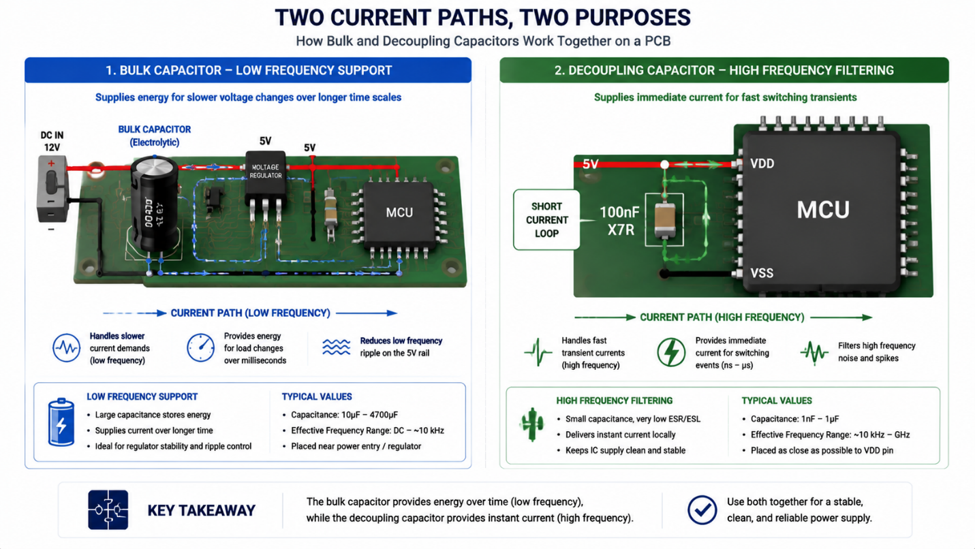
When the load suddenly increases, the bulk capacitor can temporarily supply additional current while the power source responds.
Common values range from tens to hundreds of microfarads, depending on the application.
Understanding Decoupling Capacitors
Digital ICs such as microcontrollers, processors, and communication chips switch millions of times per second. These rapid changes create short current spikes that cannot be supplied efficiently through long PCB traces.
A small ceramic capacitor placed close to the IC power pin provides this local current source.
Typical values include:
- 100 nF for high-frequency noise
- 1 µF for additional transient support
The shorter the connection between the capacitor and the IC, the better the high-frequency performance.
Common Design Mistakes
Several mistakes frequently appear in prototype designs:
Using Only Large Capacitors
A 470 µF capacitor may stabilize slow voltage changes but cannot effectively filter high-frequency switching noise.
Placing Decoupling Capacitors Too Far Away
A 100 nF capacitor placed several centimeters from an IC may lose much of its effectiveness because PCB trace inductance limits its high-frequency response.
Ignoring Datasheet Recommendations
Many IC manufacturers provide recommended capacitor values and placement guidelines for reliable operation.
Engineering Note
Capacitor value is important, but placement is equally important. A perfect capacitor in the wrong location may perform worse than a smaller capacitor placed correctly.
Recommended Components
| Device | Type | Typical Application |
|---|---|---|
| Murata GRM188R71H104KA93 | 100 nF Ceramic | IC decoupling |
| Murata GRM188R60J105KA01 | 1 µF Ceramic | Local filtering |
| Panasonic FR Series | Electrolytic | Power input smoothing |
| Nichicon UHE Series | Electrolytic | Bulk energy storage |
Quick Selection Guide
Choose:
Bulk Capacitor when:
- Load changes are large.
- Power supply ripples need reduction.
- Motors or switching loads are present.
Decoupling Capacitor when:
- Digital ICs switch rapidly.
- High-frequency noise must be reduced.
- Stable MCU operation is required.
Bulk capacitors and decoupling capacitors are not competing solutions. They work together to maintain stable power delivery across different frequency ranges.
A reliable electronic design requires both sufficient energy storage and fast local current support. By understanding their different roles and placing them correctly, engineers can prevent many power-related problems before they appear during testing.
#PowerAndEnergy# #Capacitor# #PowerIntegrity# #PCBDesign# #EmbeddedSystems# #Electronics#
 #PowerAndEnergy#
#Capacitor#
#PowerIntegrity#
#PCBDesign#
#EmbeddedSystems#
#Electronics#
#PowerAndEnergy#
#Capacitor#
#PowerIntegrity#
#PCBDesign#
#EmbeddedSystems#
#Electronics#
Sign In Or Register Comment after
No comments yet. Be the first to comment!