


Watchdog Timer vs Reset Circuit: They Solve Different Problems
 View
View
When an embedded device suddenly stops working, engineers often think about adding a reset circuit or enabling a watchdog timer. Both solutions can recover a system from failure, but they are designed to solve different problems.
A reset circuit focuses on monitoring the hardware condition of the power supply and ensuring the microcontroller starts correctly. A watchdog timer focuses on detecting firmware execution problems and forcing recovery when the software stops responding.
Although they may appear similar, using one does not always replace the other. Reliable embedded products often use both techniques together.
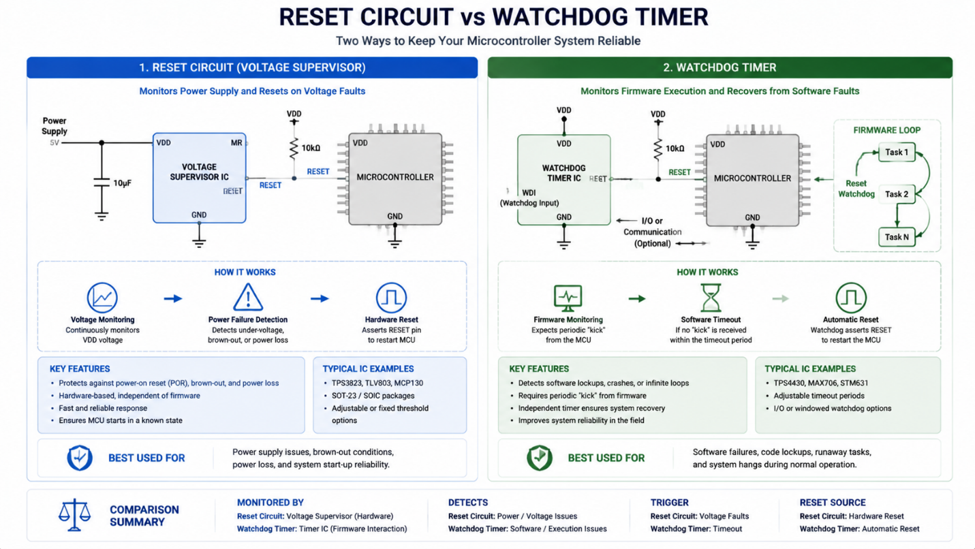
Understanding Reset Circuits
A reset circuit ensures that the microcontroller starts in a known condition.
During power-up, the supply voltage may rise slowly or contain temporary instability. Without proper reset handling, the MCU may start executing before the voltage becomes reliable.
A voltage supervisor monitors the supply level and keeps the reset pin active until the voltage reaches a safe operating point.
Reset ICs are commonly used in:
- Industrial controllers
- Battery-powered products
- Safety-critical electronics
- Consumer devices
Understanding Watchdog Timers
A watchdog timer monitors whether the firmware continues running normally.
The software periodically sends a refresh signal to the watchdog. If the firmware becomes stuck due to an infinite loop, memory issue, or communication failure, the watchdog times out and resets the system.
Typical causes that watchdogs help recover from:
- Firmware deadlock
- Communication freeze
- Unexpected software behavior
- Task failure in RTOS systems
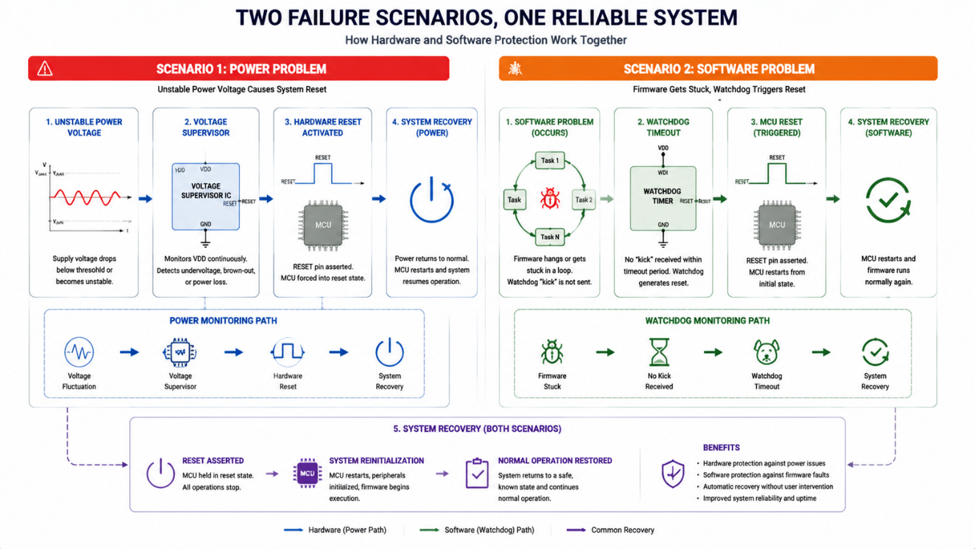
Why Many Products Use Both
A reliable embedded product usually needs protection against both hardware and software failures.
Example:
A smart industrial controller may experience:
- Power fluctuations from motors.
- Firmware communication problems.
- Unexpected sensor behavior.
A reset supervisor can handle unstable power conditions, while a watchdog timer can recover from software failures.
Together, they provide a stronger recovery mechanism.
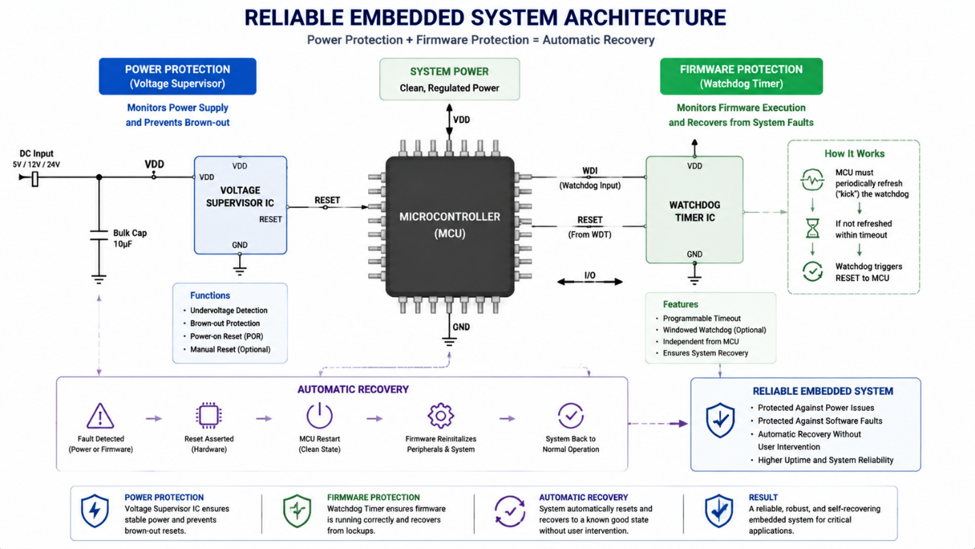
Recommended Devices
| Device | Type | Typical Application |
|---|---|---|
| TPS3839 | Voltage Supervisor | Low-power MCU reset |
| MAX809 | Reset IC | Simple MCU reset control |
| STM32 Independent Watchdog | Internal WDT | Industrial embedded systems |
| ESP32 Task Watchdog | Software/Hardware WDT | IoT devices |
Engineering Tip
A watchdog cannot fix a hardware power problem, and a reset IC cannot detect a firmware deadlock. First identify whether the failure comes from power or software before choosing a recovery method.
Reset circuits and watchdog timers are often mentioned together, but they protect embedded systems from different types of failures. Reset circuits provide reliable startup and power monitoring, while watchdog timers recover from software execution problems.
For products that must operate continuously without human intervention, combining both approaches creates a more robust and dependable embedded design.
#EmbeddedSystems# #WatchdogTimer# #ResetCircuit# #Microcontroller# #SystemReliability# #Electronics#
 #EmbeddedSystems#
#WatchdogTimer#
#ResetCircuit#
#Microcontroller#
#SystemReliability#
#Electronics#
#EmbeddedSystems#
#WatchdogTimer#
#ResetCircuit#
#Microcontroller#
#SystemReliability#
#Electronics#
Sign In Or Register Comment after
No comments yet. Be the first to comment!