


How Rotary Encoders Help Machines Understand Motion
 View
View
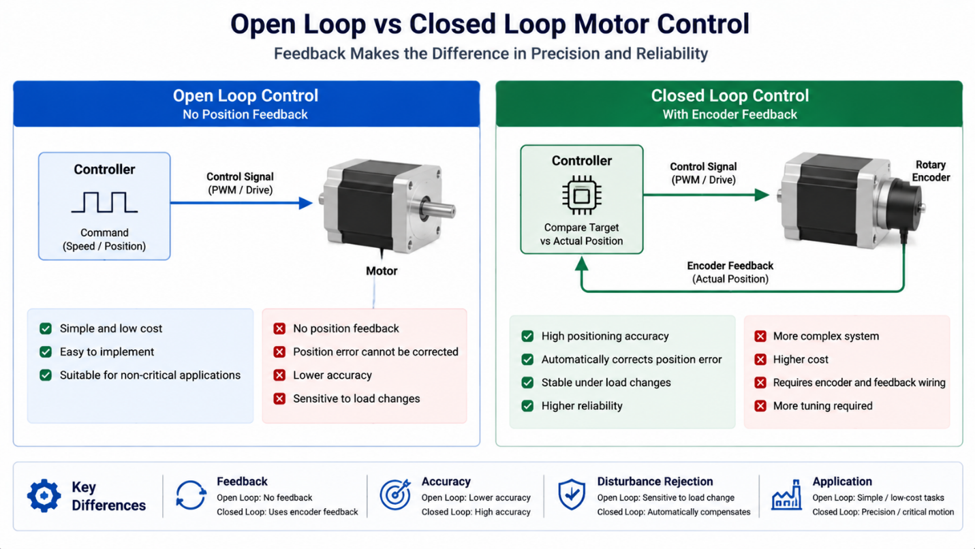
Machines cannot control movement accurately without feedback. A motor may rotate, but without knowing speed, direction, or position, the controller cannot determine whether the movement matches the target.
This is why many automation systems use rotary encoders. A rotary encoder converts mechanical rotation into electrical signals that a controller can process.
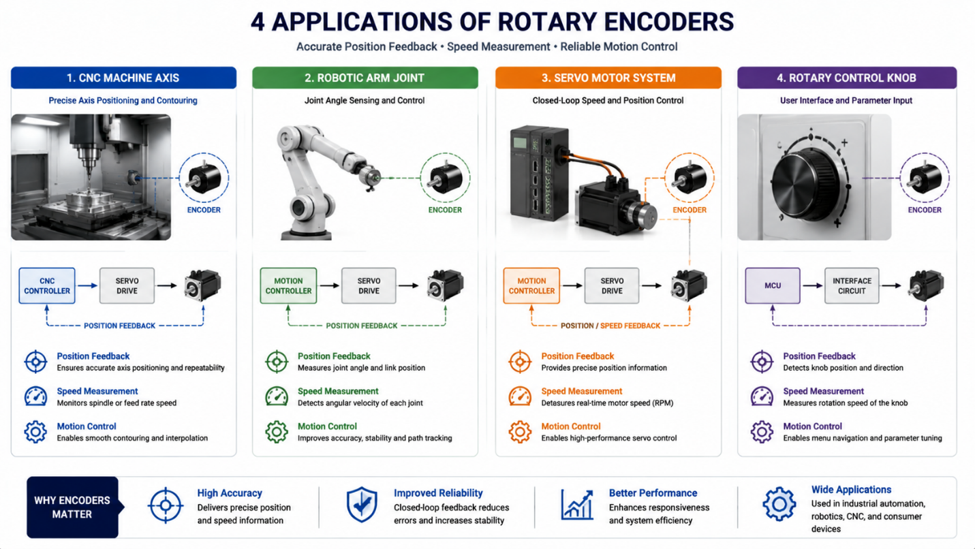
Rotary encoders are widely used in CNC machines, robotics, servo motors, conveyors, printers, and industrial automation equipment. They allow controllers to measure movement instead of simply commanding the motor and hoping it reaches the correct position.
How Rotary Encoders Work
A rotary encoder detects shaft rotation and converts it into electrical signals.
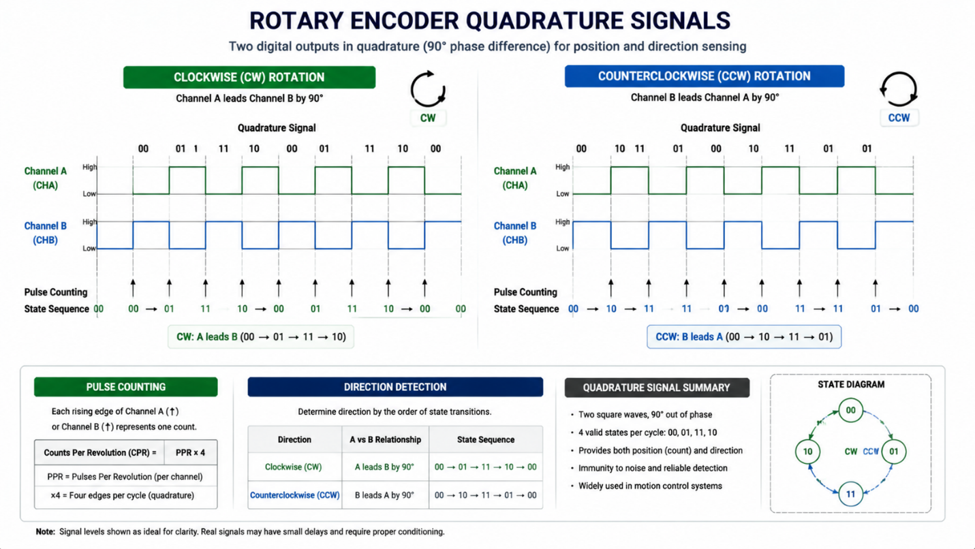
For incremental encoders, the most common output is two digital signals called Channel A and Channel B. These signals are shifted in phase, allowing the controller to determine both:
- Rotation speed
- Rotation direction
By counting the generated pulses, the controller can calculate how far the shaft has moved.
Higher-resolution encoders generate more pulses per revolution, allowing more precise motion measurement.
Encoder Signals
A typical quadrature encoder produces two square wave signals.
When Channel A leads Channel B, the system identifies one direction of rotation. When Channel B leads Channel A, the rotation direction is reversed.
The controller uses these signal changes to track movement accurately.
Common Applications
Rotary encoders are used whenever accurate motion feedback is required.
Examples include:
- Servo motor position control
- CNC machine axes
- Robot joints
- Conveyor speed monitoring
- User interface knobs
- Industrial position measurement
In simple applications, an encoder may only measure speed. In advanced motion systems, it becomes part of a complete closed-loop control system.
Recommended Devices
| Device | Type | Typical Application |
|---|---|---|
| Omron E6B2-CWZ6C | Incremental Encoder | Industrial motion control |
| Autonics E40S Series | Incremental Encoder | Automation systems |
| AS5600 | Magnetic Encoder | Embedded position sensing |
| AS5048A | High Resolution Encoder | Precision applications |
Engineering Tip
An encoder does not make a motor more powerful. It makes the controller aware of what the motor is doing, allowing corrections when the real movement differs from the target.
Rotary encoders are a fundamental part of modern motion control systems. By converting mechanical movement into electrical feedback, they allow machines to operate with greater accuracy, repeatability, and reliability.
Whether used in a simple knob or an industrial servo system, the basic purpose remains the same: giving electronics the ability to understand physical movement.
#SensorsAndActuators# #RotaryEncoder# #MotionControl# #Automation# #ServoMotor# #Electronics#
 #SensorsAndActuators#
#RotaryEncoder#
#MotionControl#
#Automation#
#ServoMotor#
#Electronics#
#SensorsAndActuators#
#RotaryEncoder#
#MotionControl#
#Automation#
#ServoMotor#
#Electronics#
Sign In Or Register Comment after
No comments yet. Be the first to comment!